One of my favorite offshore trolling spreads consists of skipping and sometimes swimming ballyhoo off the outriggers and varying two types of flat-line offerings, one being an Ilander/ballyhoo combo. This skirted bait barely tracks beneath the surface, yet has produced mahi as heavy as 42 pounds, wahoo over 66 pounds, sailfish, white marlin, blue marlin and a 125-pound yellowfin tuna off Jupiter, Florida, one January day! It’s a proven “sub-surface lite” temptation for a variety of pelagics.
Sub-surface trolling typically requires downriggers, elaborate planer systems and for high-speed fishing, heavy lures with trolling weights pulled from bent-butt rods and reels spooled with Monel wire or braid. The objective is to position baits deeper in the water column. Yet, as my introduction indicates, shallower running sub-surface baits and simpler tactics also rack up impressive catches.
Barely Under Water
Wahoo respond aggressively to fast-tracking sub-surface baits, hence the popularity of high-speed trolling. More water is covered between 15 and 20 knots. In the Bahamas, higher trolling speeds also deter unwanted barracuda strikes.
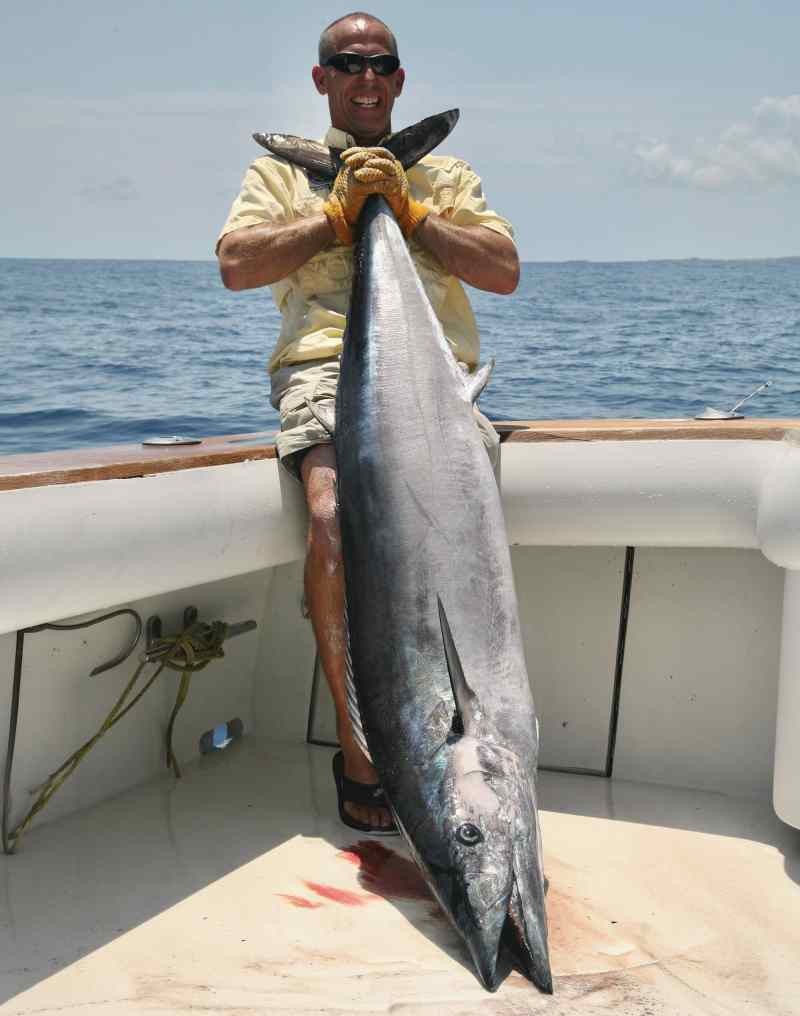
While high-speed trolling excels for numbers of wahoo, traditional trolling speeds (8 to 10 knots) and shallow-running baits consistently catch the larger ones. I’ll respectfully throw down on this: My largest South Florida wahoo weighed 66 ¾ pounds, whereas off San Salvador, Bahamas, aboard Foxy Lady II with Capt. George Gardner at the helm, I landed a 143.3-pound wahoo. Two years later in San Sal, I caught a 113.2-pound wahoo aboard Low Profile with Capt. Joe Tranior at the wheel. All three fish were caught at around 10 knots, on an Ilander/bally combo, a 2-pound Bluewater Eagle lure and a traditional mid-range marlin lure.
Easy Labor
I prefer natural baits off South Florida and the Florida Keys, and either lures or natural baits in the Bahamas, based on our desired game fish. At least one sub-surface flat-line bait joins the mix, sometimes two. Ilander/bally combos, cone-head lures and swimming plugs are my go-to sub-surface lite offerings.
The close flat-line bait is positioned where the prop wash fades into clean water, with the long flat-line bait some 100- to 150-feet beyond it. These baits generally track a foot or so beneath the surface, same for swimming plugs—more on them in a bit.
The far center ’rigger (well beyond the spread) often pulls a small jet- or cone-head pure artificial, which tracks about a foot or so beneath the surface. We go pure artificial far back for two reasons: to catch fish and avoid having to reel in and change out a damaged natural bait. These smaller lures often find tunas and even bring up schools of mahi. Our best center ’rigger catch to date is a blue marlin off Miami, by my cousin, Terry Flora. It consumed a small purple trolling feather intended for blackfin tuna!
Digging Deeper
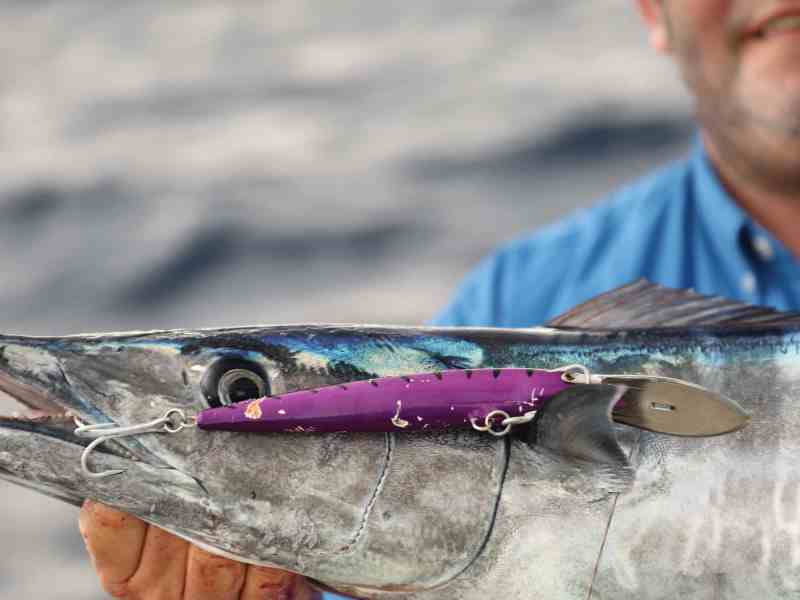
Swimming plugs are potent flat-line baits, if weeds aren’t problematic. Based on lip size, they’ll run anywhere from a few feet beneath the surface to depths of around 10 to 15 feet. They pull best between 5 and 10 knots. For serious plug-trolling, bent-butt outfits maximize their depth potential by keeping the fishing lines’ angle of entry more parallel with the sea. Braided lines are also advantageous; the small diameters slice through the water with minimal resistance.
In clean water (no weeds), we’ll often pull at least one plug off a flat line. If conditions permit, we’ll fish a pair and stagger their depths. The shallow offering is typically a Rapala CD18 (running depth between 5 and 8 feet) with either a Rapala X-Rap Magnum 20 or 30 as the deep bait (running depths between 8 and 12 feet, and between 12 and 15 feet, respectively, at speeds between 8 and 10 knots).
The deeper plug tracks beneath the prop wash. The shallower running plug swims some 100 to 150 feet back in clean, blue water. From there, it’s splashing/skipping ballyhoo and sometimes swimming ballyhoo off the outriggers. When sargassum is bad, it’s a full spread of weedless ballyhoo.
Rig ‘Em Right
Swimming plugs emit fish-attracting vibrations. Yet, their aggressive wobbling weakens and even kinks single-strand wire. For short-term plug trolling (i.e. towing a swimming plug around floating debris for wahoo), No. 7 to 10 single-strand wire is fine.
For long-term plug trolling, double-up that wire leader, or, better yet, opt for a 150- to 200-pound test fluorocarbon leader, which is impervious to kinking. When attaching a leader to a plug, use a thimble or chafe guard to reduce friction and abrasion at the connection.
As for cable, 270-pound test is common for plug trolling in the far reaches of the Bahamas for larger wahoo. To avoid galvanic corrosion with cable, use zinc or copper sleeves.
Planer Fishing Made Easy
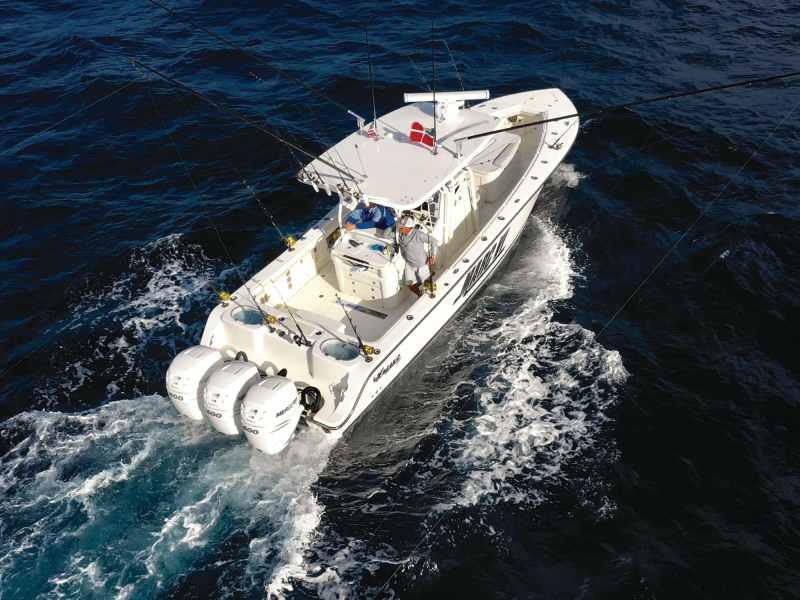
I’ve long been sold on the Sea Striker Hi-Speed Planer. An independent system sold separately or as a kit, the planer is designed to remain in water at speeds approaching 18 knots.
The kit comes with approximately 150 feet of 300-pound-test mono, with a poly loop at one end (affixes to a transom cleat) and a ball-bearing snap swivel at the other (for the planer). Also included are double-snap swivels and No. 64 rubber bands.
To deploy, attach the poly loop to a transom cleat and the snap swivel to the planer. Slow the boat to a crawl and feed over the planer; it will dig deep and stretch out its line. Resume trolling speed. Drop back a flat-line bait to a desired distance and secure a No. 64 rubber band onto the line coming off the rod tip. Affix one end of a double-snap swivel to the loop in the rubber band and, with reel drag backed off and clicker on, affix the opposite end of the double- snap onto the planer line.
Water pressure from the boat’s forward motion slides the swivel and fishing line down the planer line; you’ll need to estimate when the swivel nears the planer. Advance the drag and reel in any excess slack.
The rubber band breaks on a strike, usually with enough resistance to set a hook. Now, the fishing line is separate from the planer. The angler is free to fight a fish minus any hardware. Both angler and captain should remain aware of the deployed planer line. That means no sharp turns.
To reload, simply send out a new bait, add another rubber band and swivel and send it down. The used double snaps collect on the planer line for easy retrieval at day’s end.
Read Next: Innovations in High-Speed Trolling Lures
Deep Reflections
Deep can be a relative term, especially when offshore trolling. And while specialized tactics dial in on specific depths, don’t neglect that 1- to 5-foot slice of the water column. A simple mix of options like cone-shaped trolling skirts, swimming ballyhoo, swimming plugs and a high-speed planer will cover every bit of that window and more, with minimal effort, except when reeling in fish!