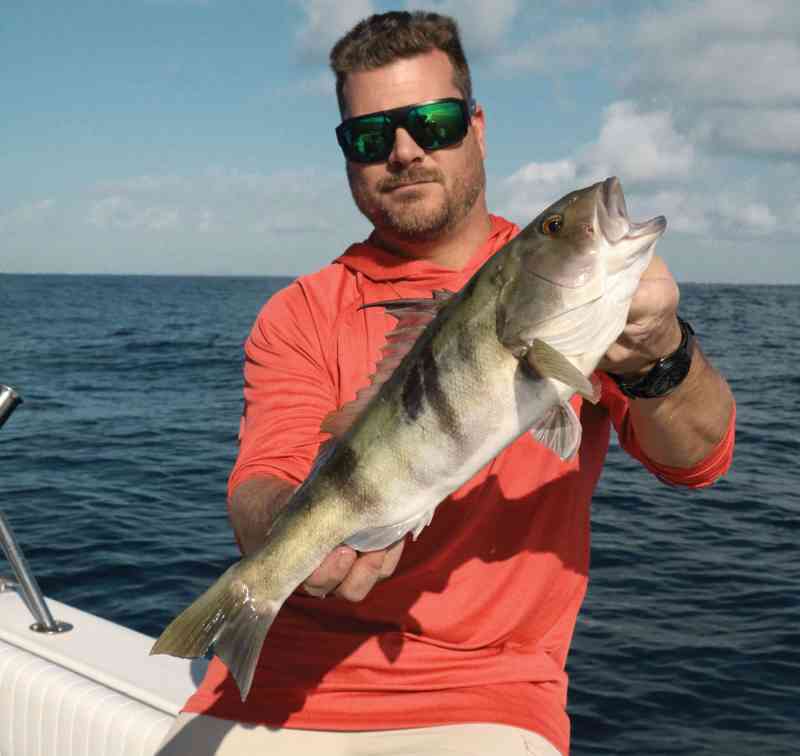
A Carhartt jacket, a sweat-stained cap, a rolling tool chest, and a Thermos full of hot black coffee—these are the proud trademarks of the American working class. You can add one more for blue-collar anglers out West—the barred sand bass.
Come summer, this species often concentrates in huge numbers along coastal flats of the Pacific Ocean off Southern California. Their mission: to procreate. Such activity must consume an enormous number of calories, because the dense schools of barred sand bass also feed aggressively—a phenomenon that seems to explode each year around the Fourth of July as inshore sea temperatures hover between 65 and 70 degrees F. The sand bass spawn can continue through mid-August.
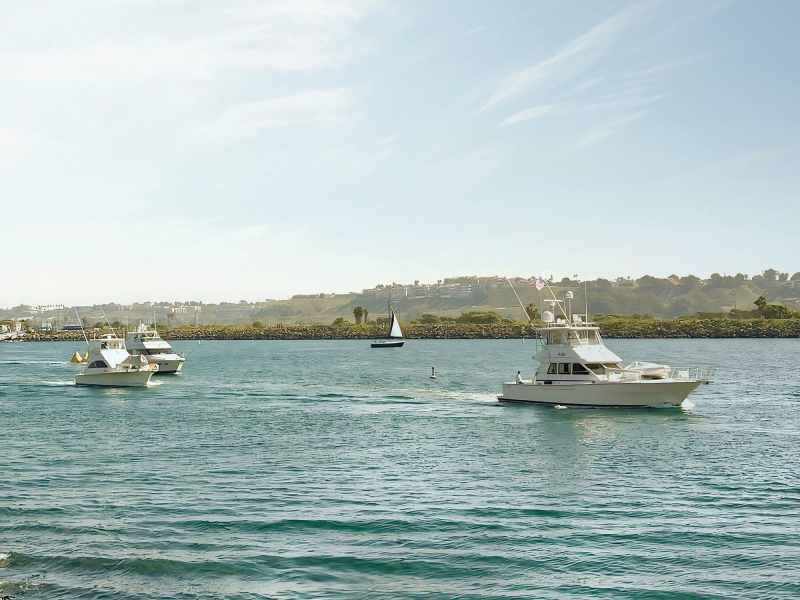
The warm weather, inshore proximity and consistent action ignite a sportfishing frenzy, with boating anglers and party boats staging in vast fleets along the flats—all in pursuit of barred sand bass, which can grow to 6 pounds and fight with gusto. It’s easy fishing and a relatively inexpensive venture, making this yearly event a working-class favorite.
There are, however, some basic techniques to help improve the opportunity for success during the sand bass spawning migration. Here’s how to stack the summer-sandie odds in your favor.
Sandie Sonar
Finding aggregations of sand bass ranks as the first order of business. In my opinion, too many boating anglers skip this step by following party boats, which are fishing just about every day and use tools like omni-sonar to locate schools of sand bass. This leads to the Cheerios effect. Once a party boat stops and starts fishing, smaller private boats cluster around it, sometimes embarrassingly close, like floating Cheerios gravitating toward each other in a bowl of milk.
I prefer a different approach. Giving the fleet a wide berth, I search over mud flats in bottom depths ranging from about 60 to 120 feet—zones in which barred bass prefer to spawn.
In other seasons, you might find sand bass around structure spots such as wrecks and rockpiles. Often, they hunker closely to the edges of the structure. When the spawning migration occurs, rules change. Sand bass largely abandon structure, frequently suspending in large numbers well above the seafloor. So, you need to look far and wide over featureless bottom.
Without the benefit of a large and expensive omni-sonar, I use side-scanning sonar to search for and find schools of barred sand bass out as far as 300 feet to either side of the boat.
Once an interesting cloud of targets appears on the sonar screen, I vector the boat in that direction and use a secondary sonar system—a high-frequency, wide-beam angle, down-facing, chirp sonar to reconnoiter the school. If I like the size of the school (the bigger the better) and its positioning (high in the water column), we set up the boat to fish it effectively.
Boat Positioning
There are a few ways to position the boat. One is to drift-fish, which I’ve found is the least effective, as the school is too easily lost as the boat slides away with current and wind, forcing you to restart the search time and again.
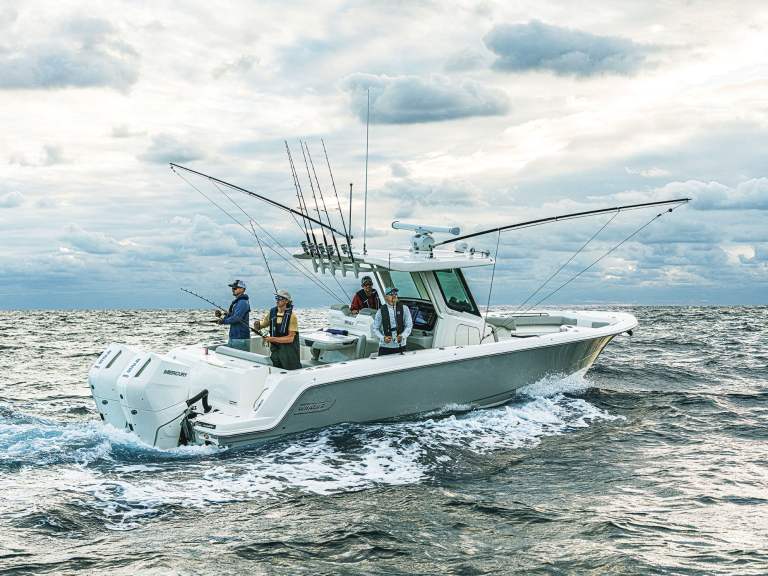
Some boating anglers now use GPS-guided trolling motors to hold their position near the school. This can prove effective, but I prefer good old-fashioned anchoring up-current or up-wind of the school. The bass might still move away from your anchored boat, but these fish possess an interesting trait at this time of year.
Spawning sand bass tend to take up residence in the shadow of an anchored boat. They do so gradually, sometimes just a few fish at first, but then the volume often starts to build under the boat and the aggregation usually ascends toward the surface. Pack your patience, because the wait for this bass bonanza might take 30 minutes or more. But the wait is worthwhile, because once a school finds a shadowed spot to its liking, it might stay put for hours.
Moving water plays heavily in promoting a sand bass bite. Ideally, once anchored up, you want a steady flow of water streaming astern. If there’s no water movement, fishing can be tough.
In SoCal, some of the best sand bass bites occur in the afternoon and early evening as the prevailing westerly winds drive water movement. This has given rise to the summer tradition of “twilight” trips in which party boats schedule late afternoon departures, allowing working-class anglers and others to climb aboard after work to enjoy the evening action while the galley chef cooks up burgers and other dinner items for everyone.
Chum It Up
Making the water under your boat even more attractive to barred sand bass lies in effective chumming. I like to use a combination of live- and cut-bait. The cut-bait might be chopped up squid or anchovies, sardines or mackerel. This is why I freeze Ziplock bags of leftover bait from previous trips—it makes for great chum.
With cut-bait, the idea is to keep a steady stream of chunks drifting back and down into the water column. This creates a scent trail for bass to follow to the water directly behind your boat.
The live chum depends on what is available at the local bait receivers—bait barges stationed at a number of harbors and bays along the SoCal coast with live offerings such anchovies, sardines and squid. All work well as chum, but many veteran skippers prefer to chum with anchovies, ranging from 3 to 6 inches in length.
With live chum, the idea is to not only attract sand bass toward the boat, but toward the surface. Successful live chumming can result in amazing surface action as bass chase, boil and bust on chum baits off the transom. Tossing out one or two live anchovies every 2 to 3 minutes is all it takes.
Live Baits
Fishing with live bait is one of the most common techniques for summer sandies. I like to cover the water column, starting with live baits such as anchovies or sardines suspended just above the bottom on dropper rigs. With monofilament line, tie a 1-foot dropper leader above a 3-foot-long tag end for the sinker. Hook size will depend on the size of the bait; I carry a selection of size 1 to 3/0 Owner Gorilla Light hooks for just about any contingency. Use a bank or torpedo sinker with enough weight to keep the line vertical while in a forward rod holder. I carry sinkers ranging from 6 to 10 ounces.
Casting other live baits behind the boat covers the rest of the water from the surface and mid-depths. In a strong current, add an egg-sinker ranging from ½ to 1½ ounces, using a small split-shot or Carolina Keeper 3 feet above the hook to keep the sinker from sliding down toward the bait.
Artificial Intel
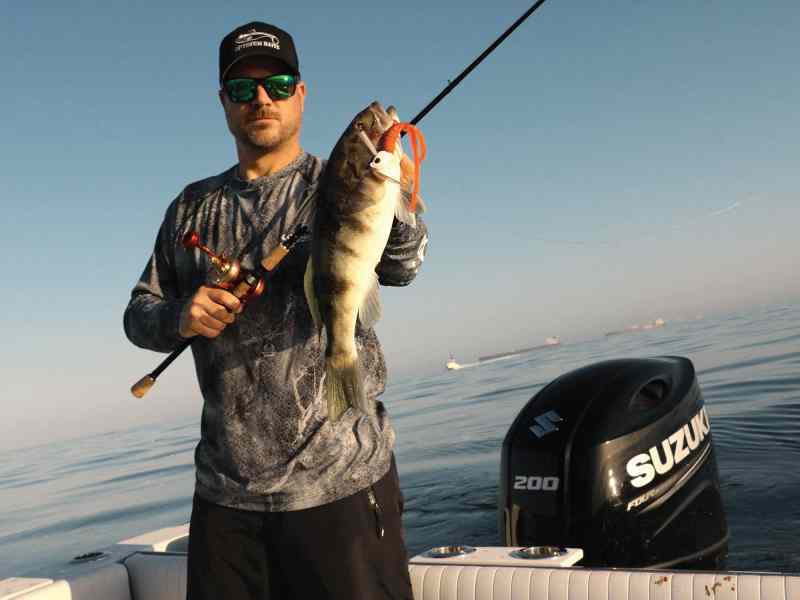
Casting artificial baits to summer sandies not only ramps up the excitement factor, it also increases the chances of hooking bigger models. Larger bass are more inclined to attack a well-presented lure and can beat smaller fish to the bite. The real fun occurs when barred sand bass are chasing live chum on the surface and a fast-moving lure catches their eye. At times, you might see five or six fish chasing a single lure.
Soft-plastic swimbaits and octopus imitations prove deadly, as do new-age tube lures and fluke baits. Rig them with a leadhead, then cast and let them sink through the water column. The falling action frequently triggers bites on the sink, as do slow to medium retrieves back up through the water column. If you see fish feeding at the surface, let the lure sink only a few feet before beginning a retrieve back to the boat. If a bass clobbers it, don’t swing—just keep reeling into it until the hook is solidly set, then raise the rod to fight the fish.
Many anglers also use a donkey rig—two flukes or tube baits with leadheads rigged with a double leader, one about 2 feet long and another 3 feet long, a lure on each. The lures swim erratically back and forth around each other, mimicking two fleeing baits on the sink or retrieve. Sand bass find it irresistible, and you often hook two big sandies at the same time. Choose a leadhead weight between ½ and 1½ ounces according to where the fish are staging.
Read Next: Timing the SoCal Mahi Migration
Lighten Up
During the summer migration, you don’t need heavy tackle for barred sand bass, as there is rarely any structure on which to break a line. You can scale back to as little as a 12-pound-test monofilament leader spliced to 30-pound-test braid on medium spinning or a low-profile baitcasting outfit (my favorite). Keep in mind, however, that you might also hook something bigger. I’ve hooked everything from California yellowtail to white seabass while fishing for summer sandies.
The jury is out concerning the eating quality of barred sand bass. Many anglers retain their limits (four fish of 14 inches or more each day as of this writing) and like the table fare. I’m not a fan. But I love to catch and release sandies. Big ones offer great light-tackle fun. And post-release mortality is very low, thus helping to ensure a healthy crop of the working-class favorite—summer sandies—for years to come.
Help Collect Data… and Win!
The Coastal Conservation Association of California is actively cooperating with the budget-starved California Department of Fish and Wildlife in developing a stock assessment for SoCal barred sand bass to help keep this fun fishery thriving and accessible to all. Much of the data is coming through CCA Cal’s season-long STAR Tournament, in which participating anglers catch, photograph and submit eligible fish, including barred sand bass. Each qualifying submission earns the angler a spot in a drawing to win great prizes, including a new boat, new gear, and new fishing adventures. To learn more about the 15-week CCA Cal STAR Tournament, visit ccacalifornia.org/STAR.