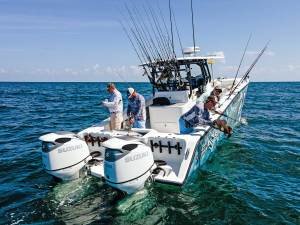
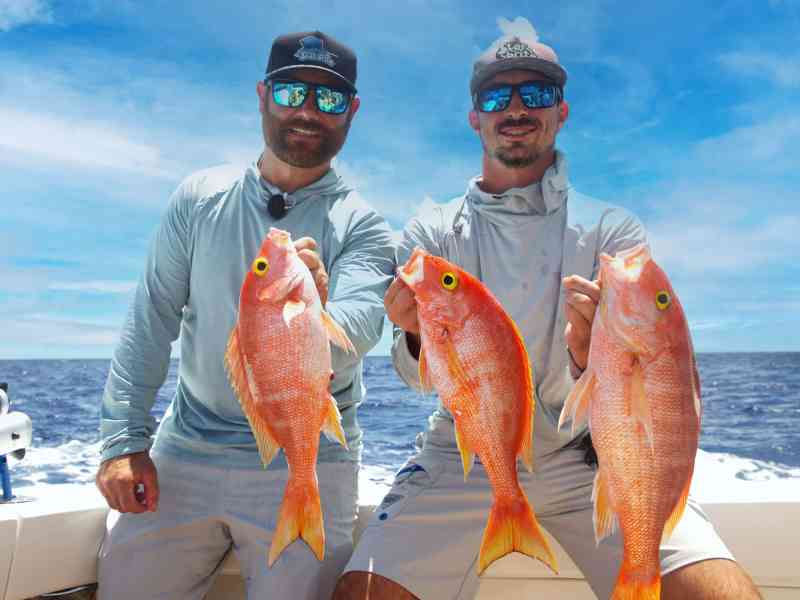
Gregor Dornau and I lowered dropper rigs baited with squid to the ocean floor 950 feet below. After a subtle tap or two on a rod tip, in an attempt to load up all of the hooks on the leader, we’d momentarily delay retrieval. A more pronounced rod bend typically followed, prompting us to activate the electric reels and haul up impressively large yelloweye snappers. We were fishing off Bimini, Bahamas, aboard Team Star brite.
The sporting debate over electric reels aside, there are skills involved in catching fish with them (i.e. how to load up a rig, keep fish from shaking free and, of course, avoid sharks). Most of my deep-drops have been hand-cranking endeavors, to preserve some sport. I’ve cranked up fish from 1,000-foot depths and as large as a 34-pound golden tilefish. Bluelines, barrelfish, queen and vermilion snappers, snowy and yellowedge groupers, and even splendid alfonsino fish have fallen to my manual labor.
Aboard Team Star brite, however, we were “fishin’ for the kitchen” with Penn’s new Fathom 30- and 80-series cordless electric reels. These lithium-ion battery-powered Penn Fathoms are portable (no electrical outlets required), boast 30 to 40 pounds of drag and a top speed of around 750 feet per minute. There’s even a hand crank option for purists like me. Yet, on this outing, even I opted to go to full power.
Cold and Delicious
Deep dwellers the likes of vermilions, yelloweyes and such exist in cold, dark waters, well beyond traditional bottom fishing depths. Therefore, risks of ciguatera (a toxin accumulated by fish on damaged reefs) are virtually non-existent compared to their reef and wreck counterparts. With primarily a squid and deep-water crustacean diet, nearly all are prime table fare.
For many, deep-dropping is a fun alternative to those long hours of offshore trolling, especially on days when bluewater fishing is slow. Then, there are hard-core deep-drop anglers. Among these specialists are Peter and Gregor Dornau, Turner Burwick and Capt. Chad Berry. They are the members of Team Star brite, and they have spent decades fishing Bimini waters, dedicating time and enery to deep-dropping. I had a chance to venture over with them last September.
Best Conditions
The greater the depths, the more challenging bottom fishing becomes. Ideally, a light to non-existent breeze and easy current enable deep-drop baits to soak longer on bottom and within fish concentrations. Less weight is required, which amps up the ability to feel bottom and subtle bites.
Strong breezes and brisk currents make deep-dropping almost impossible. Minimally, it’ll demand more aggressive powering-in-place and heavy weights to try to keep lines as vertical as possible. Baits won’t soak long, and sensitivity diminishes the more the lines scope out on a drift.
Tides & Solunar Periods
During our Bimini deep-drops, the yelloweye bite ceased during slack tide and fired back up during the initial and final stages of both tides. Off Bimini, the incoming stage ushered in clean, blue water and proved most productive.
Do tides come into play far offshore, as they do inshore? A fisheries biologist explained that it’s not so much the tidal fluctuations that stimulate an offshore bite as it is an ensuing pressure gradient from the influence of the moon, and to a lesser degree the sun, on tides.
Enter the solunar tables, which predict the times of the major (moon over/under) and minor (moon up/down) periods within each 24-hour cycle. Both major and minor moon phases are associated with increased feeding activity. They also coincide with the changing of the tides. Given consistent weather, the pressure gradients from these solunar periods do indeed have a positive effect on far offshore pelagics and bottom fish. In short, fish during these periods, and make any necessary move in between them.
Precision at the Helm
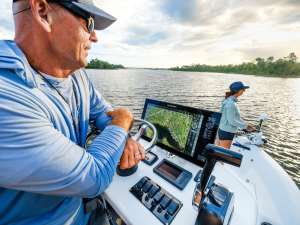
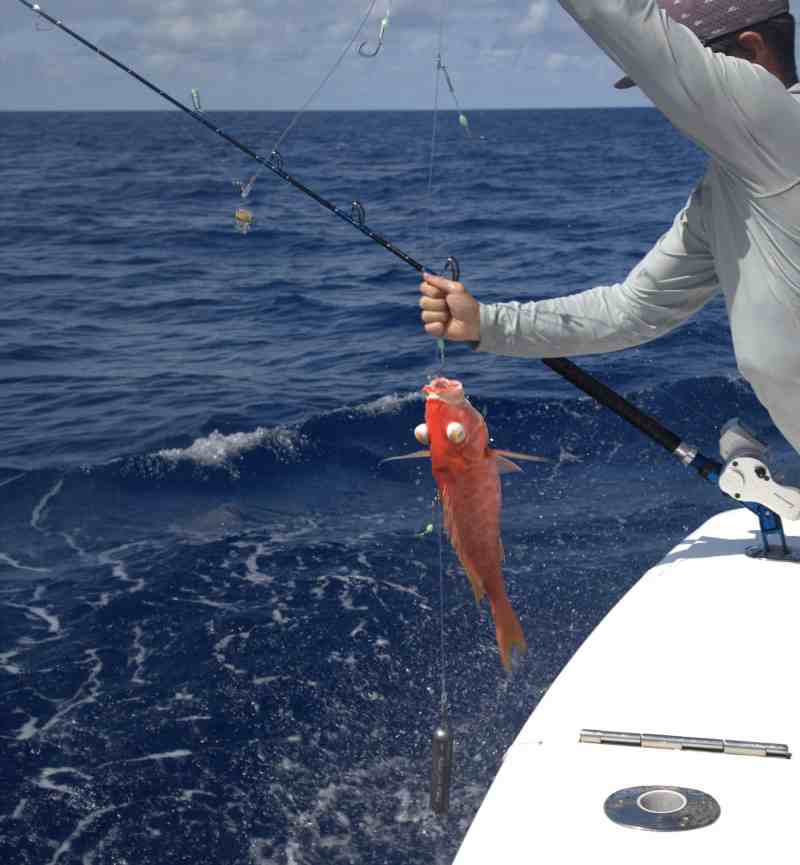
Peter Dornau kept at the wheel, eyes glued to his sonar. Once faint markings appeared 950 feet below, he stemmed the current and instructed us to drop. I had the Penn Fathom 80 with 50-pound-test braid and an 8-pound sinker, whereas Gregor fished the Penn Fathom 30 with 30-pound-test braid and a 5-pound sinker.
Success hinged on maintaining contact with the ocean floor and watching rod tips for subtle bites. Upon hooking a fish, the skill shifted to powering up a couple feet for a solid set and then stalling momentarily to keep the remaining baits in play.
The yelloweyes were schooling tightly that day, so we’d get in a drop or two before Peter had to re-position. Once fish markings ceased on the sonar, so did our bites. It’s a game of constant fine-tuning.
Speeding vs. Sandbagging
Concerns center over shaking fish free during a fast retrieve, versus an increased risk of shark predation during a slow haul. Gregor’s seasoned feel for deep-dropping, and slower retrieve, resulted in larger stringers of fish, despite Peter’s insistence to go full speed and keep ahead of any sharks. I held to mid-speed retrieves to keep both parties happy.
Our dropper-loop leader rigs consisted of 150-pound-test monofilament, 5/0 in-line circle hooks and a quick-change weight loop at the bottom. Lights and glow beads illuminate through the darkness and attract both forage and our deep-water targets.
Cut squid was the primary bait. However, bonito and ’cuda chunks are excellent and stay on a hook better. Bring a variety of baits, as even denizens of the deep can turn selective and finicky.
Battery Life
With an electric reel like the Penn Fathom, we averaged 10 to 12 drops to 1,000 feet with weights of 5 and 8 pounds—including hauling up fish—and still had enough battery power for another drop or two. A battery-and-a-half should provide for a long day of deep-dropping. We had spare batteries for change outs.
There are, of course, other lightweight electric reels to choose from, including Daiwa’s Seaborg and Tanacom series, and Shimano’s Forcemaster and Beastmaster lines. These can use a cord that plugs into onboard power, but you can also buy aftermarket lightweight lithium batteries that strap to the fishing rod.
Hand Crank
The weight of the sinker is what makes hand-crank deep-dropping most arduous. Without fish on the line, I put the outfit in a gunwale holder and wind up the ballast. Fighting a fish is actually easier. Unlike muscling up a grouper or amberjack from a reef or wreck, serious bottom hangs aren’t as prominent out deep. Therefore, after winding rapidly and feeling confident over the hook set, you can relax and enjoy the long fight. Slowly lift the rod and wind down under pressure when taking up line. Eventually, barotrauma becomes your friend—this is when a fish’s swim bladder expands and floats your catch to the surface.
Tricks for successful hand-cranking include using light braid line, preferably 15-pound test. The ultra-small-diameter braid has minimal resistance, so it takes less weight to reach and stay on the bottom. And 15-pound test braid is plenty strong for cranking up a large fish from the deep.
Read Next: Hand-Crank Deep-Dropping Techniques
Seafood Mission
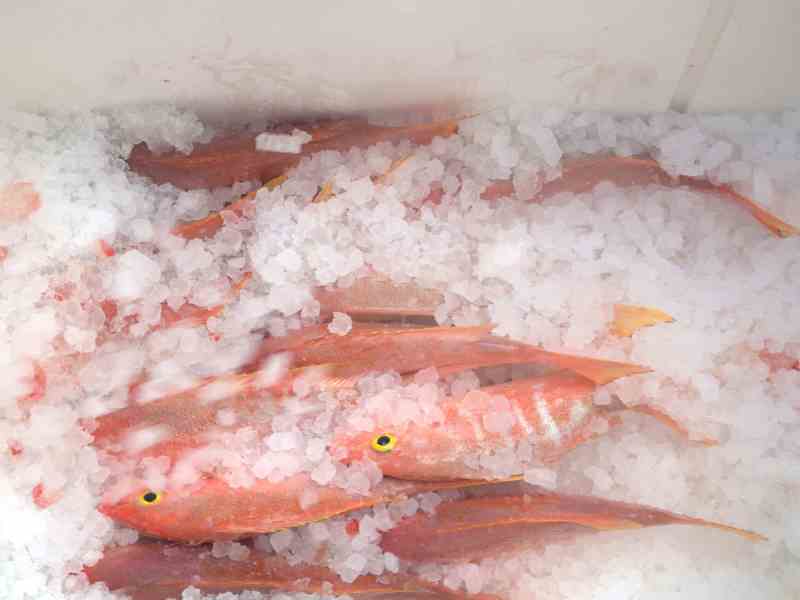
Deep-dropping is basically a food mission, versus a sporting tactic—hand-cranking included. While it’s surely fun and even challenging to haul up these deep dwellers, they don’t release well, even with descending devices. Therefore, catch-and-release deep-dropping isn’t recommended. Make sure you know the closures for specific species for the area you’re fishing, as well.
Once enough deep-drop fish have been iced down for a few fresh meals, that’s a perfect time to rack those electric outfits and go and see if the pelagics are ready to play.