
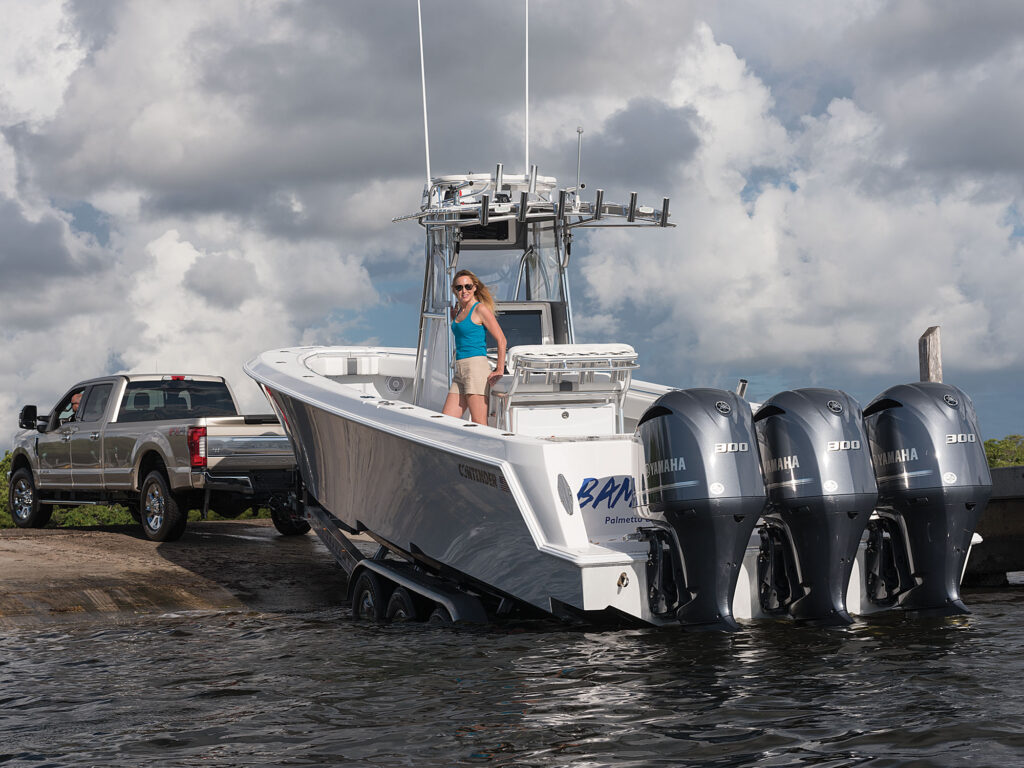
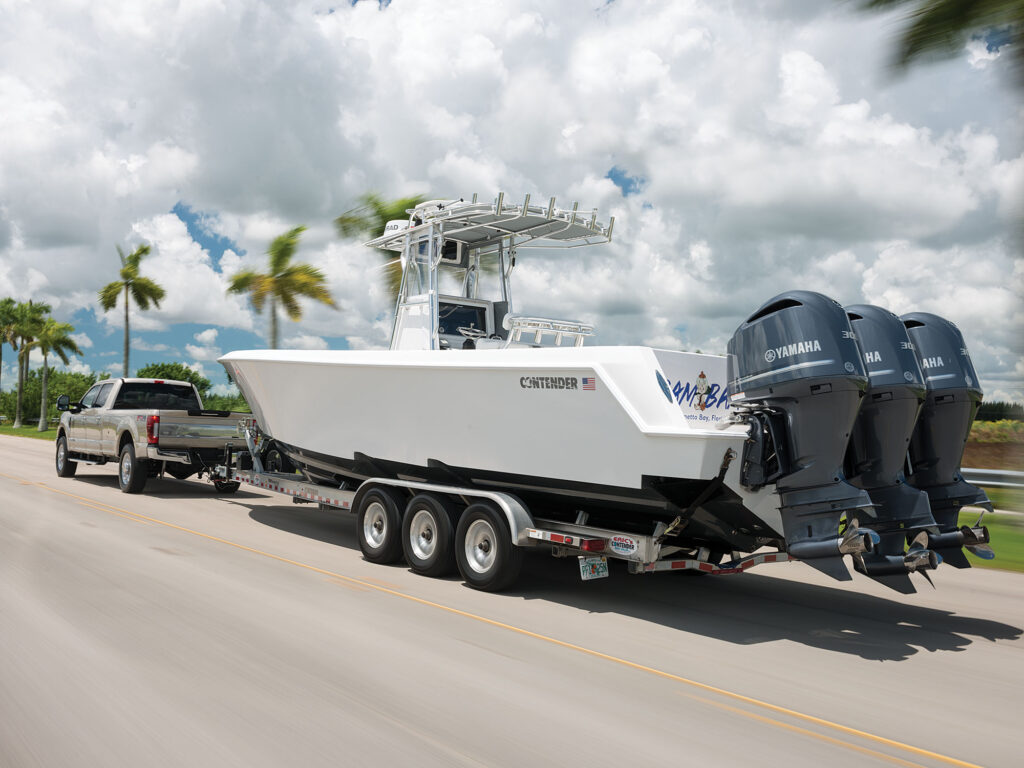
Without boat trailers, many anglers might not be able to own boats. Marinas would fill to capacity, and prospective new-boat buyers would be out of luck. That, of course, is not the case. An estimated 11 million boats—including some pretty big boats—ride to and from the water on trailers in the United States. Yet a trailer for a saltwater boat faces a tough life. It requires rugged construction and corrosion-resistant finishes and equipment to keep it safely rolling down the highway. Here are factors to keep in mind when choosing a trailer for your new boat.
Weight Rating
Your boatbuilder, dealer or trailer shop serves as an invaluable source in helping you find just the right trailer for your new boat, ensuring that the trailer is rated for the weight of the boat and trailer combined—known as the gross trailer weight (GTW). Determined by a combination of ratings of each trailer axle, frame construction and tire capacities, this spec should be labeled on the trailer itself.
A boat manufacturer, dealer or trailer shop will also make sure the tongue weight—the amount of weight exerted by the coupler on the tow hitch— is correct. It is usually about 10 percent of the GTW. This is an important consideration when towing. Too little tongue weight can lead to dangerous trailer sway, and too much can overly stress the tow hitch and the tow vehicle’s rear suspension and adversely affect vehicle steering.
Trailer Frames
Boat trailers dunked in salt or brackish water are subject to corrosion, so picking the right frame material is critical. Aluminum or galvanized-steel trailers hold up better in marine environments than painted steel trailers. Aluminum trailers can cost as much as 50 percent more than comparable galvanized trailers, but aluminum models also tend to last longer and stay better looking than galvanized-steel trailers. For maximum service life, all trailer models should be thoroughly rinsed after each dunking.
Hull Support
Properly fitting the trailer to the boat proves critical. Support usually comes in the form of either bunks or rollers, but in either case, each boat model requires a custom fit. Otherwise, the hull might become damaged, and you might experience difficulties launching and loading. For the best advice on fitting the boat to the trailer, consult your boat manufacturer, dealer or trailer shop.
Trailer bunks covered with carpet or special plastic runners provide excellent support and work well where the angle of the launch ramp is fairly steep. Rollers work best when the ramp angle is shallow or power loading is prohibited. However, with roller supports, securing the boat on the trailer is particularly crucial because the boat can inadvertently roll off.
Suspension Systems
Many boat trailers in the past had leaf-spring suspension systems to cushion the ride, but these don’t damp the bouncing motion. On the other hand, many boat trailers now use torsion axles because these reduce bouncing and allow the boat to ride lower for more stability. But torsion axles can be more expensive than leaf-spring systems.
Trailer Tires
Make sure your trailer uses ST tires. There should be a “ST” marked on the sidewall (for special trailer service). These have tougher sidewalls for the rigors of towing. For optimal performance, and to avoid blowouts and trailer sway, maintain the maximum air-pressure posted on the sidewall. Trailer tires achieve their maximum capacity rating only at maximum air pressure. Also, the total rating of all the trailer’s tires should at least match or preferably slightly exceed the trailer’s gross-axle-weight rating.
Tongue Jacks
These hand-crank devices let you easily lift or lower a heavy trailer coupler when detaching or hooking up the trailer to the tow vehicle. Located near the coupler, some tongue jacks simply telescope in and out, while others have swing-away features for stowing them securely when towing. Some also have wheels that let you jostle the trailer tongue a bit, but heavy-duty jacks usually feature just a metal “foot” that does not roll.
As with trailer frames, avoid painted-steel tongue jacks because these corrode far too quickly when exposed to salt water. Instead opt for the corrosion resistance of a cadmium-plated model from a company such as Dutton Lainson, Fulton or Sierra. These too will eventually rust, but will last longer than painted steel.
Side Guides
Side guides and posts help you line up the hull on the trailer when loading at the ramp. Not all trailers have these, but they can be helpful when crosswinds or currents want to push the boat sideways. Side guides are usually carpeted horizontal boards on both sides of the trailer, while posts are vertical plastic pipes that spin as the boat is coming onto or sliding off of the trailer.
LED Illumination
Most trailers today feature LED taillights, brake lights and side-marker lights versus old-style incandescent bulbs. LED lights possess longer life spans, stay cooler and react to brake-light inputs milliseconds faster than incandescent lights. LED trailer lights used to be far more expensive than conventional lights, but the good news is LEDs are now fairly comparable in price, making them the logical choice for today’s saltwater boat trailers.
Bearing Lubrication
Trailer wheel-bearing protectors are a godsend. These ensure the wheel bearings are continuously swathed in marine grease or an oil bath, and at the same time seal the wheel hubs to prevent water intrusion. The most common system is a sealed bearing protector on the outside of the hub. Make sure each wheel on your new trailer is equipped with these bearing-lubrication systems.
Brake Choices
Brakes are required by law in many states for trailers rated for a GTW of more than 3,000 pounds. Disc brakes are the dominant system on boat trailers today. They self-adjust—a big advantage over old-school drums. Most boat-trailer brakes are activated by hydraulic surge systems. Surge brakes are tailor-made for boat trailers because, unlike electric brakes on travel trailers, the brakes can be submerged without damage to electrical connections.
A properly built, rated, equipped and maintained trailer can serve to carry your boat to saltwater angling adventures for years to come.