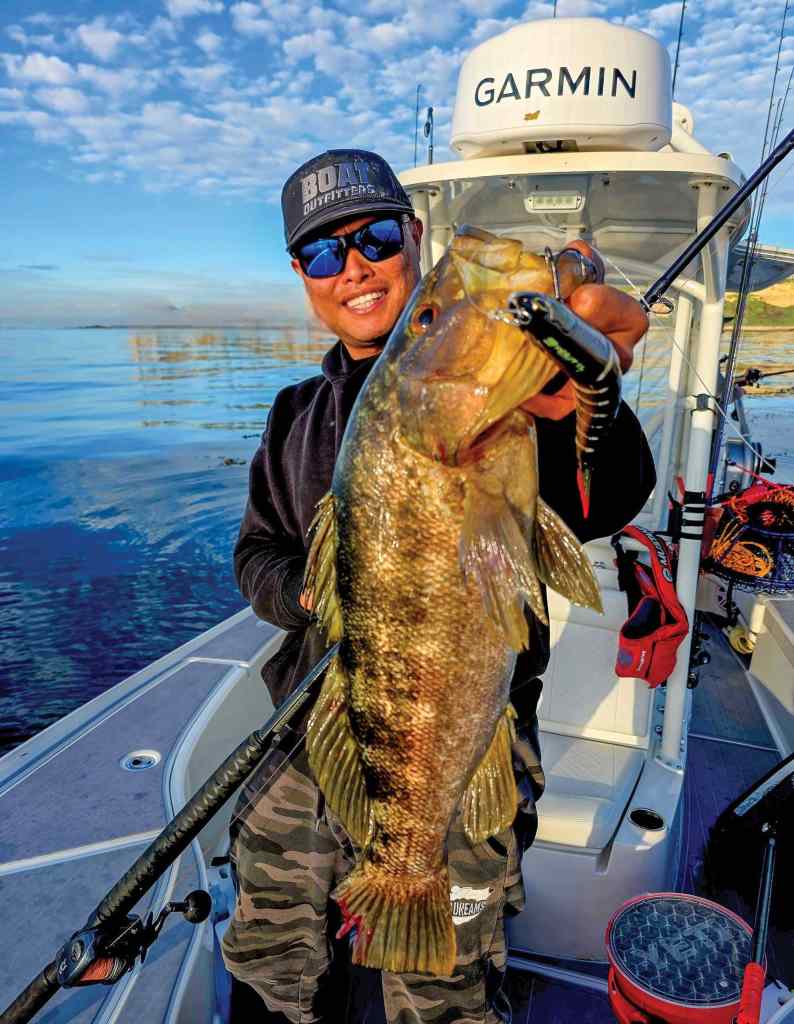
A long-standing consensus among Southern California anglers is that feeding habits of calico bass are mostly dictated by water temperature. During summer, calicos are known to feed aggressively in the top of the water column, readily biting fast-moving lures near the surface. But in cooler water months, they tend to feed lower in the water column. As their metabolism slows, so do the presentations required to get bit.
While this may appear to be a sound theory, it might just be confirmation bias. If you go out during the winter and only fish slow and low in the water column, you will catch the fish that are feeding there. But what if you were to think outside the box and fish surface lures year-round?
Over decades targeting calico bass and studying their feeding habits, I have a different theory to offer. Water temperature does play a huge role in how and when calico bass bite, but it’s not the average temperature, it’s the temperature fluctuations that affect them. Calico bass, like any inshore species, prefer stable water temperatures. Be it 55 degrees or 70 degrees F, if you get a few days without any big water temperature drops, the fish will feed on or near the surface given the right conditions.
Regardless of the current water temperature, a sudden drop of even 3 degrees F can be enough to put bass in a funk. I’ve had days when it dropped from 71 to 67 degrees F, and the previously biting bass will drop down in the water column and become reluctant to bite.
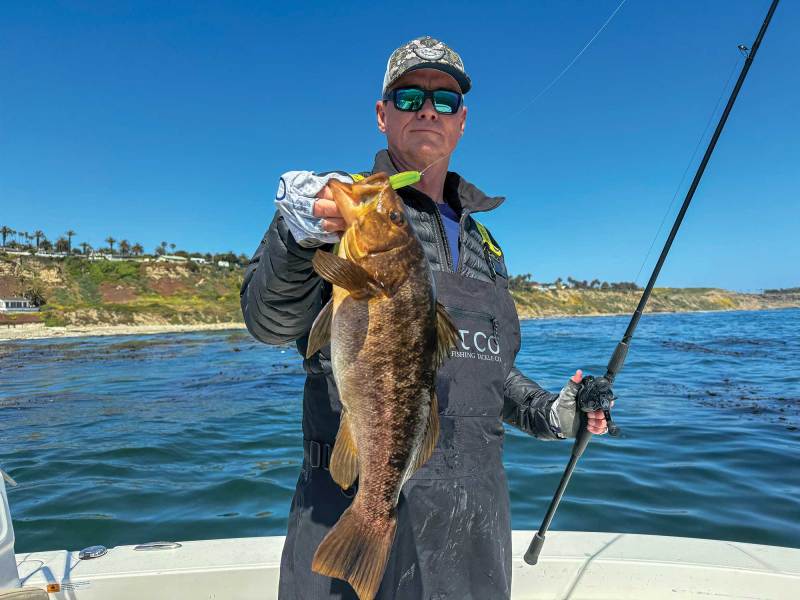
The location of forage is the true determining factor regarding where in the water column bass will bite on any given day.
Over the last few years, there has been a influx of juvenile anchovies along our kelp beds and rocky shorelines. Unlike sardines, which can be found schooling in any part of the water column, small anchovies are almost always found near the surface, as they use the kelp canopy or dirtier water along the shoreline to hide from predators. Even in the absence of anchovies, calico bass hang in that upper part of the water column waiting for more to show up.
When fishing for calicos in kelp, finding baitfish is the first step in getting bit. That entails driving around and looking for signs of bait. Sometimes it’s easy to find when you see bait puddling on the surface or birds actively feeding. Other times it is as subtle as seeing a cormorant sitting in the water, or spotting a few baitfish swimming by as you’re driving along.
Just because there’s bait doesn’t mean there will be bass, so the best way to quickly find out if there are biting fish in a kelp bed is to start on the upcurrent edge of the bed and make a few casts to the leading stringers. If there are fish there, they will show themselves immediately. If you get bit, keep fishing through the bed, but if you don’t get bit, it’s a waste of time to fish any further.
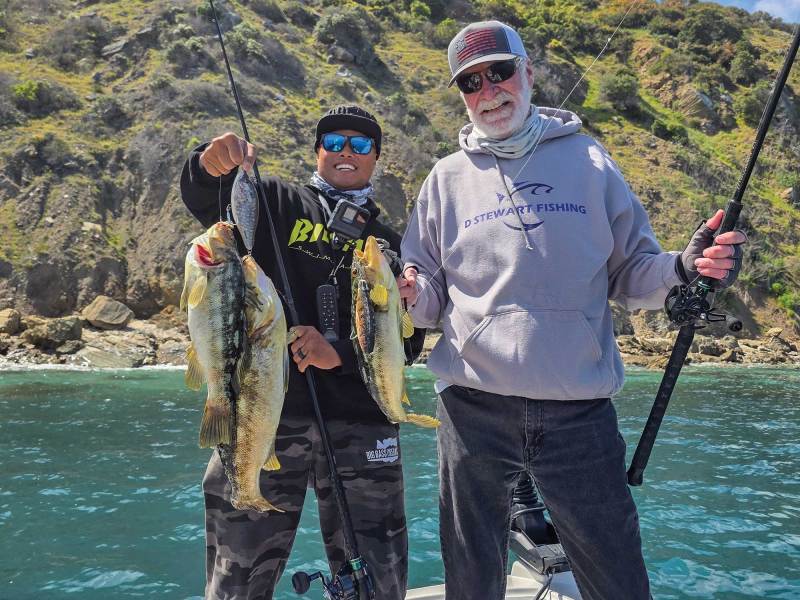
Your choice of lure will depend upon the composition of the kelp bed you are fishing. Beds with isolated stringers and open casting lanes can be fished using treble-hooked lures, while a weedless presentation is needed when casting around denser beds.
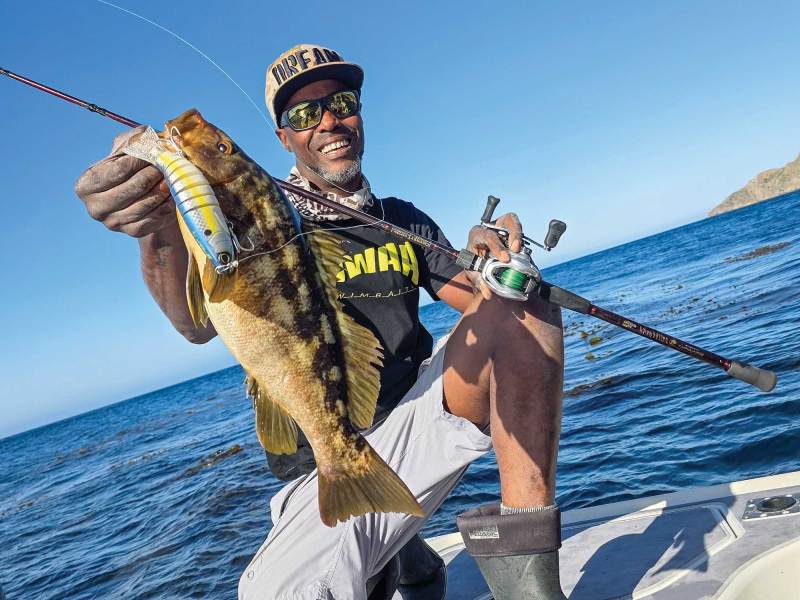
Productive topwater lure types include floating “walk-the-dog” lures like Yo-Zuri’s Hydro Pencil; stick baits like AFTCO’s Blue Fever 160; and soft plastics like MC Swimbaits’ 7-inch weedless swimbait or 7-inch slug, both of which are fished on a keel-weighted hook. Freshwater lures also work well in this situation, and my current favorite is the BIWAA USA 6 ½-inch S’Trout.
Regardless of the lure you’re fishing, the direction of retrieve makes a big difference when fishing calicos in kelp. Whenever possible, you should swim your lure against or perpendicular to the current as you retrieve it. Due to the fact that bass point their noses into the current as they swim to hold position, if you retrieve your lure with the current, bass can see it coming from a distance and will often let it swim by because it doesn’t look like an actual baitfish.
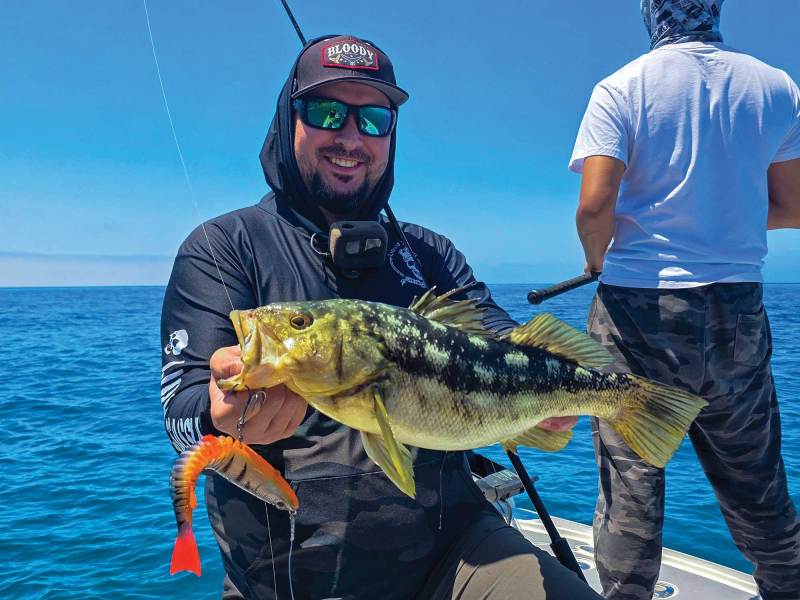
When you are winding against or perpendicular to the current, a bass’s lateral lines will pick up the sound of the approaching lure, but it will only get a quick glimpse of it while it passes and react by trying to eat it. By the same token, your retrieve speed should be as fast as the lure you’re fishing will allow. If you’re fishing a weedless swimbait, retrieve it quickly with a steady retrieve. For stick baits, a fast stop-and-go erratic retrieve works best, as the lure puts out a lot of vibration and the erratic action mimics a fleeing baitfish.
All of these same lures can effectively be fished over shallow-water reefs or around boiler rocks. And while the presentation is basically the same, the casting direction varies according to the layout of the reef. While feeding in these zones, calico bass will position themselves to not only hide, but to stay out of the current, so they don’t have to expend too much energy to hold position.
They do this by tucking in behind larger rocks along the reef. In this case, the bass are like rainbow trout that tuck behind rocks in a stream. They can easily hold position and watch for baitfish carried along in the current. On clear-water days, these hiding spots are easy to see because they show up as dark spots in the water.
When fishing shallow reefs, you’ll want to present your lure across any dark spots you spy in the water. If it’s a small spot, a couple of casts should tell you if a fish is there, but for larger spots, it pays to make casts to both sides of the spot as well as bringing your lure across the top of it. Pay attention to where you were casting when you got bit, as other bass in the area will likely be set up in a similar way.
Unlike when fishing kelp, a fast retrieve is not necessary on reefs, as you are now casting to specific targets in a turbulent environment. In this setting, bass rely mostly on their lateral lines to track baitfish movement. In fact, sometimes a really slow-moving bait will draw more strikes than something fished faster. If you’re willing to risk losing one, a large freshwater swimbait like the Roma Trout by West Coast Baits can be deadly when slow-rolled on the surface over expanses of shallow reef.
Read Next: Using Weedless Baits to Catch Calico Bass
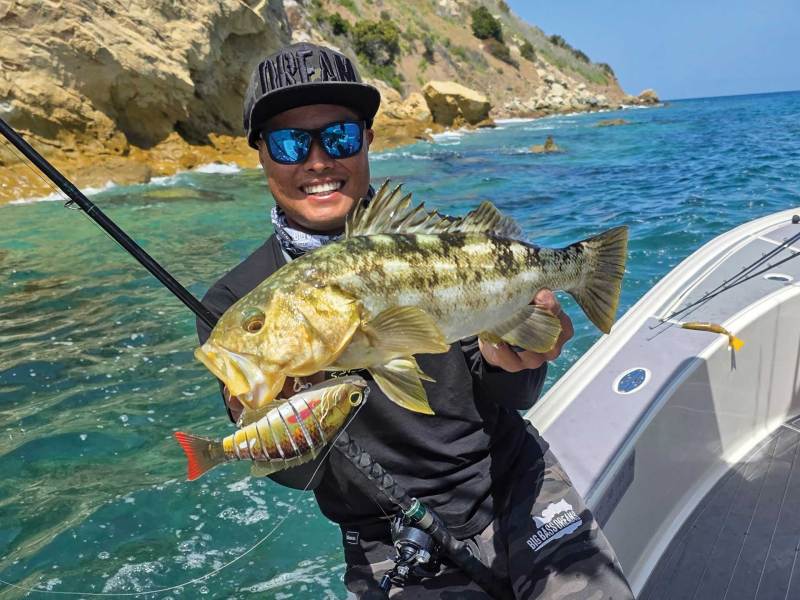
Rod and reel combinations for these applications vary anywhere from slight spinning tackle and 20-pound braid, with a 20-pound fluorocarbon leader, for small stick baits to a 300-sized baitcaster and 50-pound braid, with a 40-pound leader, for weedless swimbaits. When presenting smaller lures over shallow reefs, I often fish 15-pound fluorocarbon line instead of braid, as its stretch keeps me from pulling the hook on fish.
Conditions change from day to day and a bass’s choice of preferred lure does as well. Just remember to keep an open mind. If water temperatures are stable, you’ll find fish willing to eat.