
Thousands of years ago, in a cave on an island off southern Asia, some paleolithic fisherman carved a rudimentary fish hook out of a sea snail shell. Archeology tells us this roughly 20,000-year-old artifact is the earliest evidence of terminal tackle.
What archeology can’t tell us is the story of the caveman on the other side of the bay. In competition for resources, this guy—who was still wading around trying to stab fish with a stick—must have witnessed his neighbor’s success. Shamed in front of his hungry children, you can bet he called fish-hook man a cheater.
It might seem simple, but the first fish hook was a huge leap in fishing technology. The history of fishing is dotted with such advances, each of which led to marked periods of rapidly improved angler efficiency — and sometimes overfishing. Scientist Brendan Runde with The Nature Conservancy noted this pattern in his abstract of a recent study on omnidirectional sonar.
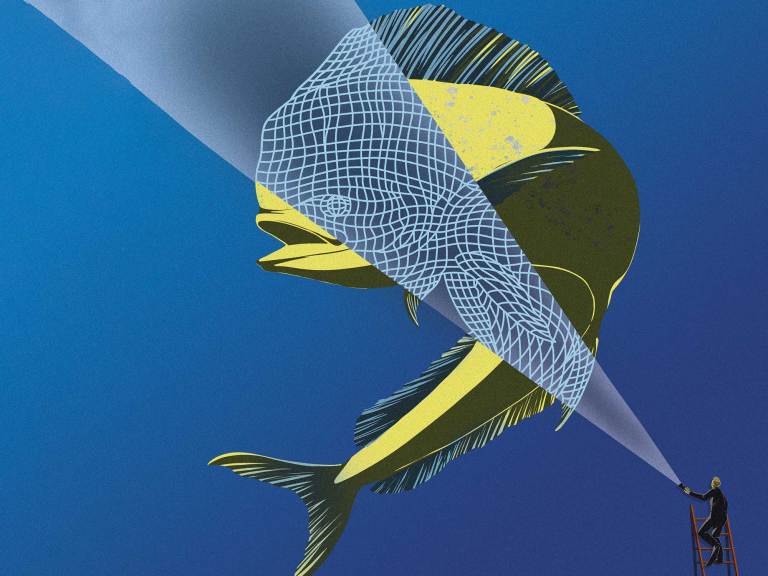
Today, fishing is in a period of surging efficiency. Sonar paired with radar, GPS and satellite data already changed the way we fish, but the latest wave of sonar technology available to recreational anglers is scary powerful. It’s powerful enough that even angler-aligned conservation groups are calling on fisheries managers to take a closer look.
Omni Sonar Offshore
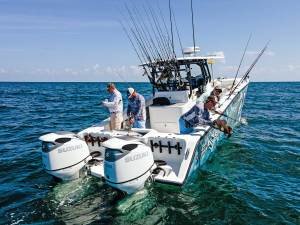
When Furuno released its CH-250 Searchlight more than two decades ago, it forever changed the game. The technology took time to catch on, but today’s widespread use of even more advanced omnidirectional sonar allows recreational boats, particularly sport-fishing yachts, to catch a lot more fish.
We all knew that, right? To be competitive at a high level in offshore tournaments, omni sonar is now a requirement. But when a trio of scientists crunched numbers to quantify just how effective omni is, the statistics proved astounding—even if they aren’t all that surprising.
Boats equipped with omnidirectional sonar caught 84 percent more billfish (blue marlin, white marlin and sailfish) than those fishing without the technology at the Big Rock Blue Marlin Tournament in 2024 and 2025.
Runde, along with Paul Rudershausen and Jeff Buckel of North Carolina State University, parsed data from the annual Morehead City, North Carolina, tournament because the Big Rock hosts hundreds of boats each June and includes sonar and non-sonar divisions. Over the two tournaments, 291 boats used omnidirectional sonar and
283 did not.
Here are a Few Eye-Popping Stats from the Study:
- All 25 boats that caught five or more billfish during a week of competition were equipped with omni sonar.
- Forty-five of the 46 boats that caught four or more billfish used omni sonar.
- Billfish catch rates increased across the board from 2024 to 2025. They increased 41 percent for boats fishing without omni both years. They increased 81 percent for boats that fished with omni both years. Catch rates increased by 91 percent for boats that did not use omnidirectional sonar in 2024 but acquired it ahead of the 2025 tourney.
- The technology also dominated awards for non-billfish divisions. Of 17 prizes for mahi, wahoo and tuna, 14 went to teams using omni sonar.
Journalist Mark Taylor wrote an in-depth article on the study for our sister publication Sport Fishing. It gives us concrete evidence of what you might expect from technology that scans thousands of feet—both in depth and 360 degrees around the boat—to identify and track individual fish in real time.
With Simrad, MAQ and JRC joining Furuno in the omnidirectional sonar market, the tech is bound to get better and less expensive. Even though billfishing is primarily a catch-and-release endeavor, Runde and his colleagues suggested fisheries managers study and account for this increased efficiency to ensure sustainability.
Forward-Facing Sonar
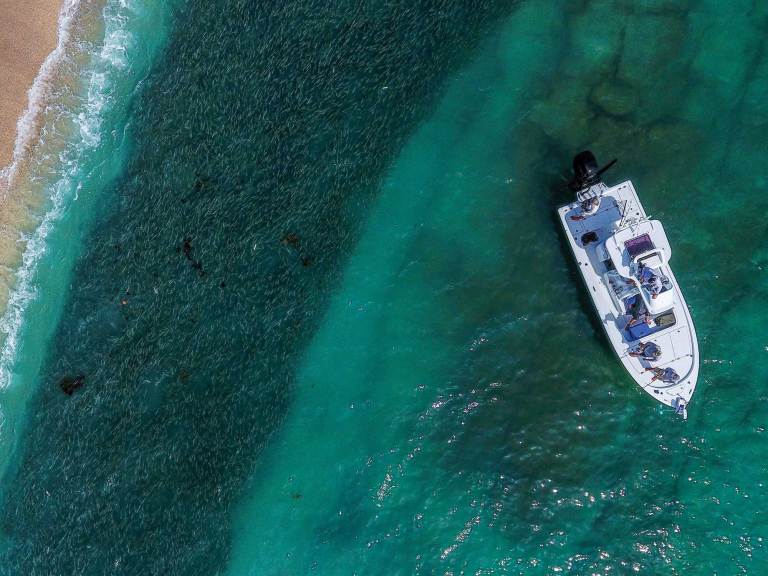
Moving inshore, sonar was a subject of much discussion aboard Capt. Joey Murphy’s 25 Contender Bay this past summer. We were spot-locked off a blue-green Islamorada flat, soaking mullet as large tarpon rolled off the stern. During that morning’s search for bait, Murphy had mentioned he does things “a little different.” While we waited for a tarpon to eat, I asked him what he meant by that.
“I do it the old-school way, just looking for signs of life. This time of year, it’s pretty much all mullet they’re chasing, so I’m looking for bait and muds, and I’m also just looking in areas where they would normally be,” he said. It took me a minute to decipher that by “a little different” Murphy meant he was observing his surroundings instead of watching a screen.
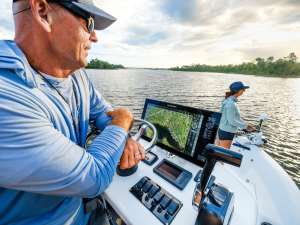
Side-scan sonar was already a game changer for locating fish not visible to the naked eye. Forward-facing sonar is the latest advancement, and it allows anglers to identify fish or groups of fish 80 feet or more in front of the transducer. In real time, almost like a video, it’s possible to cast to a fish and watch its reaction to a lure or bait. The benefits are obvious.
This technology ignited an uproar in freshwater last year, to the point where major bass tournaments limited its use. It fundamentally changed the sport. Without forward-facing sonar, or the savvy to use it, some of the best anglers on tour were rendered obsolete in a single season. In fresh and salt water, skills anglers develop over years to locate fish—skills like local knowledge, observation, instinct and intuition—are being relegated to “traditional” status by advancing technology.
Read Next: Live Sonar: The Bold Future of Fish-Finding Technology
Bonefish & Tarpon Trust issued a statement this past summer warning of potential negative effects of forward-facing sonar to tarpon in the Florida Keys and called for precautionary management measures in Everglades National Park. The primary concern is sonar exposes tarpon to added angler pressure when they are inactive or holding deep and would otherwise be undetectable.
As a charter captain, Murphy does not begrudge his colleagues for using all the tools available to put paying clients on fish, but he does worry that added pressure could push tarpon out of Florida Bay, which is a refuge during migration.
“Does it help people catch more fish? Yes,” Murphy said. “But my thing is, I feel like it puts undue pressure on a species that is already being affected by so many factors. We don’t want to pressure them to the point where they just don’t return.”
Inshore and off, most boats fish with some form of sonar these days. Traditionalists argue this latest tech amounts to cheating, but in some situations not having it is the equivalent of wading around trying to stab fish with a stick. Yet we’ve seen technology crash fisheries before, and the small slice of data available warrants a closer look.