My little brother and I spent much of our teens fishing the magical waters of Mexico’s Sea of Cortez, and when anyone mentions triggerfish—what the Mexicans call cochi—I drift back to those formative, halcyon days in the late 1960s and early ’70s casting along the shores of Baja California Sur.
We caught so many finescale triggerfish that eventually we tried not to catch them, preferring instead to target pargo (snapper) or cabrilla (small groupers) amid the shore rocks and reefs. But triggers were ever-present.
I am not sure why we had that early aversion to triggerfish. After all, in Baja they reach weights in excess of 10 pounds, fight hard and taste great, if you have a fillet knife sharp enough to slice through the armor-like hide.
Today, more than five decades later, I’ve come full circle. That’s because warming summer ocean temperatures in my home waters off Southern California have ushered in a population of finescale triggerfish from the south. Unlike the days of my youth in Baja, catching these triggers has proved a bit challenging.
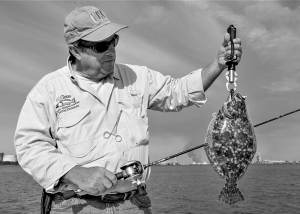
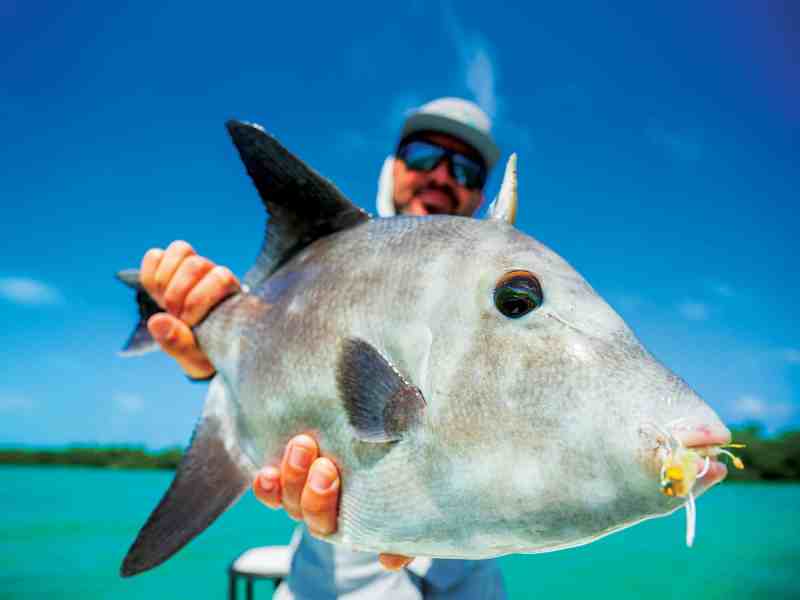
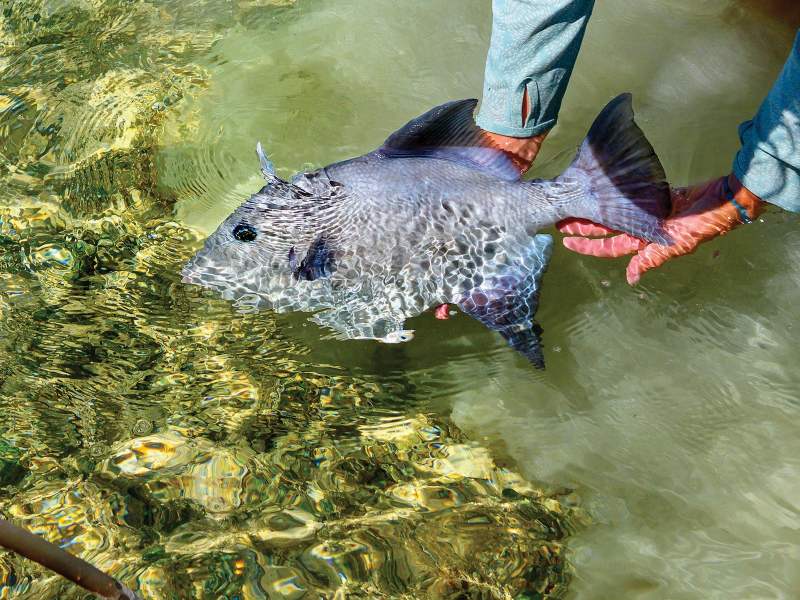
In reality, Southern California is late to the party when it comes triggers. Anglers as far north as Nova Scotia, as well as the south Atlantic and Gulf coasts have targeted these fish for many years. But the species in these waters are different. One of the most common and popular in the Northeast and Southeast is the gray triggerfish. There’s also the ocean triggerfish (seen in the image above) and the colorful queen triggerfish, both largely confined largely to the Gulf and Caribbean.
Southeast Grays
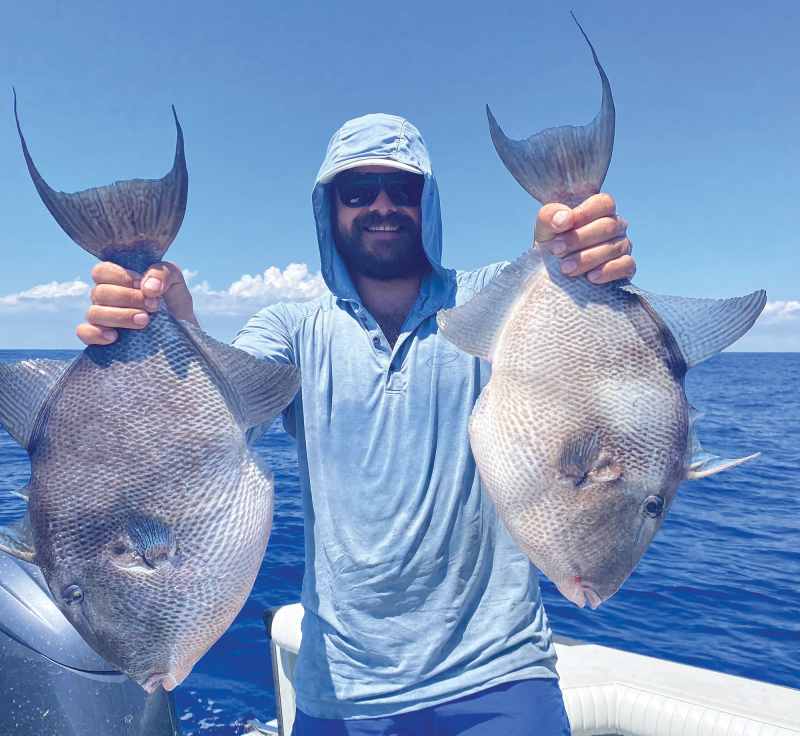
Daniel Glenn targets gray triggerfish in the Atlantic waters off Ponce Inlet north of New Smyrna Beach, Florida. “We focus on ‘live bottom’ areas, usually in anywhere from 120 to 150 feet of water,” Glenn reveals. “However, we have also caught some incidentally while fishing for grouper in water as deep as 250 feet.”
The gray triggerfish that Glenn catches range up to about 17 inches in length and 5 pounds in weight, though fish caught in deeper areas tend to be larger— up to 24 inches in length and 8 pounds.
Places on the ocean floor where hard, rocky substrate is covered by a dense carpet of soft corals and other marine organisms (aka live bottom) and lie adjacent to wrecks seem to be some of the most productive spots, Glenn has learned over the years. “If you’re fishing for grouper with live bait, you can tell if there are triggerfish around because they will eat the eyeballs and bellies out of the baits,” Glenn says.
When this occurs, Glenn often switches over to triggerfish tackle and tactics, as they are one of the most delicious fish to catch, in his opinion. “I love to eat them when lightly fried with lemon butter and parsley,” he says. That said, the tough skin of a trigger can make it a challenge to fillet. For tutorial on the easy way to fillet a trigger, check out this Reed the Fishmonger video.
Glenn uses a chicken-rig leader consisting of two short dropper-loops spaced approximately 10 to 12 inches apart with a sinker at the bottom of the leader. He uses 40-pound-test fluorocarbon to make the leader.
Triggerfish possess relatively small mouths, but they come equipped with bone-crushing jaws and teeth. A Mustad No. 2 O’Shaughnessy live-bait hook (model 94151) fits the bill. It’s small enough to fit in a trigger’s mouth, yet has a 3X strong-wire construction to keep from breaking if the fish bites down hard on it.
The amount of weight needed depends on the depth, current and wind, as you need to be fishing on or very near the bottom. Glenn carries a variety of bank sinkers ranging from 12 to 24 ounces.
Gray triggerfish in Florida waters are fairly indiscriminate about what they will eat. “We use cut baits from a fish like a mullet or grunt, a chunk of shrimp or a strip of squid,” Glenn explains. “Bait up both hooks and drop them to bottom.”
Triggers will peck hard at the bait. “That’s your signal to reel down and set the hook,” Glenn advises. Applying a tight drag and heavy pressure keeps a trigger from wrapping the line around bottom structure and helps you land it before a shark homes in to collect its pound of flesh.
Fishing for gray triggerfish is consistently good year-around in Florida waters, but pay close attention to Florida Fish and Wildlife Commission regulations (myfwc.com), especially on the Gulf side, where (as of presstime) gray triggerfish take is open from March 1 to May 31 and then again from Aug. 1 to Dec. 31, with 15-inch fork-length minimum size and a daily bag limit of one. On the Atlantic side, fishing is open year-around with a 12-inch fork-length minimum size and daily bag limit of 10.
Northeast Triggers
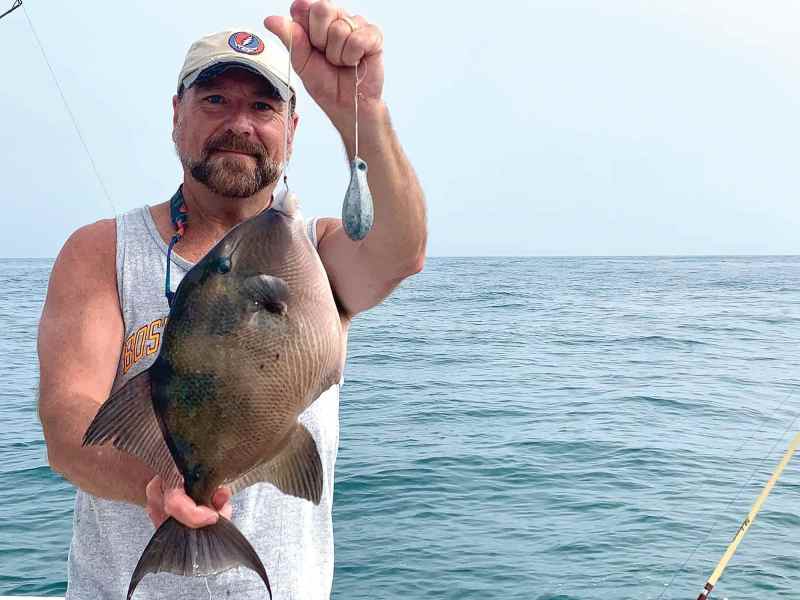
Gray triggerfish seasonally migrate up the Atlantic coast, riding the Gulf Stream in late summer and early fall. That’s when anglers in the Northeast target these fish.
New York-based Capt. Kevin Falvey pursues structure-loving triggers in the ocean and bays off Eastern Long Island aboard his 23-foot Regulator center console, Breakaway. One of his preferred tactics is to focus on the barnacle- and mussel-encrusted buoy chains in bays such as Shinnecock Bay, Moriches Bay, and Gardiners Bay. Falvey also fishes the chains of offshore buoys (the “mile buoys”) marking the inlets.
“Of course, I also fish jetties, rockpiles, reefs and wrecks,” Falvey notes, “but the buoy-chain thing is kind of a special or off-the-beaten-path tactic.”
Once triggers reach this latitude, they quickly gravitate to these man-made structures,” Falvey points out. “You can catch them anywhere along the buoy chain, but also near the big cement block or anchor on bottom.”
Falvey uses a two-hook chicken rig tied with 40-pound test monofilament, and he prefers a Virginia hook in size No. 1 or 1/0. The long-shank Virginia hook features a hollow hook point for excellent penetration and hook sets. It is designed for bottomfishing using a variety of bait, such as crabs, clams, and squid.
As in most bottomfishing scenarios, the amount of weight depends on how much is needed to fish as vertically as possible, as dictated by wind and water current.
One of Falvey’s favorite baits for triggerfish is clam meat, but squid will also work. “Whatever the bait, it is important to leave the point of the hook exposed,” he advises. “With triggers, the bite is quick, so as soon as you feel the bite, you have to set the hook.
“Be ready to strike and then immediately bring the rod over your head,” Falvey adds. “Fail to do this and Mr. Trigger will almost certainly wrap you ’round the chain and say goodbye.”
Stout tackle is needed to wrestle triggers away from structure and prevent them from wrapping, snagging or cutting the line on a barnacle-studded buoy chain. Falvey uses 30-pound-test main line on spinning or conventional gear to fish for triggers.
In New York State, gray triggerfish are typically managed under “unregulated marine species” rules, meaning that (as of presstime) in state marine waters where Falvey typically fishes for gray triggers, there is no minimum size limit, no closed season, and no bag limit.
In federal waters (outside the 3-mile state waters limit), there is a seasonal closure from Jan. 1 to the end of February and again from June 1 to July 31. The minimum fork-length is 15 inches, and the daily bag limit is one in federal ocean waters.
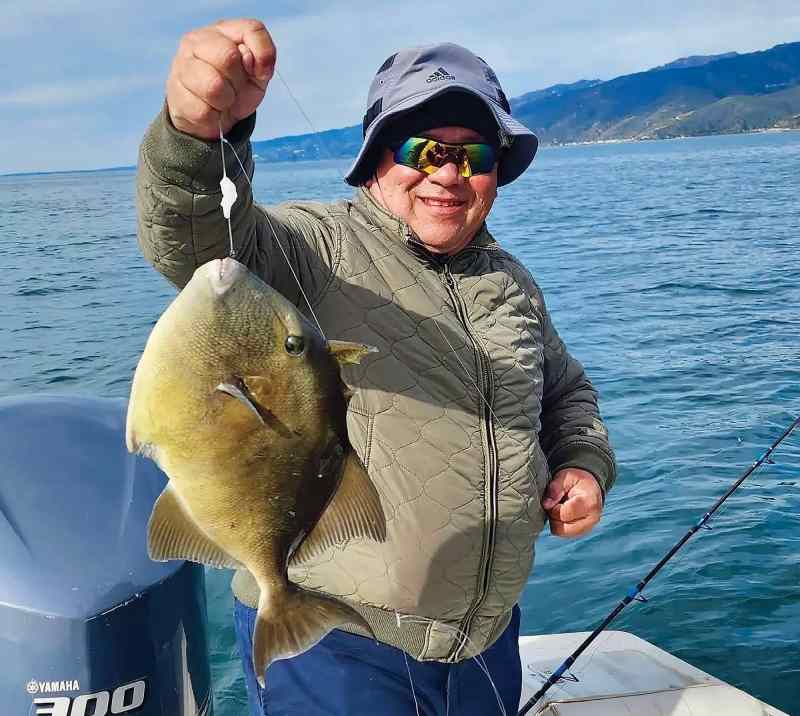
SoCal Finescales
The finescale triggerfish is the first and only variety of trigger I have ever caught, and as indicated earlier, all of those occurred in my youth in the Sea of Cortez along the eastern side Baja California Sur. I remember well the power of these fish as I watched them battling deep in the crystalline waters of what many today call The Aquarium of the World.
Now, that same species has found its way to waters off Southern California, coaxed northward by warming Pacific waters, wrought in large measure by the El Nino episode of 2026. That said, there is definitely a population of finescale triggers that inhabits SoCal coastal structure areas such as natural reefs, man-made rock piles and oil platforms year-around.
This has left many an angler puzzled while fishing with larger hooks for barred sand bass or calico bass on coastal reefs. As one angler informed me: “If you’re getting solid bites, but you’re missing them, they’re triggerfish.”
Anglers who focus on triggers in SoCal stay tightlipped about their fishing spots and techniques, but I have ferreted out secrets of some of the most successful anglers in this close-knit community. Interestingly, the methods are not dissimilar from anglers in Florida and the Northeast.
Triggers have established residence amid a number of the artificial reefs that dot the Southern California coast—primarily those reefs that lie in 60 to 120 feet of water. Some prime reefs include the sprawling Bolsa Chica artificial reef off Bolsa Chica State Beach and the Santa Monica Bay artificial reef complex off Santa Monica. Rock piles in the 90-foot-depth zone often produce the best fishing for triggerfish.
Read Next: Sight Fish Tripletail on the Georgia Coast
Southern California triggerfish experts use a double-dropper loop (same as a chicken rig with 6-inch-long loops), but made with lighter fluorocarbon such as 20- to 25-pound-test. Hooks are smaller, too. A No. 1 or No. 2 octopus hook, but with 2X strong wire, is preferred. A 4- to 6-ounce torpedo sinker generally provides enough weight to hold bottom while fishing directly over the rocks that comprise the reefs.
Raw shrimp is the bait of choice. Use the meat of the shrimp with the head, shell and tail removed and used for chum. Bury the hook in meat of the shrimp, but with point just barely exposed. As soon as you feel a solid thump, wind down and set the hook.
The first inclination of a finescale trigger is to dive back into rocks, so use a minimum of 50-pound-test braid and very tight drag. The battle is usually won or lost in the first five seconds.
In California, there is no closed season or minimum size for finescale triggerfish, but there is a maximum bag limit of 10 per day within the statewide general limit of 20 finfish total in combination of all species.