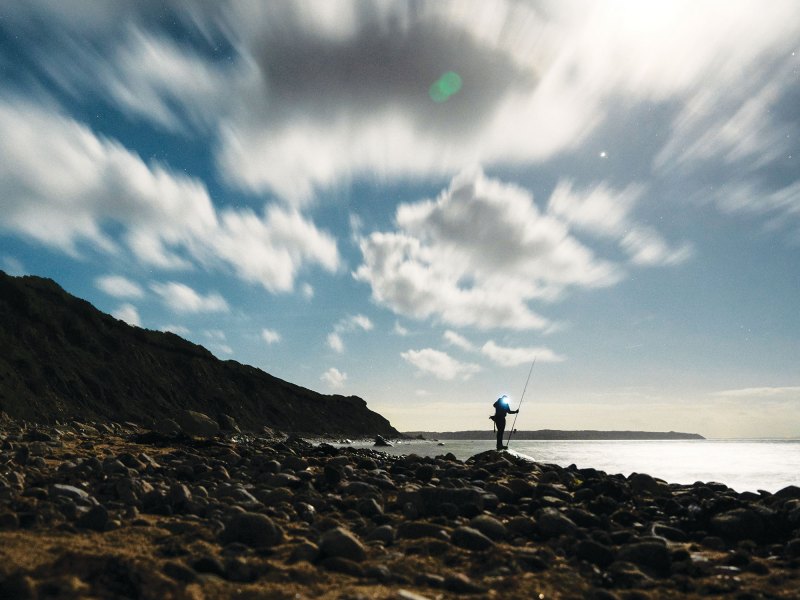
Marine inshore environments are comprised of an almost-infinite spectrum of structure, and every piece holds its own secrets. The deeper you get into the world of saltwater angling, the more you realize that the most common, most discussed, and most fished structure types are just the tip of the iceberg—and in many cases, they may not even be the most productive.
One of my favorite unsung places of the coastal shoreline is the “inside corner.” These often-overlooked bends have produced thousands of fish for me in my local waters, and some amazing catches while fishing more distant locales. While bars and troughs, rips and drop-offs may get all the glory, the inside corner has proven time and again to be my ace in the hole.
Classic Curvature
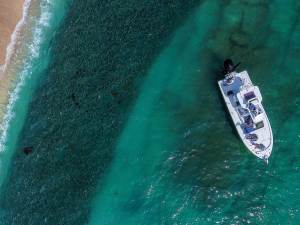
An inside corner is fairly simply to define: A curvature where the shoreline transitions outwards into a shallower area like a point, curve, or hump. To use a metaphor, if you bent your arm, the inside corner would be the “crook” of your elbow, and your forearm is the shallower point extending out into the water, and the bicep is the continuation of the shoreline. Often the crook of the inside corner is constituted by significantly deeper water, but not always. Along our Northeast coast, inside corners are often associated with sandy or rocky points.
The inside corner is all about the alteration of water movement. The curvature of the shore at an inside corner results in either an acceleration or deceleration of wind- or tidal-driven currents, and it can also alter its direction. Predators use all of this to overwhelm prey.
Busy Corner
Let me offer an example. Imagine a sandy point that runs straight out from shore, and is approximately 2-feet deep, falling away quickly to 7-feet deep on the left side. The right side of the point tapers less dramatically over a long distance, with no corner and a maximum depth of only 4-feet.
Now, consider a tidal current running from right to left over the point first, then into the corner. When the moving water hits the point, it accelerates. This is a simple matter of physics, as the water is being squeezed more tightly through the shallower area. This increase in velocity can overwhelm crustaceans and baitfish, and out of control, disoriented, and panicked, they get swept across the point and dumped into the deeper water in the crook of the corner.
Injured and dying prey is immediately vulnerable, but even strong prey is in trouble. Having been deposited haphazardly, it has to make a choice: head out around the point, swim back directly against the current, or go toward shore. The stronger current sweeping across the point often serves as a barrier, and most avoid heading offshore into deeper water where they’re even more susceptible to predation. So, the only choice is heading toward shore. For this reason, prey—dead, dying, and healthy—accumulates in the inside corner at the junction between shore and point.
That’s just one scenario, but let us quickly examine another. Imagine the exact same setup—inside corner to the left, point to the right—but now instead the current is running in the opposite direction, flowing from left to right. As the current pushes into the corner, high pressure is formed as it’s slowed down or blocked by the depth change at the point, and it is often deflected. This results in all manners of strange outward running, reverse, and swirling currents, which confuse and pin bait in the corner. This draws predators that use this to their advantage. In essence, in this common scenario, the corner becomes a trap that is hard to escape.
Finding the Corner
While they’re everywhere, inside corners are not always obvious. I find they typically do not show up on nautical charts, as they’re simply too subtle. Therefore, it’s extremely important to hunt for them at low-tide, when the shape of the shoreline will be revealed more clearly. To make things easier, I look for points, shoreline curves, and shallow humps first, because they are easier to find (whether on the beach, with electronics, or on electronic charts). Then, once I find a point that could have potential, I’ll survey the spot more thoroughly to see if I can identify the inside corners.
Inside corners are extremely prevalent on sandy beaches, but there they are transient. As sand is pushed and pulled by the tides and storms, inside corners can appear or disappear quickly. While I am constantly on the hunt for sandy-beach inside corners, and fish them frequently, corners associated with stable, rocky, or structured shorelines are far more reliable. This is true whether you’re “out front” in the ocean, or if you’re inside coves, harbors, or other protected areas. Inside corners are also surprisingly stable in estuaries, marshes, and tidal rivers, no matter the composition of the bottom, because the water movement remains generally consistent outside of major storms, king tides, or flooding events. Don’t overlook corner-point pairings in these backwaters, as they can be even more productive than on an open beach.
Corner Eddies
I’ve found many ways to take advantage of an inside corner depend on the specific dimensions of the spot (size, depth, contour, etc.), the species being targeted, the coastal conditions (wind, weather, etc.), and the direction of water movement. What works best for you at the corner may prove unique, based on all these factors, as well as the techniques you chose to employ such as bait, lure, or fly.
There’s a lot of nuance with inside corners, but I will return to two things I demonstrated at the beginning of this piece: Look for bait traps and changes in current speed or direction. The curve of the shore and change in depth (associated with the point) is the foundation of these two components, but understanding the dimensionality of the water movement and the aggregation of other factors (like wind, bait species, time of year, etc.) is critical to getting the most out of any corner. To put it more simply and in one sentence: Find where conditions make the water do something differently within the corner, and then fish it!
One of the most common scenarios you’re likely to find is a swirling eddy. If current is pushing into the corner (as opposed to dumping off the point), and wave action is opposing it (driven by onshore wind), an area of moving water that loops continually back in on itself is typical. These swirling currents trap and confuse prey within the loop and offer a significant feeding advantage to predators. To make the most of an eddy in a corner pocket, don’t cast directly into the center of it. For most game species, the stagnant water in the middle of an eddy offers no feeding advantage. Instead, fish the current at the edges of the eddy, and key on the zone where the shoreline or wind-driven current intersects with the loop.
The Three Edges
Generally, I like to focus on the three “edges” of an inside corner. The first edge is the shoreline, which is likely the most obvious, but do not neglect it. The tighter into the corner I get, the more important the shoreline becomes, but it can be productive to throw casts right into the wash anywhere within the corner pocket. Again, this is because the corner is a trap, and when getting over the point is impossible (due to depth or current), bait is forced to choose between going out deep or hugging in close. It often chooses the latter, and ends up tight to dry land. The shoreline edge of the corner can also have a lot more current than you might expect as the water is squeezed into the pocket by tidal current, waves, or wind.
The next edge is where the corner transitions to the point and runs outward away from the shore. It doesn’t have to be a dramatic cliff-like drop off, as I’ve had luck with subtle transitions of 1-foot. This edge of the corner can be productive regardless of which direction the current is flowing, but I like it far more if the current is sweeping off the point and dumping into the corner. When targeting this area, I highly encourage you to sweep your lure or fly right off the point—don’t just cast out and retrieve straight back. Bait tumbling or swimming off the edge is frequently the most natural presentation, and can be the key to triggering a bite.
The final edge is the toughest to find, but can be the most important. On the open side of the corner,the side opposite the point, there is a zone where things get, for lack of a better word, weird. It’s much more nebulous and hard to define. I typically discover it by carefully dissecting the spot. This edge can be many things: the seam of an eddy, a change of depth or water clarity, the zone at which bait can escape a current acceleration, or even the start of current escaping the corner. This is the edge that will change most dramatically between different corners, or even with changing conditions, but it can also be the most productive. To find it, start deep in the corner and methodically work your way out, physically moving away from the pocket every few casts until you find it.
One Side or the Other
Most points along the coast will have an inside corner on one side that is more productive than the other given specific wind, tide stage, or current direction. That is, the right side of a point might fish best during onshore wind and tidal current pushing into the pocket, while the left side fishes best with offshore wind and current sweeping over the point. This can even partially rely on the predominant bait.
For example, if you are focused on a bite driven by crustaceans, sand eels or mole crabs, focusing on the corner where current is being swept across the point by waves and dumping into the pocket might be best. But at the same spot, if the bite is on minnows, it could be much more beneficial to focus on the corner where a flooding tidal current is pushing bait into the crook of the corner. The trick is putting these factors all together for your particular spot.
Taking this a step further, many corner-point pairings are lopsided: There’s only one corner that produces no matter the conditions, all season. This is more common with point-corner pairings where the point doesn’t run straight out, but rather curves to one-side or the other, at an angle to shore. While not a definitive rule, I’ve had the best luck focusing on the corner on the acute side, or the corner pocket that’s squeezed more tightly between the point and shore. There’s a few ways to handle this one-sided phenomenon, but once you think you have a handle on which side fishes best, and score some success, ignore the other side. I’ll generally fish through the optimal conditions and tidal window on the side I think is best, and then simply move to another spot (corner or otherwise) when that closes.
Read Next: World’s 10 Toughest Inshore Fish
Escape Currents
I’ve suggested a few general parameters to both look for and avoid, but there are many nuanced, very specific approaches you can develop as you drill down on fishing the inner corner. One component I believe is worth looking for no matter where you are on the coast or what species you target is what I call an “escape current.”
To explain escape currents, I’ll rely on my second example from earlier: a corner pocket with a point to the right and a lateral current running down the shore from the left, pushing into the pocket. In this case, add in a moderate on-shore wind that is pushing wave action onto the shore. All of that water being pinned against the shoreline by the wind and waves will move with the current, running along shore, and ultimately collecting in the corner to create an area of high-pressure. The water can’t just freely run over the shallow point to release the pressure, as it’s too skinny, and it’s being pushed against the shore by the wind.
It has to go somewhere. While there may be a prevailing eddy or slower moving current under calmer conditions, I have found time and again that this combination of moderate wind, tidal current, and the shape of the corner creates smaller, surprisingly strong currents that cut through the churn: escape currents. Typically they run out at an angle from the corner, but they can also cut straight out, along the edge of the point, or even at a tight angle to shore, depending on specific aspects of the structure of the corner and point, as well as the wind direction and the tidal current.
These escape currents are often physically small, occupying only a few yards, and rarely visible. The best way to find them is swimming a lure through the corner and letting it feel around for you. When the lures starts to thump or wiggle harder, you may have found the escape current.
I like working these little pieces of faster moving water by swinging my lure through them at intervals, not just casting straight out and dragging the lure back. That is, if the current is to my right and running out, I’ll position myself to the left and alternate long, medium, and short casts, where I cast across it and pull my lure back into the moving water. Once I feel the contact, I just hold tight, reeling slowly, and let the escape current swing the lure out. The fish—many species from drum and stripers to snook and tarpon—can be found both in the “meat” of the escape current, or at either seam, so it pays to be thorough.
Do not underestimate how close to shore predators will follow the escape current. They often move to its source, which can be tight in the pocket. Where the escape current starts to die out can be a hot spot, too. This can sometimes be out of reach for a shore angler, but from a boat or kayak, it should be one of the first places you prospect when you find an inside corner.