In a decade spent guiding everything from naïve neophytes to grizzled veterans, Justin Bowles should be jaded by now. For him, catching fish should just be part of the job, like flipping burgers or entering numbers on a spreadsheet.
But during a trip last winter, the Slidell, Louisiana, fishing guide was talking quickly in a high-pitched voice that betrayed his normally laconic demeanor. “This is a big fish! This is a big fish!” he said.
Bowles had just felt a jolt that began at his suspending Bill Lewis Scope Stik, used his 12-pound fluorocarbon as a conduit and delivered a message to the tip of his medium-powered rod. Years of muscle memory instructed him to set the hook, and whatever was on the other side that started the cascade of energy didn’t even budge in the direction of the arcing rod. Instead, it ran sideways, and Bowles knew he had something that would dominate his attention for the next several minutes.
Through the rod tip, Bowles could feel the fish shaking its head, trying desperately to dislodge the treble hooks that had it tethered to an unseen force above the water’s surface. That’s a telltale sign of a trophy-sized speckled trout, but as all Gulf Coast anglers know, redfish also employ this technique.
Bowles has nothing against redfish, and often targets them when fishing solo or with clients, but when big speckled trout are the aim of the day, redfish are simply a waste of time. They mangle your hooks, stretch your line and cost you casts that could draw strikes from the target species.
This indeed could have been a redfish, but Bowles was fishing the Mississippi River-Gulf Outlet (MRGO) during the month of December, and this is where some truly gargantuan speckled trout — by Louisiana standards — like to hang out in the wintertime.
It was a big speckled trout, right? Couldn’t be a big redfish, could it? Bowles was marinating in that confusing cocktail of excitement and anxiety that for centuries has dragged anglers out of their beds way too early and kept them coming back for more. All anglers are adrenaline junkies, and Bowles’ levels were surging.
“Get the net!” he instructed before the fish had even revealed its size or species.
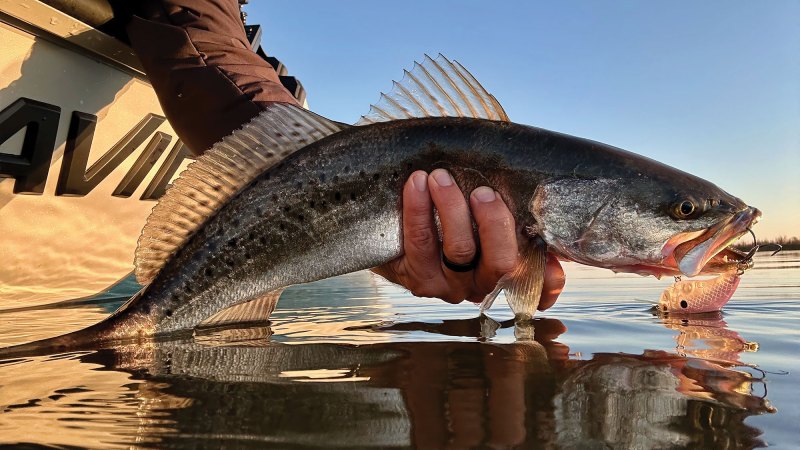
Almost immediately, the fish broke the surface, its heft rendering it incapable of fully breaching. All it could do was shake its massive mustard-colored mouth in one last attempt to regain freedom.
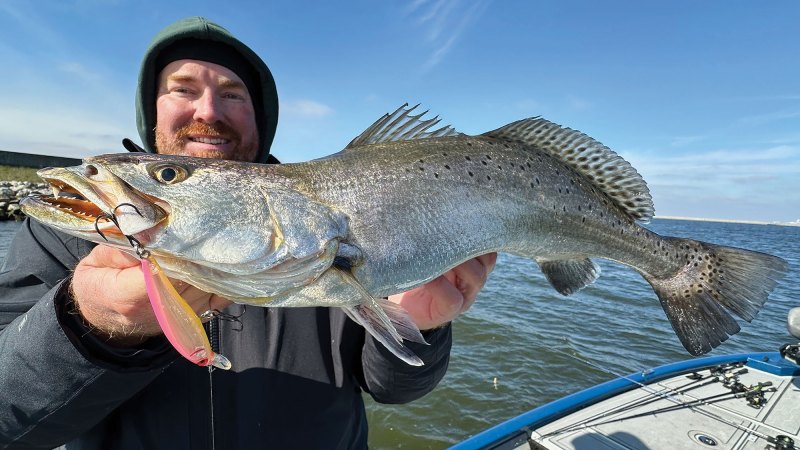
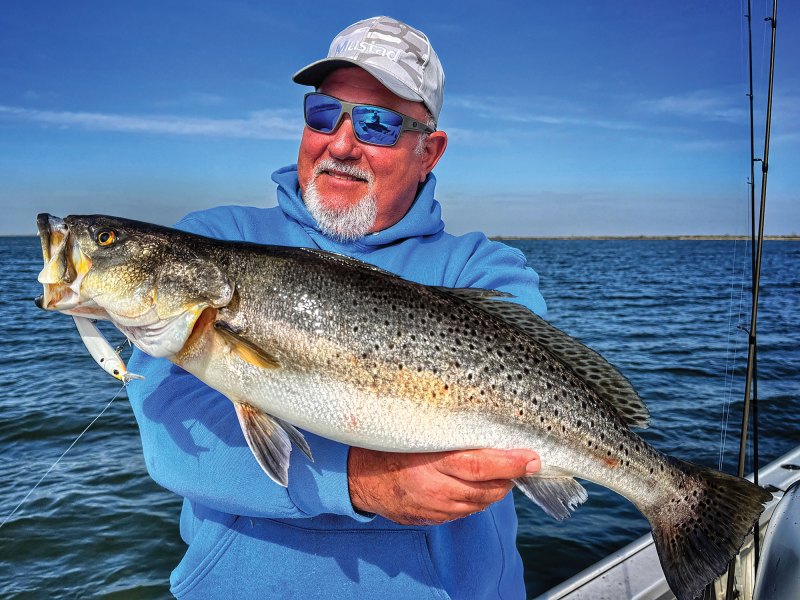
Alas, it was to no avail, and Bowles’ fishing partner for the day slipped a landing net under a 6-pound speckled trout.
In certain parts of Texas and Florida, a 6-pound trout might warrant a head nod or maybe a half-hearted thumbs up, but in Louisiana, where schoolies seem to outnumber the blades of marsh grass, 6-pounders qualify as bragging fish. Bayou State anglers just don’t catch that many of them.
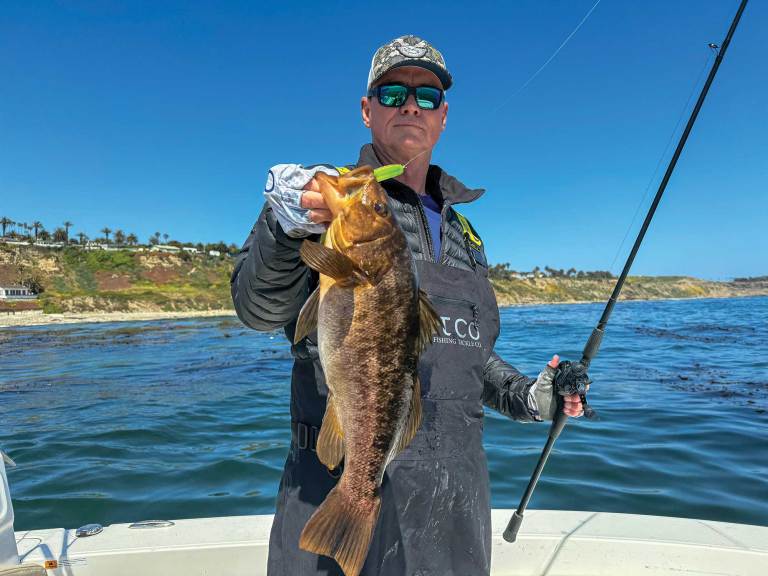
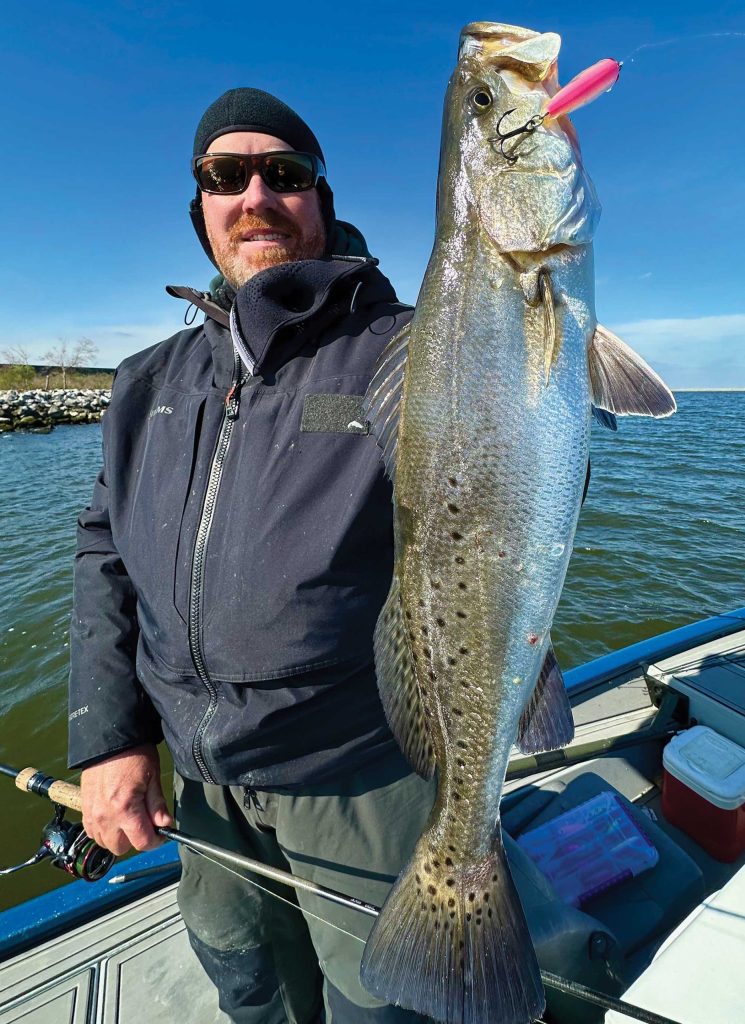
That being the case, Bowles posed for multiple pictures before easing the fish back into the water, giving it a moment to regain its senses and celebrating as it kicked its fanned-out tail and swam off, vowing never to make the same mistake again.
Bowles would repeat the process, although mostly with slightly smaller fish, multiple times over the course of the winter. Among most local anglers, spring is thought of as the season for trophies, but Bowles catches his biggest specks of the year from November through February, when the “mule trout,” as they are known colloquially, set up shop along the rocks that armor the shoreline of the MRGO.
Setting the Scene
Dug in the 1950s and ’60s to provide a more direct route for ships to the port of New Orleans, the MRGO is an environmental boondoggle that allowed salty Gulf water to surge into towering cypress swamps, converting them within decades to brackish and intermediate marshes that look shorn by an Army barber. Even today, anglers must take care when running the marshes northeast of the MRGO, because they are minefields of remnant cypress stumps that sit just under the water’s surface, eager to turn lower units into metallic pretzels.
But every cloud, as they say, has its silver lining, and though the MRGO has caused far more harm than good, it provides just about the perfect habitat for overwintering speckled trout. They call the channel home this time of year because it loads up with bait and provides protection from the Arctic blasts that seem to slip all the way into the Gulf once or twice a year.
“Speckled trout come in here when the water temps drop because you’ve got 35, 40 feet of water in the middle, and it has shelves on the edge that go up to 25, 15, 10 feet right up next to the rocks,” Bowles said. “There’s constant bait coming through here, and so everything they need is here.”
The migration into the MRGO begins in October and includes speckled trout of all sizes. Meat-minded local anglers soak
live shrimp or drag soft-plastic paddletails on the bottom of the shelves to crank up fish that clear Louisiana’s 13-inch minimum size limit.
Bowles does that with most anglers who hire him this time of year to add fillets to their freezers, but when he’s fishing alone or with select clients, he hurls jerkbaits along the rocks, trying to catch fish that have an opinion and aren’t shy about expressing it.
Jerk and Pause
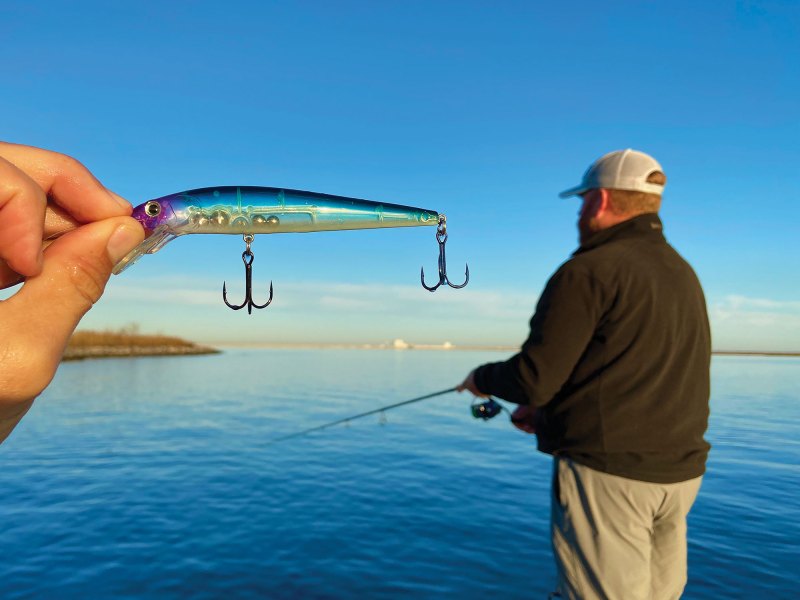
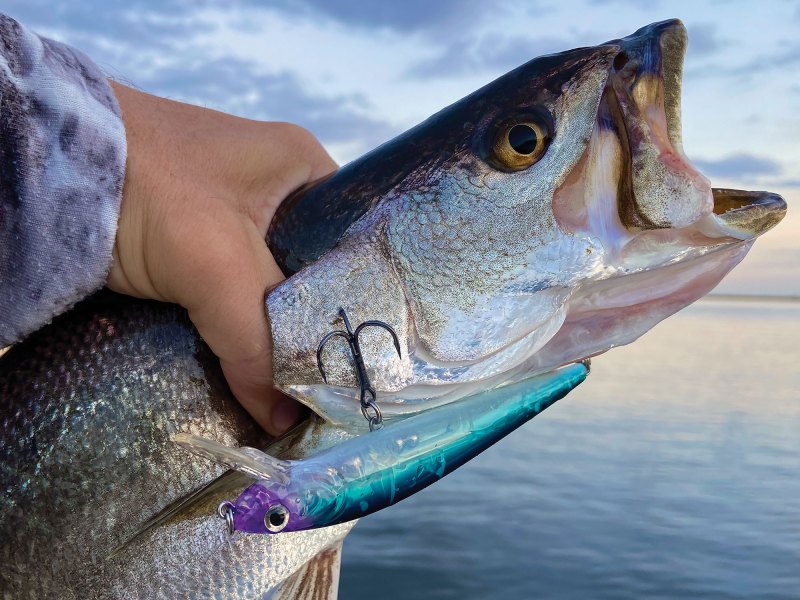
Early in the season, Bowles throws a MirrOlure MirrOlip or the aforementioned suspending Scope Stik. As the season moves along, however, and water temps get colder, he switches to a Rapala Shadow Rap Deep.
“It has a bigger lip on it, so it dives and stays down a little deeper,” Bowles said. “I think the fish move off the rocks a little bit and get on that first shelf whenever the temps drop.”
He also tends to extend his pauses when water temps are low, which for the MRGO means upper 40s or low 50s. Either way, those pauses are the key to success, Bowles said.
“I find in warmer temperatures, you can work it a little bit faster,” he said. “You don’t have to pause it as long, but day in, day out, they’re always gonna hit it on the pause. It’s very rare to catch one while you’re twitching the bait.
“When it’s colder, a longer pause normally is better.”
Patience, Grasshopper
By now, most southeast Louisiana anglers have heard about the outstanding action for big trout along the MRGO rocks, but many have tried it, failed and given up. Even for veterans like Bowles, endurance is essential.
“You’ve got to have patience,” Bowles said. “If it’s something new to you, you may come, drift the shoreline for an hour, not get a bite, and think, ‘OK, this doesn’t work.’
“I’ll normally give a stretch, you know, 15 to 30 minutes, and if I have people in the boat with me, I’ll have somebody with a deeper bait, somebody with a trusted bait, one person with a bright color, one with a natural-looking color, and just try to figure out what the fish want.
“If I were coming by myself, I’d probably rig two or three rods with different depth-range baits and different colors.
“I haven’t found a rhyme or reason why sometimes they want a real bright, loud color versus a natural bait — say, a green back that looks like a shad. But I just try everything while I’m out here.”
Read Next: Spring Speckled Trout and Flounder Fishing in the Bayou
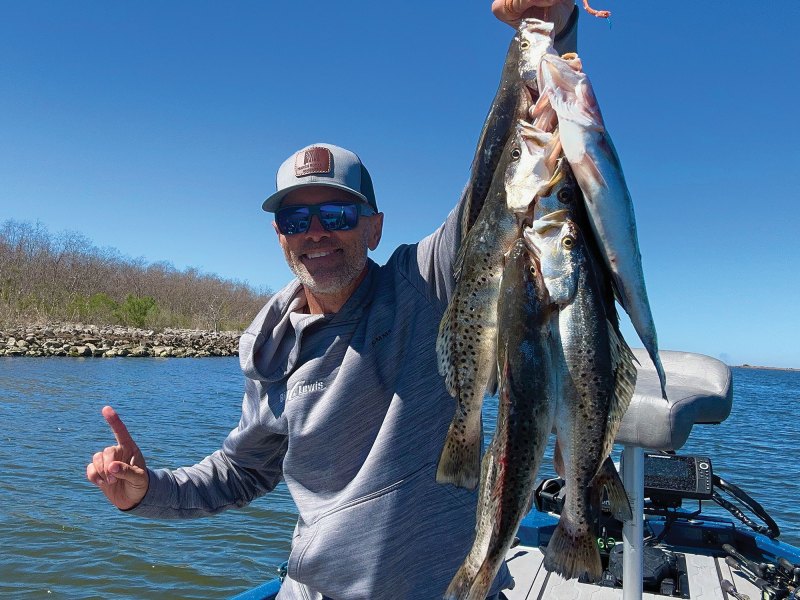
As with any new challenge, the right attitude is critical, Bowles said.
“You’ve really got to come with the mindset that you’re not going to look for a limit of fish,” he said. “You just want to catch some bigger fish. And when you do that, a lot of days, we end up limiting out doing it. But I’d never go with that intention.”
Every year, fishing this technique, Bowles catches and releases several 4- and 5-pound speckled trout, and usually a 6-pounder or two. Last winter, fellow charter captain Mike Gallo caught and released an 8-pounder while throwing a jerkbait — a Berkley Stunna 112 — along the rocks.
In the heart of winter, there aren’t many other places you could go in the Bayou State and have any hope of doing that. Fish like that will make you squeal like a little girl — no matter how jaded you are.
Accessing the MRGO
The Mississippi River-Gulf Outlet is most easily reached from launches along Paris Road in New Orleans. These include:
- Eddie Pinto’s, 2651 Paris Road, New Orleans, Louisiana
- Bait Inc., 2001 Paris Road, New Orleans, Louisiana
- The Wharf on Bienvenue, 6301 Paris Road, Chalmette, Louisiana
The route to get there from the Paris Road launches includes passage through a flood-control structure at Bayou Bienvenue that is sometimes closed during high-water periods. To check its status, call 504-286-3140.
Other access points include:
- Campo’s Marina, 1301 Yscloskey Hwy, St. Bernard, Louisiana
- Chef Harbor Marina, 21135 Chef Menteur Hwy, New Orleans, Louisiana
- South Shore Marina, 20510 Chef Menteur Hwy, New Orleans, Louisiana