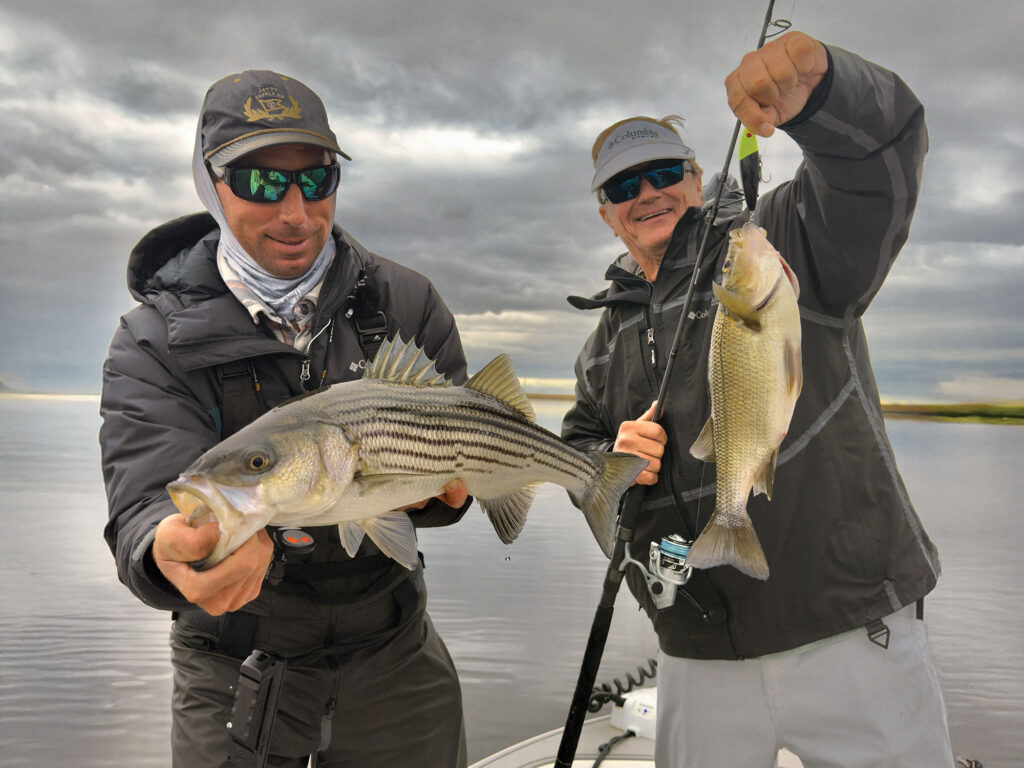
It was crisp and drizzly as Capt. Brian Williams wheeled our skiff across the shallow back bays near Atlantic City, New Jersey. He eventually shut the outboard some 100 feet shy of a marsh point and eased us into casting range with the trolling motor. Fortunately, the ensuing striped bass action alleviated most of the chill on that November morning, though this South Florida boy is still thawing out.
We’d release a few striped bass at one spot and repeat the scenario at the next. It was “stick-and-move” striped bass fishing at its finest on topwater Rapalas and soft plastics. I even caught a huge white perch on a Skitter Walk! Locating fish within the vastness of these marshes is often a tall order, yet pros like Williams (ocnjfishing.com) know exactly where they’ll be on all tidal stages.
Stripers to the North
For New Jersey’s back bay stripers, Williams focuses on points, feeder creeks and deep pockets. “The absolute best way to find prime spots amid the marshes is to go exploring on a low tide with the sun high above, where the entire environment can be studied,” Williams revealed. “Look for small veins jutting from them, which striped bass traverse in pursuit of baitfish which, ironically, are doing the same exact thing to avoid predation.”
The feeder creek mouths we fished averaged 2- to 4-feet wide, with plenty of water on high tide for bait and stripers to access the marshes. As the tide falls and creeks shallow up, their mouths are where stripers gather to prey on exiting baitfish. Williams favors creek exits with adequate water flow, often revealed by slight ripples and nervous water when wind opposes tide. However, it gets a little deeper (pun intended) than that. He also seeks deep bottom pockets, common around channel bends.
From an average channel depth of 15 feet or so, these depressions drop to between 30 and 60 feet. “During low tides, the lack of adequate water in the marshes and feeder creeks forces bait into main channels and often around deep pockets, bridges included,” Williams explained. “Look for baitfish activity at the surface and on the sonar around such depressions and structures. This is where stripers will concentrate.”
During low tide, Williams kept on the move, stopping by such outlets and deep pockets around channel bends; some bends were void of life on the sonar while others revealed the stripers stacking tightly. On encountering the latter, Williams hovered in place with the trolling motor while we scored using soft plastics. Once we wore out a showing of fish, or they became wise to us, we’d move to the next location.
During high water, we focused primarily on the down-current sides of marsh points where stripers gather to avoid peak water flow, conserve energy and, naturally, ambush bait. this included our topwater plugs!
Casting deep into the feeder creeks is also a worthy endeavor, as is continuously scanning both the surface and sonar for bait. Find the bait, and stripers will be close by. At one point, Brian and I ventured way up into brackish water and uncovered schools of juvenile bunker; such a find often translates into a striped bass bonanza.
Read Next: Chasing Striped Bass Through New Jersey Marshes
Redfish to the South
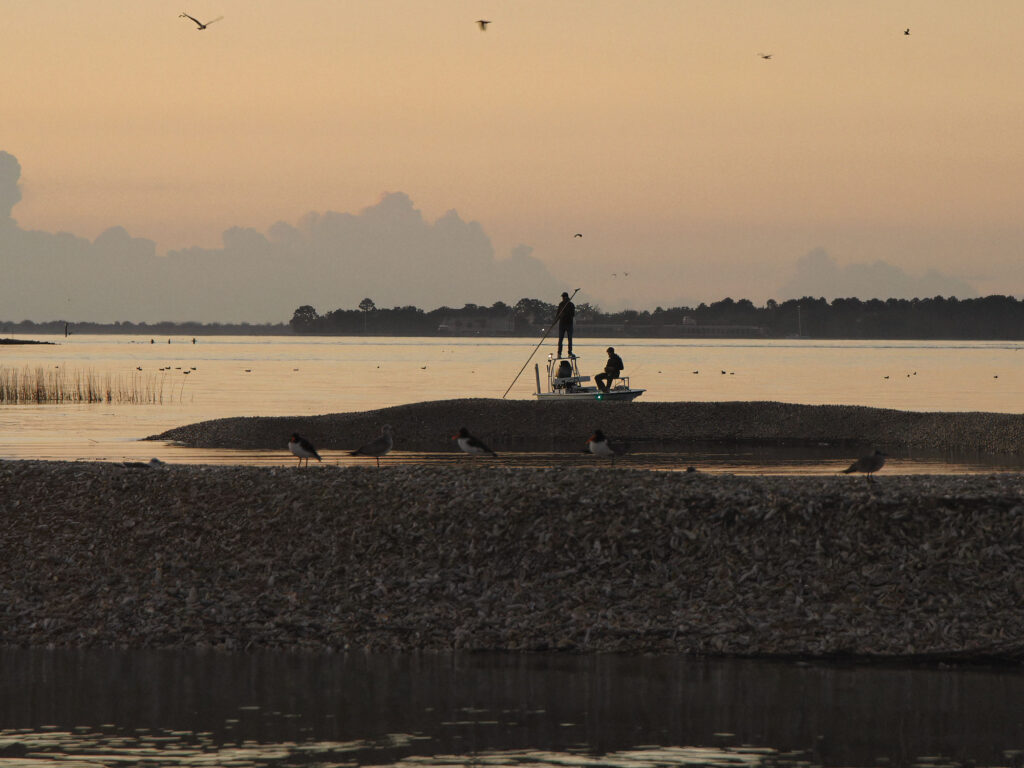
Just recently, I spent a day targeting Charleston Harbor redfish with Capt. Tanya Dowdy (reelchicacharters.com), which gave me an opportunity to compare her marsh tactics with striper fishing in New Jersey. Launching from Charleston Harbor Resort and Marina, Dowdy steered us to nearby marshes. She explained that we’d have our best opportunity around 1 p.m. that day, which coincided with the final stages of an outgoing tide. We were around a full moon, which delivers tidal fluctuations with higher highs and lower lows.
Mirroring my New Jersey outing, Dowdy explained the marsh scenario. “High tides enable redfish to push way back into the marshes for two main reasons,” she said. “They forage throughout the marshes, with fiddler crabs a primary food source, but they also go into skinny water to avoid dolphins, a main predator of theirs, especially during winter.”
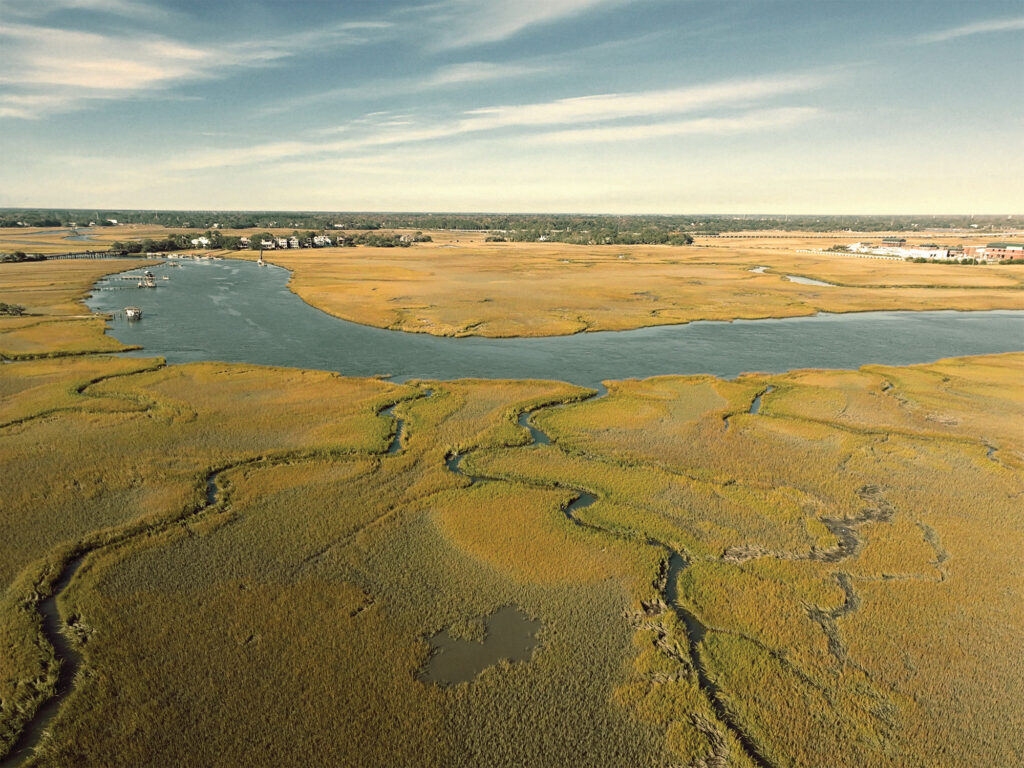
Lowcountry marshes are typical of those along the Southeast and Gulf, where redfish are sought. Oyster beds adjacent to feeder creeks and just off main channels are prime feeding spots for both redfish and trout. “Look for and study feeder creek environments during low water,” Dowdy said. “Oyster beds will be exposed. Find these shell beds by feeder creek mouths accented by slight bottom dips or ruts and you’ve found prime spots.”
As Dowdy predicted, our morning high tide was a bit slow, save for a few trout blowups on topwater plugs. We were filming one of my TV episodes, so we launched a drone over the marshes. Sure enough, these feeder creeks, brimming with water, extended far back into the marsh. However, as we approached the bottom of the tide, the feeders were nearly dry.
The lack of adequate water drove bait and redfish into the main channel.
Anchored with Power-Poles by a feeder creek, we enjoyed explosive redfish action. It kicked off with me catching one on topwater and her following up seconds later with an even larger fish on a soft plastic. The tide-driven bite with big redfish was nothing short of sensational and marked a dramatic change to the slow morning high tide.
As the low tide ebbed and water began moving in, the bite cooled off. Yet, we were so excited that we called it an early day and headed back to the marina.