The phrase “game-changer” is one of the most overused marketing terms in the boating industry. But it is the best way to describe Seakeeper’s Ride system. The first time I saw this self-described vessel attitude control system (VACS) was as a judge at the IBEX Innovation Awards in 2022. Ride easily won its category. The system uses curved actuators that make 100 small corrections per second to keep the boat running level. It reduces the up and down oscillation of the bow and roll by up to 70 percent while underway.
Since its introduction for model year 2023 boats, its acceptance within the boat-building community has been astounding. It is now a standard feature on 352 new boat models from 66 boat builders. Why? Of the dozen or so boats I’ve tested with Ride, the simple answer is that it has made every one of them ride more comfortably. When I found out it was also available for retrofitting to older boats, I knew I wanted it on my 2006 Pro-Line 32 Express.
DIY or Professional?
During the process, I learned that sometimes the installation is straightforward, though there are 146 steps, not counting the commissioning. Not surprisingly to me, my boat fell into the sometimes-it’s-more-complicated category. While it’s true that a mechanically skilled owner and helper can install a Ride system, this project was far above my pay grade. Thanks to the BILT app, Seakeeper offers first-rate instructions for those willing to give it a shot. The app guides the user through each step with voice coaching and 3D CAD illustrations that can be viewed from any angle.
During the initial installation session, it was determined that the Ride 600 system, designed for boats 31 to 35 feet long, didn’t quite fit on my boat’s transom. The problem was my boat’s extended engine bracket. It was in the way and needed to be cut and re-glassed to provide the necessary clearance, which was not a do-it-yourself job. After shopping around, I found Stellar Marine Services, an authorized Seakeeper dealer in Northeast Florida—an important consideration when installing these systems. They also build Front Runner center console boats, which gave me confidence they could do the fiberglass work properly.
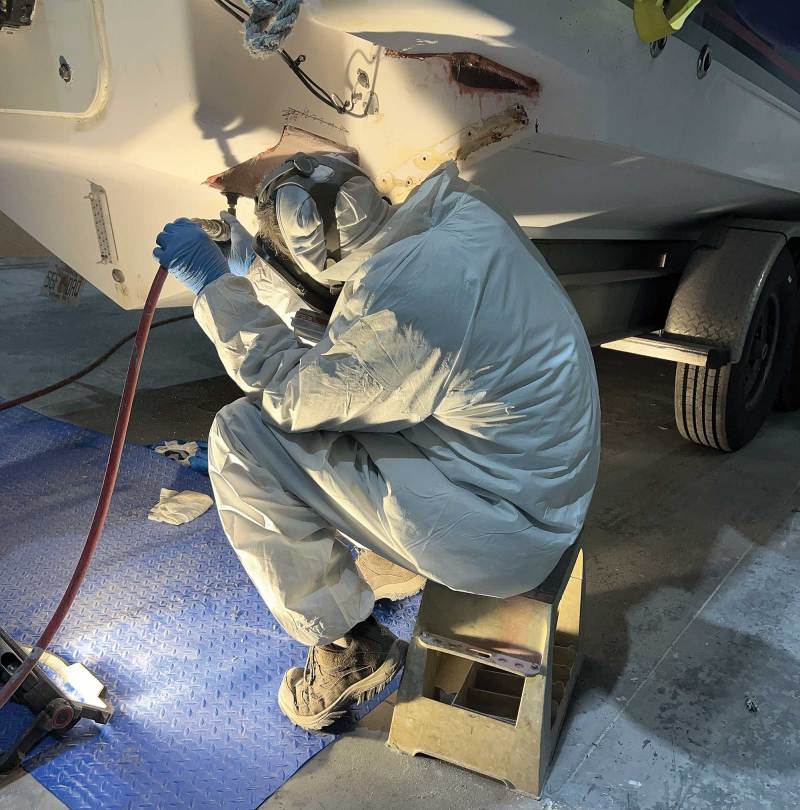
Still, the idea of seeing someone cutting into my baby with a Sawzall was traumatic. First, the Pro-Line’s hull is a tank. The affected sections were at least a couple of inches thick, and anything on the transom, especially the fiberglass engine bracket, is a critical, load-bearing part of the structure. Roughly, four 8-inch by 6-inch cuts would be needed to provide clearance.
De-Installing Old Tabs
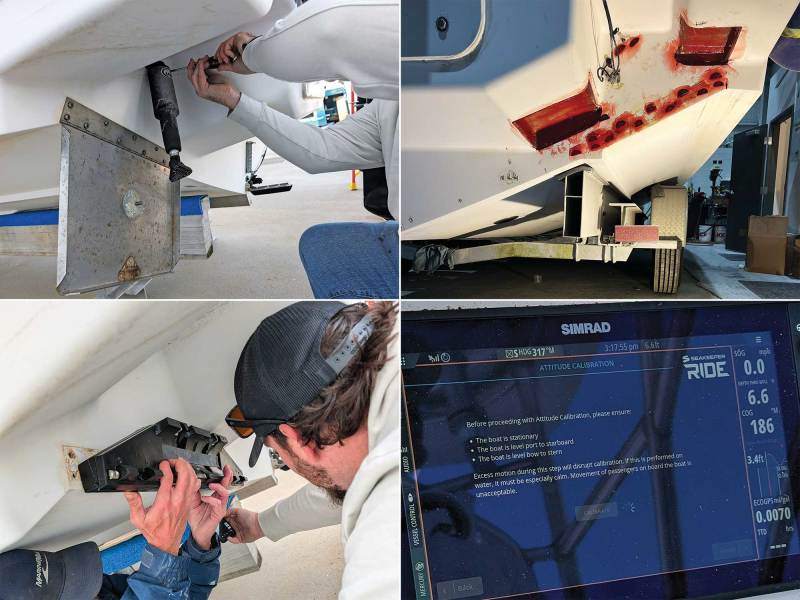
The installation began by removing the Lenco trim tabs, which had served me well. While Lenco makes an automatic Pro Control tab system, the ones on my boat were manually operated and required driver input to work. I am one of those obsessive types who can’t stand to see the boat list even a tiny bit, so during a run, my hand is constantly working the tab controllers, especially in rough conditions. To further complicate things, the Pro-Line 32 has recessed trim tab pockets. For some models, Seakeeper has a 3D-printed plug to fill the void, but not for mine. Because it’s more of a cosmetic issue, we left the pockets as is.
The only issue was water started dripping in when the initial cuts were made. It may have come from a storm a few days before, but because the Pro-Line’s hull is built without wood, it wasn’t a serious issue. We did have to let it dry for a couple of days. Hurry up… and wait.
Fit and Grind
After new fiberglass surfaces were fabricated to cover the voids, the holes left by the trim tabs were filled and the area where the actuators are mounted was sanded down to the fiberglass to ensure a perfect surface for the methyl methacrylate adhesives (MMAs) to bond them to the hull. Sometimes, the holes for the actuator’s wiring can be positioned directly behind the unit, but because of the stringer placement, the hole through the hull had to be made higher up.
A distribution module was installed high in the bilge, providing a connection point for the wiring to the software module, the system’s brain. The module was mounted in an electrical box in the cabin, and its proper placement is critical because it contains the inertial motion sensors that detect the vessel’s pitch, roll, and yaw, dictating the system’s ability to correct the boat’s attitude. It must be securely mounted on a rigid, level surface to accurately interpret motion data and to avoid false readings caused by vibrations.
Read Next: Is Seakeeper’s Ride System Really Better Than Trim Tabs?
Ride Sea Trial
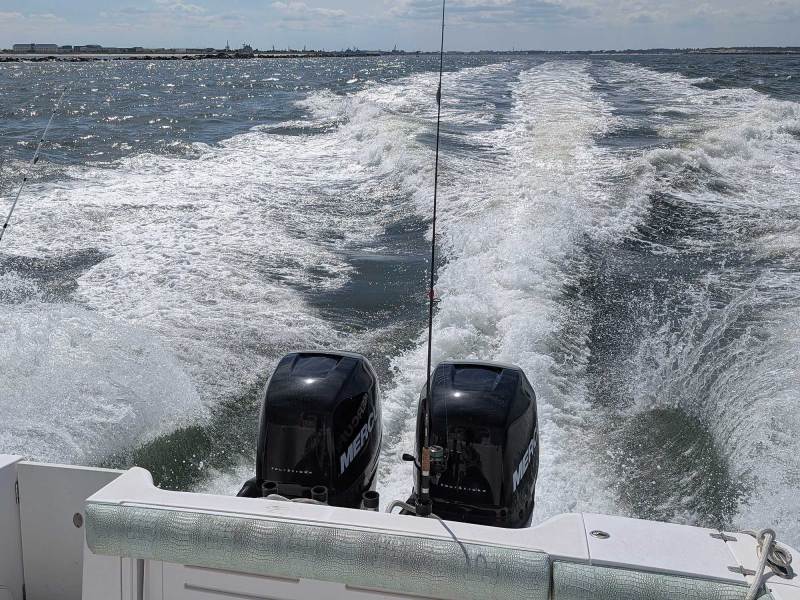
After the calibration process to establish readings with the boat level and confirm the actuators were working correctly, it was time to hit the water. The first sensation I got was that I was driving a larger boat because there was virtually no side-to-side roll; the deck felt like it was still on a trailer. My 30-something was now a 40-footer. First, the holeshot had virtually zero bowrise as it got on plane in 4.5 seconds.
Because it’s capable of making 100 corrections a second, it adjusts any potential list before those on board perceive it. It also eliminated a nasty porpoising issue my boat had. Taking it out of the inlet in 3- to 4-foot seas in Jacksonville, where I live, my boat’s ride was as smooth as possible because it remained balanced on its keel. The 32 Express has 22 degrees of deadrise, with a sharper angle at the bow, making it a moderately deep-V design. There was minimal up and down oscillation of the bow, which kept the sharper entry taking the vanguard in slicing through the waves. Best of all, I could keep my hands on the throttles to make corrections when needed. Before, I would invariably be fiddling with the tabs when the odd 6-footer would catch me off guard.
Rough Water Efficiency
At a cruise speed of about 30 mph in calm water, the negligible negative effect on fuel economy was about 5 hundredths of a mpg. In rougher conditions, fuel economy is slightly improved because it’s running at an ideal attitude. Top speed was 0.2 mph slower (48.6 versus 48.8 mph). The tradeoff was a much smoother ride and more precise directional control. The retail price of the Seakeeper 600 system is $10,900. Because of the extensive fiberglass work required for this install, the cost was $7,000, which I thought was high when they quoted me. But after seeing the work required to complete the install, it was a fair price. Was it worth the cost and the stress of watching my hull being filleted like a flounder? To quote Marge in the movie, Fargo, “You betcha!”