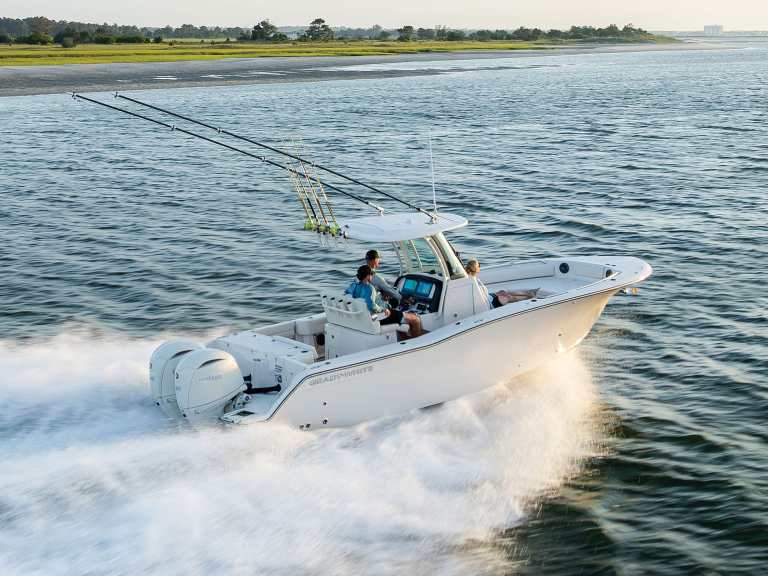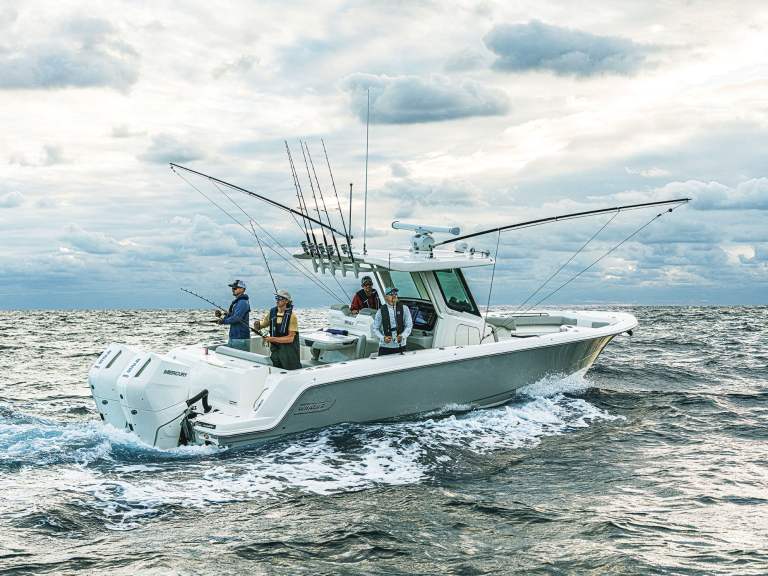
For the better part of a century, the boat lift has been one of the most utilitarian objects on the American waterfront. It did one thing: held the boat out of the water. Exposed motors, visible gearboxes, tangled cables, and towering pilings were just part of the deal. Nobody expected more from a boat lift than they expected from a garage jack.
Ken Hey, founder and CEO of Sunstream Boat Lifts, has spent the last three decades arguing that boat owners should expect a lot more.
“As an avid boater and engineer, I ask myself what would it take to use my boat like my car,” Hey said. “If there is a nice sunset, what would it take to watch it in my boat on the water vs my deck.”
That question has driven every product Sunstream has launched since Hey built the world’s first freestanding hydraulic boat lift in his garage in 1996. But answering it has required rethinking what a boat lift is supposed to be in the first place.
Speed Changes Behavior
The old school lifts operated at a pace that discouraged spontaneity. Several minutes to raise or lower means you don’t take the boat out for a quick sunset run. You plan around the lift instead of the other way around.
Sunstream’s approach with its freestanding hydraulic SunLift, then with the freefloating hydraulic FloatLift, and now with its piling lift products, has been to compress that timeline to seconds. The LiftBar, winner of the 2025 Miami International Boat Show Innovation Award, lifts and launches at speeds up to 10 feet per minute. That puts your boat in the water in roughly 30 seconds, not several minutes. The Helix2-P, its hydraulic piling lift counterpart, delivers the same category of speed.
When the mechanical barrier between you and the water drops from minutes to seconds, Hey says, you’ll naturally change your boating behavior. That happened when Sunstream introduced the SwiftShield Automatic Boat Cover System, which replaces 74 snaps and 20 minutes of wrestling with a phone-activated hydraulic cover that deploys to the waterline. Users report boating three times more often after installing a SwiftShield. Speed and convenience make boaters more likely to engage in the hobby more often.
Rising Stakes, Rising Expectations
The economics of waterfront life have shifted dramatically. Boat prices and waterfront home values have surged over the past two decades, and the expectations that come with those investments have risen in lockstep. When you’re sitting on a seven-figure property with a six-figure boat, a rusting cable lift with exposed gearboxes and four tall pilings blocking the view is an eyesore and doesn’t do justice to the rest of your equipment.
Today’s boat prices also mean owners need to protect their vessels better than ever to preserve resale value. A boat lift, as Hey notes, typically represents less than 10 percent of the vessel’s value, which is often less than the depreciation saved when a well-maintained boat goes to market looking newer than its age.
Sunstream’s piling lift products were designed with that reality in mind. The Helix2-P hides cables, motors, and gearboxes entirely from view. Pilings sit low, and there are no side beams in your view. The cradle locks in the up position to prevent wind sway, reducing cable fatigue and noise while extending cable life.
Since the boat does not need to be in the middle of the cradle, the LiftBar and Helix2-P can be installed with as little as a four-inch gap between dock and hull, meaning safer, easier boarding. As the average age of recreational boaters continues to climb, that’s a bigger necessity than ever.
“A boat lift is more than a storage solution for your vessel,” Hey said. “It is a way to protect your investment while showcasing the beauty of your boat.”
Many HOAs in high-end waterfront communities have already recognized the aesthetic benefit and begun requiring hidden-structure lifts. Hey sees the same market transformation that happened a generation ago when freestanding hydraulic lifts replaced hand-crank cable lifts. Even though the old ones still worked, homeowners replaced them because they no longer fit the waterfront.
An App That Knows When to Stop
Sunstream’s smartphone app ties the entire product line together through Bluetooth 5 connectivity. It displays real-time voltage, charging status, battery health, performance data, and diagnostic codes. It records the operating voltage of every cycle and counts total cycles to build a running performance history. Owners can email diagnostic data directly to their dealer for remote troubleshooting, often resolving issues without a service call.
“I love taking my boat cover off with my phone while walking to my boat,” Hey said. The app also monitors diagnostics to proactively flag pending issues, which can save a day on the water before a problem ever surfaces.
But what the app deliberately does not do may be just as important as what it does.
“Even though it’s tempting to add more tech features like wifi networking, boat monitoring and sensors, we decided to prioritize keeping the app simple and totally reliable to prevent frustration that tech can bring,” Hey said.
It’s a philosophy of deliberate restraint in an industry where feature creep is the norm. Hey’s bet is that an app that does what boat owners actually need (flawlessly, every time) is worth more than one that tries to do everything and delivers inconsistently.
The Dock of the Future
Traditionally, dock design and boat lifts have been two distinct industries. The dock gets built first. The lift gets bolted on after. The result is a waterfront that looks and functions like what it is: two systems from two companies that were never designed to work together.
Sunstream is promoting a different concept, what Hey calls “the dock of the future.” The lift is designed into the dock from the beginning, hidden within the structure for a modern, clean look.
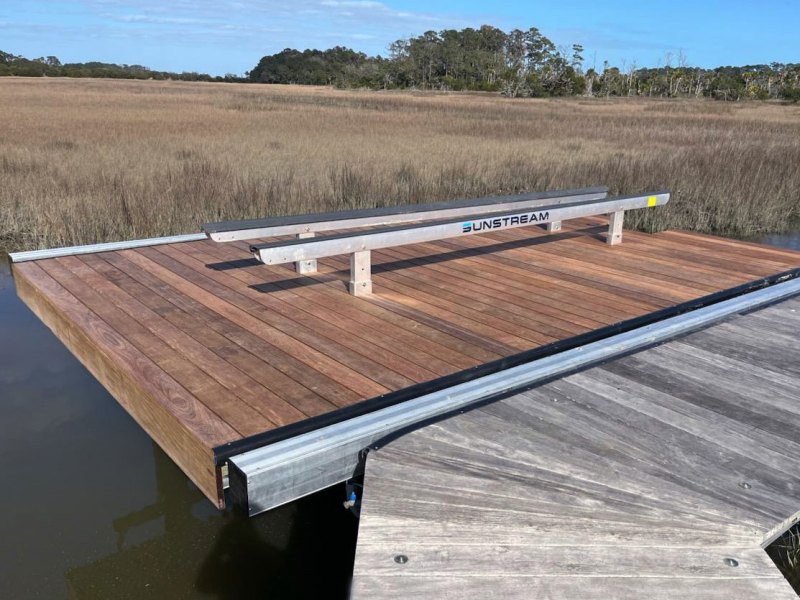
The LiftBar makes that vision possible. Its entire screw jack-based lifting mechanism fits inside a 6-by-7-inch aluminum tube with contained hoses, no external powerpack, and no components cluttering the dock surface. It bolts onto pilings, integrates into fixed docks, or builds directly into fabricated floating docks, whether they’re concrete, wood, or truss. The bar can also be mounted above the dock surface to serve as a bench. A walkable lid with traction stripes or an optional solar panel sits flush at dock level.
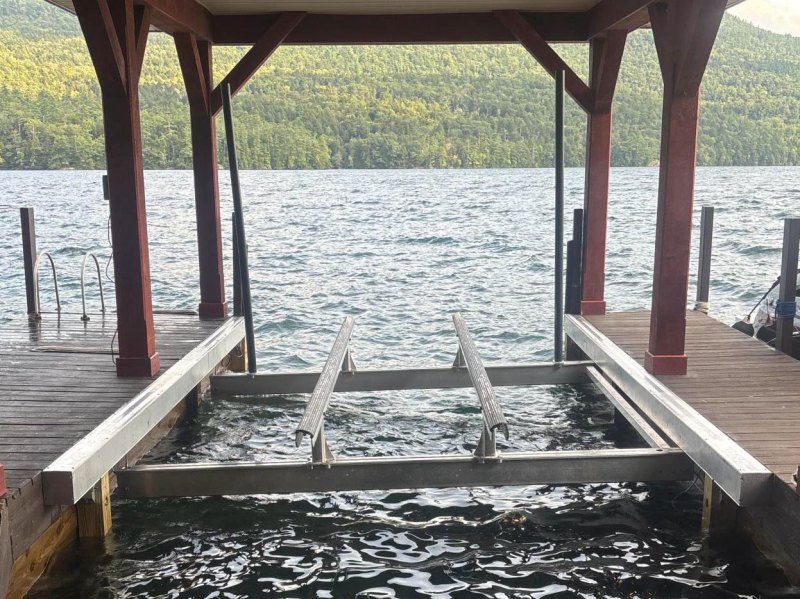
Because LiftBar is fully self-contained and submersible, it eliminates the storm vulnerability that plagues conventional piling lifts in coastal markets. The regenerative braking feature, which is another industry first, charges the battery during lowering, keeping the batteries small enough to fit inside the bar itself.
Installation is equally streamlined. Each bar arrives pre-assembled, light enough for two people to carry and bolt into place by hand. There’s no crane, no electrician, and no 220-volt service required. All of this makes for an unprecedented 2 hour installation.
“LiftBar will not only change the customer’s experience but will change the way docks and marinas will be conceptualized well into the future,” Hey said.
Marina operators are already taking notice. Less than one percent of marinas currently offer in-slip lifts, yet studies show boaters will pay 50 to 100 percent more for a dry slip. LiftBar’s competitive pricing, easy installation, and ability to integrate directly into floating dock fingers make it a practical path for marina developers to create dry slips at scale and grow revenue in the process.
The LiftBar is well suited for marinas with reliability never seen in the industry, with no limit switches, spindles, or birdnesting cables.
If you’ve been tired of living with the noise, the clutter, and the sluggish pace of a conventional piling lift, you should know that the dock of the future is already here. Learn more at sunstreamboatlifts.com.