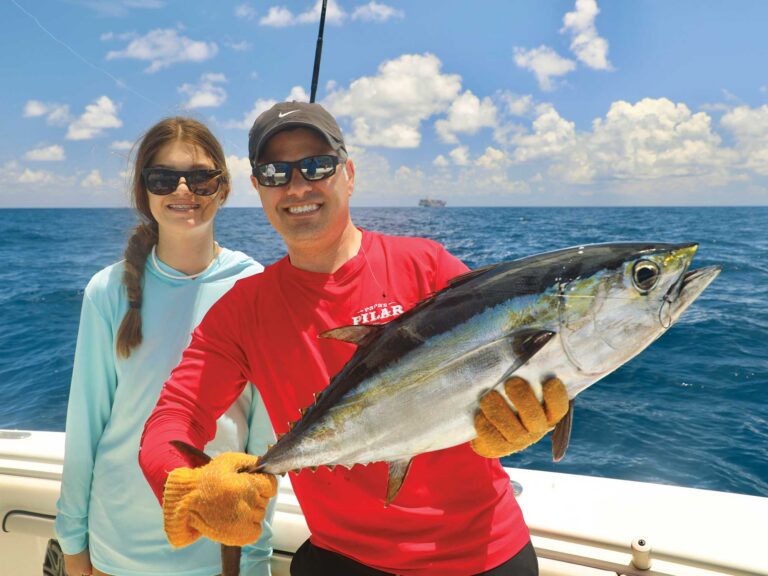
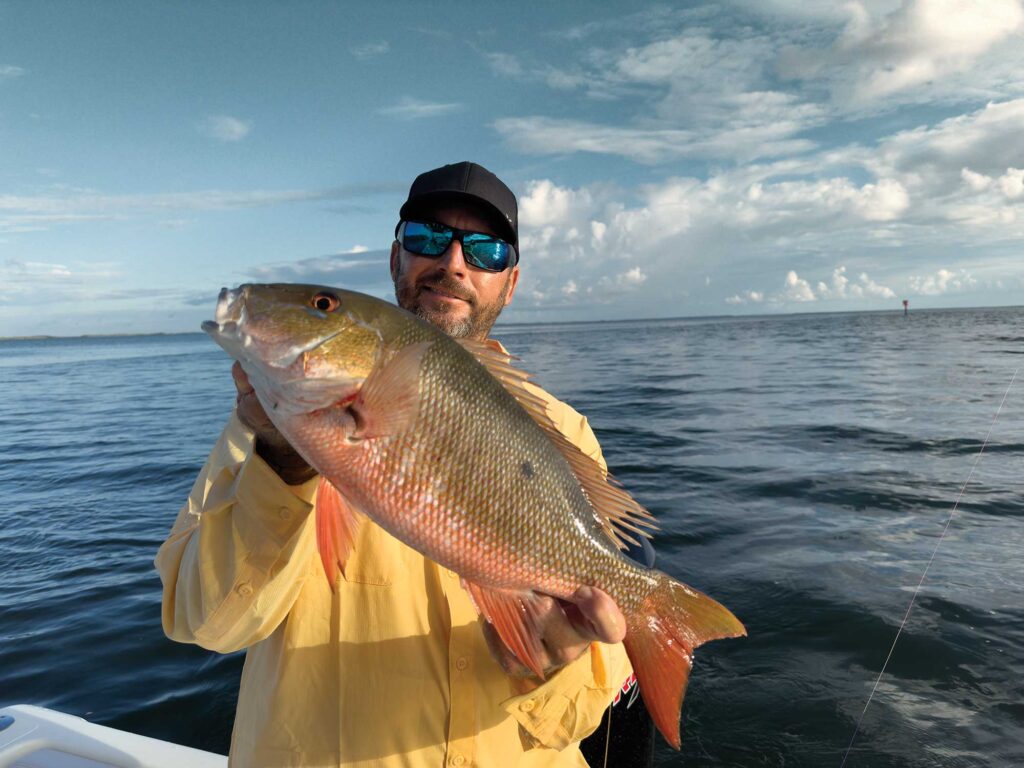
Spring triggers major gatherings of spawning-class mutton snapper around the offshore wrecks, reefs and structures of South Florida, the Florida Keys and the Bahamas, with April and May representing the peak of the run. However, spring is also the curtain call for a spectacular showing of shallow-water muttons, with fish upwards of 15 pounds caught along patch reefs in waters less than 25 feet, within creeks and even on the flats – and it’s a highly overlooked fishery.
No Food, No Fish
From October through June, impressive numbers of muttons frequent these shallow environments to gorge on baitfish like pilchards, ballyhoo and even mullet. The migration periods of baitfish and mutton coincide. That is, pilchards run heaviest during fall, winter and into spring. Florida Keys ballyhoo abound during fall through March. Mullet show in force beginning around fall, with ample stocks remaining into early summer. Selective feeding often occurs when there’s an abundance of a specific bait.
Once the waters of late spring and early summer begin warming, bait populations thin out. In turn, muttons cease coming into the shallows in any kind of numbers.
Patch Reefs
A leading Key Largo, Florida Keys, reef and backcountry guide, Chris Hanson (scales2tales.com) specializes in catching muttons in Hawk Channel. “This is a bait-driven fishery,“ says Hanson. “These muttons not only frequent Hawk Channel, but also our local creeks. Both environments require certain tactics to be successful.”
In Hawk Channel, Hanson focuses on reef patches between 10 and 25 feet deep. Rather than position his boat close enough to chum and bait these patches, he’ll anchor roughly 300 feet upcurrent of one. “Muttons aren’t on the hard structure itself but rather meandering along the grasses surrounding it,” Hanson explains.” We soak baits on the grasses and live chum over them, where the muttons are. I’ve caught them as heavy as 15 pounds in these shallows.”
Fluorocarbon leader no heavier than 20-pound test, a 2/0 live bait hook and a No. 7 split shot 12 to 18 inches above the leader is the setup. “I’ll often use a 1/16-ounce jig to hook a live pilchard just behind its pectoral fins,” Hanson says.
Baiting with pilchards 2 to 3 inches long is also key. That size really makes a difference on the patches; bigger is not necessarily better here. “We live chum to gather the muttons and whip them into a frenzy, and I’ll sometimes hang over a chum block,” Hanson explains.

Creek Muttons
As mentioned earlier, these muttons also seek forage within local creeks. I recently spent a day catching Key Largo creek muttons with Capt. Bruce Davis (trubluecharters.com), another top-tier guide. Our success dictated anchoring upcurrent of shelves, bottom depressions and rises, creek openings and pronounced shoreline bends. We hung over a frozen block of chum and broadcast chummed with live pilchards to get the party started. Hook baits were live pilchards paired to 1/16-ounce jigs.
Our tackle was the same as on the patches, small Penn spinners with 20-pound-test braid. These small creeks produced very well, as did Jewfish Creek proper, from which Davis pulled out an impressively large mutton. For creek fishing, the first of the incoming and last of the outgoing tides are most manageable.
On the Flats
Spring is prime for stalking a mutton snapper on the flats, similar to bonefish, permit and tarpon. My personal best flats mutton to date was caught in the Abacos, Bahamas, with legendary Green Turtle guide Ronnie Sawyer. As Sawyer poled along a mangrove flat at dead low tide, we saw a brownish-orange tail stirring up marl in 2 feet of water. Within range, and thinking it was a nurse shark, I pitched a plastic grub on 8-pound-test spinning tackle, primarily for casting practice. To our surprise, it was a mutton snapper, which, after one helluva fight and mucking up the flat, scaled 15 pounds!
Live Bait Alternative?
As a 13-year-old, going on family visits to Islamorada’s Cheeca Lodge, I would walk to the end of their dock and soak half a mullet for barracuda. Despite a heavy rod, a big spinner with 30-pound-test line, 80-pound-test wire leader, an egg sinker and an 8/0 long-shank hook – the ’cudas always seemed aggressively hungry. One morning, befuddled by a long and different kind of fight, I ultimately reasoned it was a shark. However, when a huge mutton came to the surface, I nearly freaked out! I rebaited with shaky hands, cast far out and caught two more muttons in short order. Later at the Yellow Bait Shop, the muttons weighed 13.5, 7 and 6 pounds apiece!
Since those early halcyon days as a teenager, and out Marquesas way, we began adding a fresh mullet chunk to our typical bottom fare of squid, ballyhoo and live pinfish, and have experienced remarkably good success catching muttons. Therefore, even with a well full of live pilchards, try soaking a mullet chunk by the patches and even in the creeks, especially when the mullet are running. You might be pleasantly surprised by the productiveness of an “off-brand” bait.
Miami’s Finger Channels
The finger channels of Miami’s Key Biscayne region offer excellent mutton opportunities from fall through spring. Capt. Abie Raymond (gohardfishing.com) fishes within these 10- to 12-foot-deep piscatorial highways, especially when it’s too rough to go offshore.
From September through November, Raymond focuses on the bay-side fingers nearly exclusively. “We get some big muttons in these fingers,” Raymond says. “The big ones aren’t as fat as the offshore muttons, but they’re every bit as long. The average size is around 19 inches, but you’ll get some in that 22- to 24-inch class.”
Live chumming and baiting with pilchards is key to success in the finger channels, Raymond explains. “I like an outgoing tide with a little wind,” he says. “The cloudy, outgoing water makes it difficult for muttons to detect terminal tackle.” Once anchored on the deep-side edge of the channel, Raymond uses a 30-pound-test fluorocarbon leader and a ¼-ounce jig head tipped with a live pilchard (through the lower jaw and out the upper). He follows that up by flat-lining a pilchard on a 5/0 in-line circle hook and live chumming to bring fish to the surface.
Read Next: How to Catch More Mangrove Snapper
Come April and May, Raymond adjusts where he anchors and changes up the bait selection. “Compared to early in the season, I’ll set up on the ocean side of these fingers, primarily along their mouths,” he reveals. “The fish seem more abundant here during this time. Again, I prefer dirtier outgoing water; sometimes it’s a struggle with clear incoming water.”
The other switch up is bait. “Live ballyhoo is best during this period,” Raymond says. “I’ll impale one onto a ½-ounce jig head by running the hook under the lower jaw and out its upper. I’ll also freeline a ballyhoo hooked the same way on a 5/0 circle hook.
Raymond also notes that the patch reefs are nearby too. “If it’s a slow pick in the finger channels, head to the patches,” he advises. “As long as there are baitfish around, the muttons should be waiting on you.”