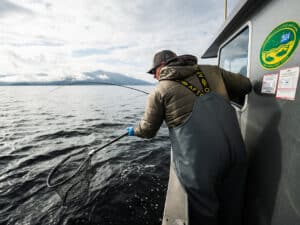
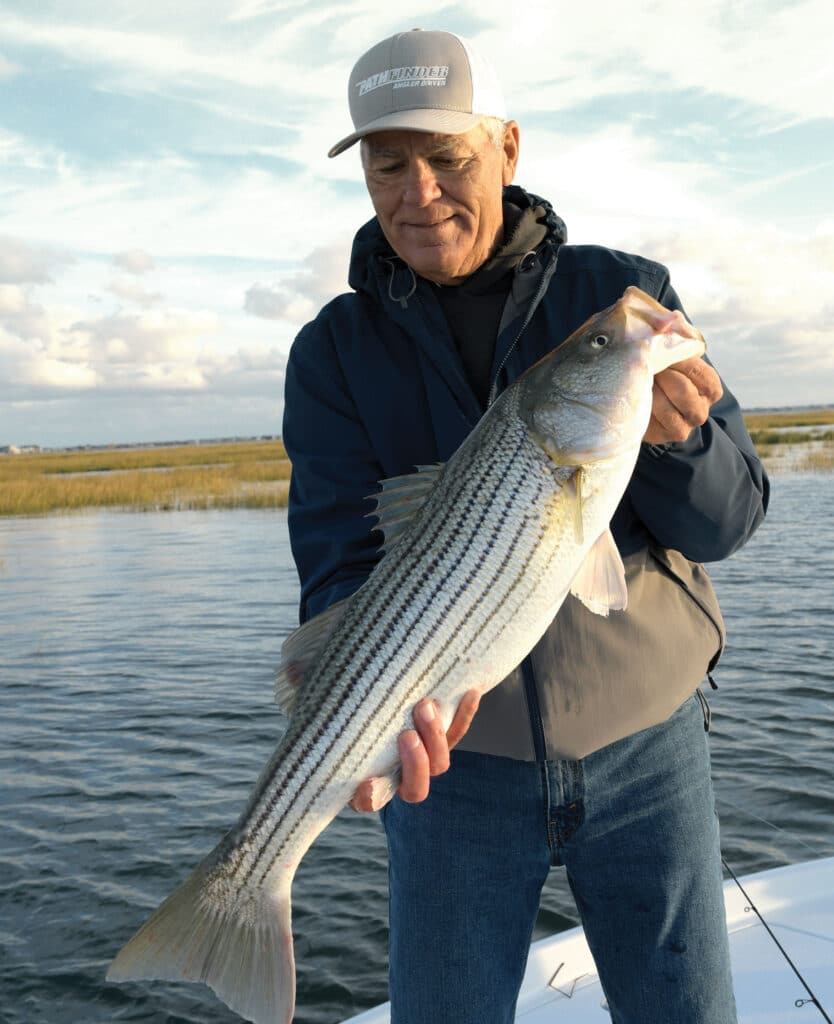
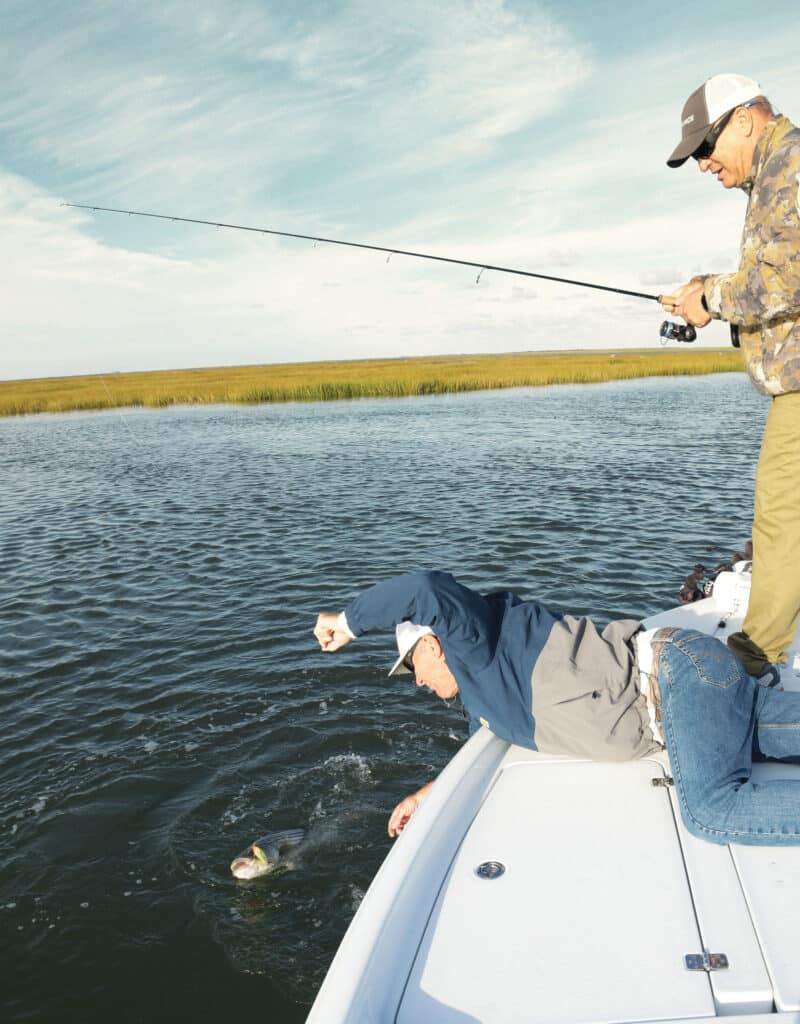
A well-placed cast near a grassy point in little more than a foot of water was rewarded with a huge swirl and a rod-bending strike. The predator took off straining the drag, leaving a prominent wake in skinny water. At the end of a spirited fight, the net slipped under a 32-inch striped bass. Pictures were snapped, fist bumps exchanged, and the fish was gently placed back in the water for a clean release. That would be one of many caught on the outgoing tide as the sun set slowly in idyllic surroundings.
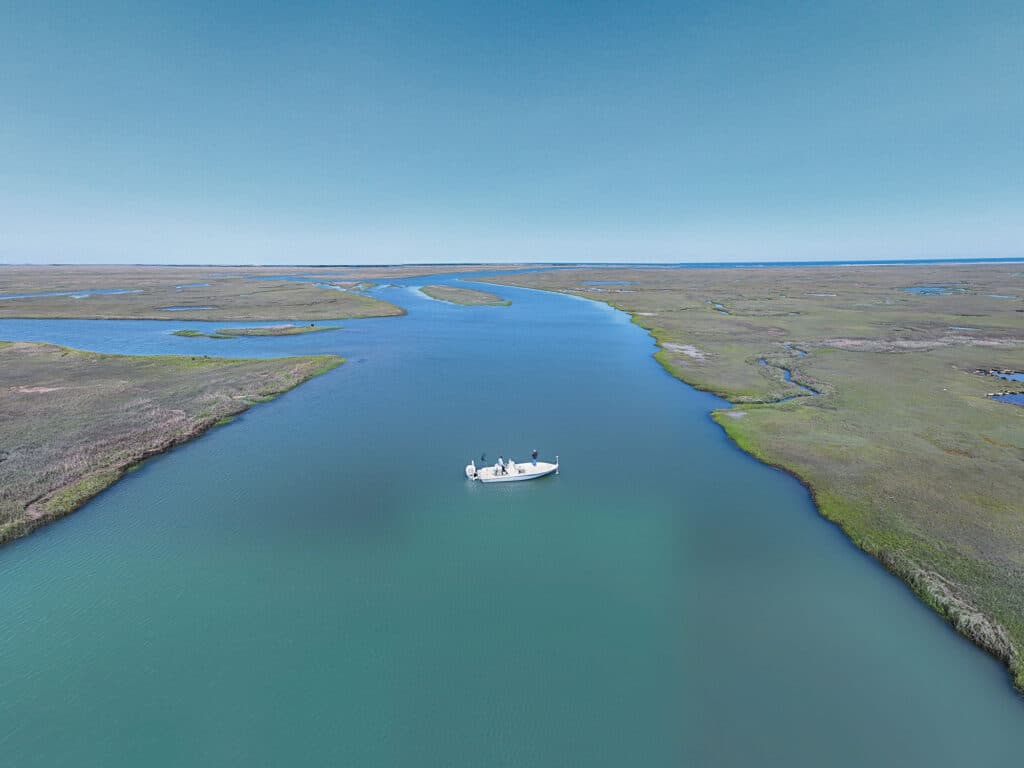
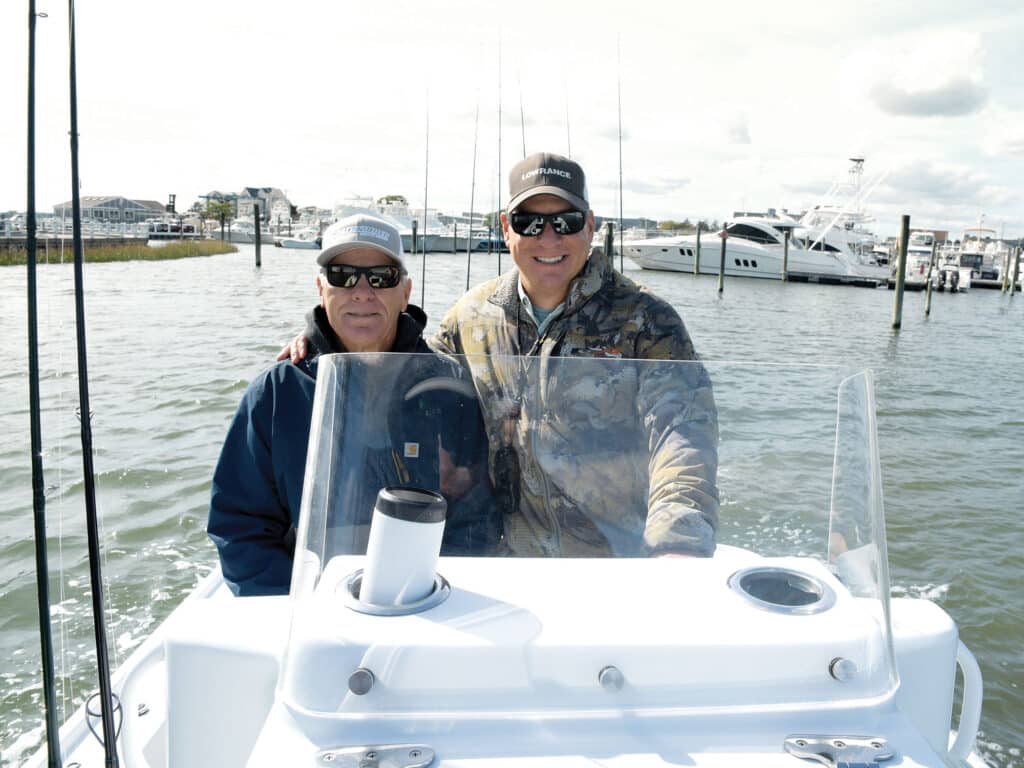
I was fishing with Tom Zambetoglou and Terry Sullivan aboard Zambetoglou’s bay boat in a seemingly endless estuary not far from Atlantic City, New Jersey. The vastness of the salt marsh could fool most southern anglers into thinking we were after redfish, but this is striper territory. Egrets, herons, ospreys and terns dotted the marsh grass and sky, and there was not another boat in sight. The scenery is beautiful beyond comprehension, an anomaly in the most densely populated state in the Union. New Jersey boasts tens of thousands of acres of tidal rivers, shallow bays and salt marshes between its extensive network of barrier islands and the mainland. With some knowledge and time spent exploring, the fishing can be spectacular.
Finding and catching skinny water stripers requires a unique skill set, which is why I spent the day with two specialists who know this fishery intimately. Sullivan has lived in Ocean County most of his life and grew up fishing the Manasquan River and Barnegat Bay. He was a highly regarded light-tackle guide for many years, known for his success with striped bass. More recently, he fishes for enjoyment, exploring tidal rivers and estuaries with an emphasis on catching stripers in very shallow water.
Zambetoglou is a native of south Jersey who keeps his boat in a marina in Somers Point. Like Sullivan, he has fished the back bays since childhood and knows them like the back of his hand. He is a senior account manager for Navico, with more than three decades in the marine electronics industry. Fishing skinny water is his favorite way to unwind.
Getting Skinny
When we started our discussion, Zambetoglou made one point perfectly clear. “For this fishing, you need a specialized boat, and I can’t emphasize the importance of draft enough,” he said. “To get into many of the places where we find the best fishing, a boat with no more than 15 inches of draft is optimal. I see traditional V-bottom boats that stray just a few yards outside the channel markers run aground all the time.”
Sullivan fishes a 2200 TRS Pathfinder powered by a Yamaha 250 VMax SHO outboard. The rig draws about 13 inches. He keeps it on a trailer to access tidal waters near and far. Zambetoglou runs a 24 Yellowfin Carbon Elite, a lightweight flats craft with a 350 Mercury Verado. It draws 14 inches fully loaded. Both boats have remote-control and GPS-enabled trolling motors and jackplates for navigating the skinny with stealth. Zambetoglou also has a pair of Power-Poles. We used these shallow-water anchors at creek mouths so we could cast to every nook and cranny without noise from the engine or trolling motor.
“One example of having the right boat is an area I fish where bass hunt over a shallow submerged grass bed located in the middle of a popular tidal river,” Sullivan chimed in. “Using the trolling motor with my jackplate up, I can slip into the spot where the water is 2 feet or less. When it’s on, I’ll hook up every other cast. This is usually going on while deeper-draft boats barely a hundred yards away are resigned to fishing the main river channel, so yeah, draft is important for skinny-water success.”
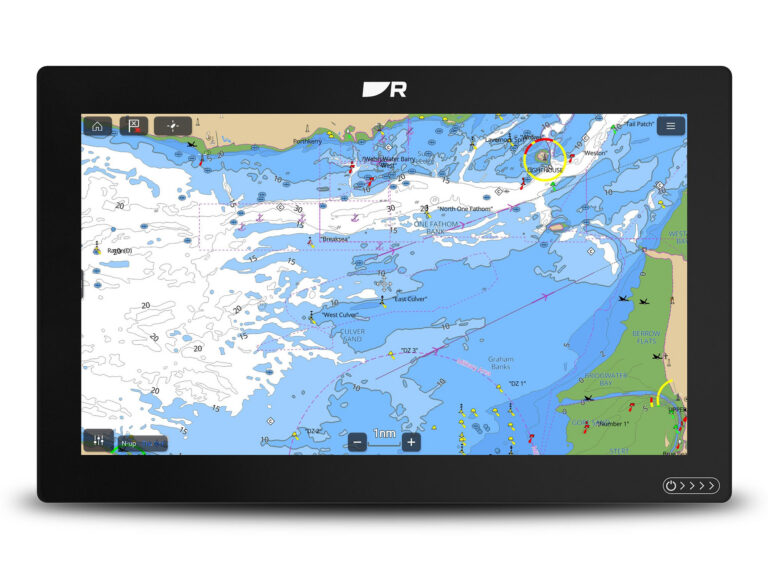
Both anglers rely on their trolling motors to stalk sod banks and marsh grass. Sullivan recently linked his Minn Kota trolling motor to his chart plotter. “I have a mile-and-a-half milk run along a sod bank that I preprogrammed into the plotter,” he explained. “Bass can be anywhere along the edge, and I can run the bank in either direction, depending on wind and tide, while casting the entire stretch without having to touch the remote. It is a neat feature that helps me catch more fish.”
Timing and Temps
When can be as important as where when hunting stripers in skinny water. Sullivan starts looking for bass in tidal-river and back-bay waters in the northern part of the state in early March. He seeks areas away from strong tidal influences, where the water warms more quickly. The magic temperature to turn bass on is 58 degrees F.
“Shallows with dark bottom can warm a couple of degrees with just a few hours of direct sun and offer forage like grass shrimp, worms and small baitfish,” he said. “Sometimes that small temperature difference will concentrate stripers. It is surprising how far back in some of the bays and rivers the bass will push. Heading into April, as water temperatures rise, more baitfish arrive. In some of the tidal rivers, large menhaden make an early appearance, which means I can throw big plugs like my favorite Musky Doc.”
For Zambetoglou, the best skinny water bass fishing in the state’s central and southern bays does not kick off until early May, and it runs through Thanksgiving. The one thing that slows it down in midsummer is when bay temperatures rise above 78 degrees. Then fish abandon the flats for cooler water in deeper holes and channels. In spring, some of the earliest shallow-water action takes place far from inlets, where the water warms more quickly.
“My preference is catching stripers in the skinniest water, but bass can be caught earlier and later in the season when the shallow sod banks and grass beds are not productive,” he said. “During the prime shallow-water season, bass will be wherever baitfish are most prevalent.”
Cover Water Completely
Our experts agree that tides influence fish movements and feeding patterns, and both study tide charts to plan the best times to be on the water. A week before we got together, Zambetoglou was looking ahead for the right tides for an afternoon of fishing. He gave us a three-day window, and the weather forecast made the final decision for us. We left the marina at 3 p.m., heading north past the bay side of Atlantic City to an extensive area of shallows, sod banks and grassy islands. The tide was just starting to run when we arrived at our first spot.
“One of the keys to a good bite is moving water,” he explained. “I fish on tides that have a minimum of a 2.6 feet or greater tidal fluctuation. Much less than that and the bite is poor, and many of the places I like to fish will not have enough water for even my boat to get to.”
Sullivan explained there are two high and two low tides each day, but the variance in tide height between the two can be significant. One tide might be 2.5 feet, and the other 4 feet on the same day. The higher of the two pushes water farther into marsh grass and shallow flats. Bass move into places they might not be able to reach on the weaker tide. A larger tide also means more forage is washed out, which influences feeding.
Zambetoglou and Sullivan both stressed covering potentially productive areas completely. “Place a cast at every pocket and point along a grass bed or sod bank. If you’re not getting bites, change lures frequently,” Zambetoglou advised. “If topwater isn’t working, throw soft plastics on a light jig head or a shallow swimmer. Don’t leave a good spot until you’ve covered all the bases.”
Read Next: World Record Striped Bass: The Biggest Stripers
Tools of the Trade
The tackle choices of our experts varied, likely because they fish different areas that require slightly different approaches. Zambetoglou prefers 7-foot rods with a light fast-action blank for topwater plugs and a medium-action for subsurface presentations. He uses 10-pound-test braid with 20-pound leaders on 3000-sized Daiwa spinning reels. “The light braid gets fewer wind knots and casts farther,” he said. “Light line is sufficient for fighting these fish since they rarely run up into the weeds.”
Sullivan prefers longer 7.5-foot fast-action rods with 20-pound braid on his 3000-sized reels and 30-pound on his Van Staal VR50 for throwing big topwater plugs. “The longer rods cast farther, and there are a lot of times when long casts catch more fish,” he said. A few times, he out-casted me and hooked fish on points that were out of reach of my slightly shorter rod. I’ve fished with him at times when he’s put on a clinic dropping long casts into tiny pockets with pinpoint accuracy. Casting accuracy makes a difference.
The lures our experts prefer are what you’d expect, with poppers, sliders, glidebaits and shallow swimmers making up the arsenal. Zambetoglou likes smaller plugs that match the size of the bait found in his area, and each angler has favorites. Sullivan often takes a different tact. When conditions are right, he throws larger plugs, including his favorite, the Musky Doc slider, in both the 9- and 12-inch models, largely to mimic menhaden.
He had one of the new 9-inch Berkley Nessie sliders that we all marveled over, but our day was spent throwing smaller walk-the-dog lures and a variety of small poppers and super-shallow swimmers. Zambetoglou uses a variety of Z-Man plastics, because they are bluefish proof, on ¼-ounce jig heads when the topwater bite does not materialize.
Keeping Track
Zambetoglou and Sullivan both stressed the importance of keeping a log that includes locations fished, weather, tide conditions, types of bait encountered and fish caught. The longer your log goes back in time, the more useful it is. Looking back to prior years with similar conditions helps narrow the search for fish.
Sullivan photographs each fish he catches with his iPhone with the date and time stamp and geolocation turned on. It’s an easy way to log data for future reference.
Our experts also discussed the importance of looking for signs of life in the back bays with some surprising suggestions. They keep an eye out for birds, and that means pretty much all types of birds. Circling or feeding terns can mean small baitfish are near. The presence of ospreys is indicative of larger bait like herring or menhaden. Herons and egrets concentrated along a sod bank or grass bed can indicate the presence of bait pushed tight to the living structure. Gulls, terns or cormorants resting after a heavy feed, something Sullivan calls, “the scene of the crime,” offers additional information.
Zambetoglou put the capper on our discussion when he said, “Look for bait, signs of life, running water and go catch stripers.” Sage advice indeed.