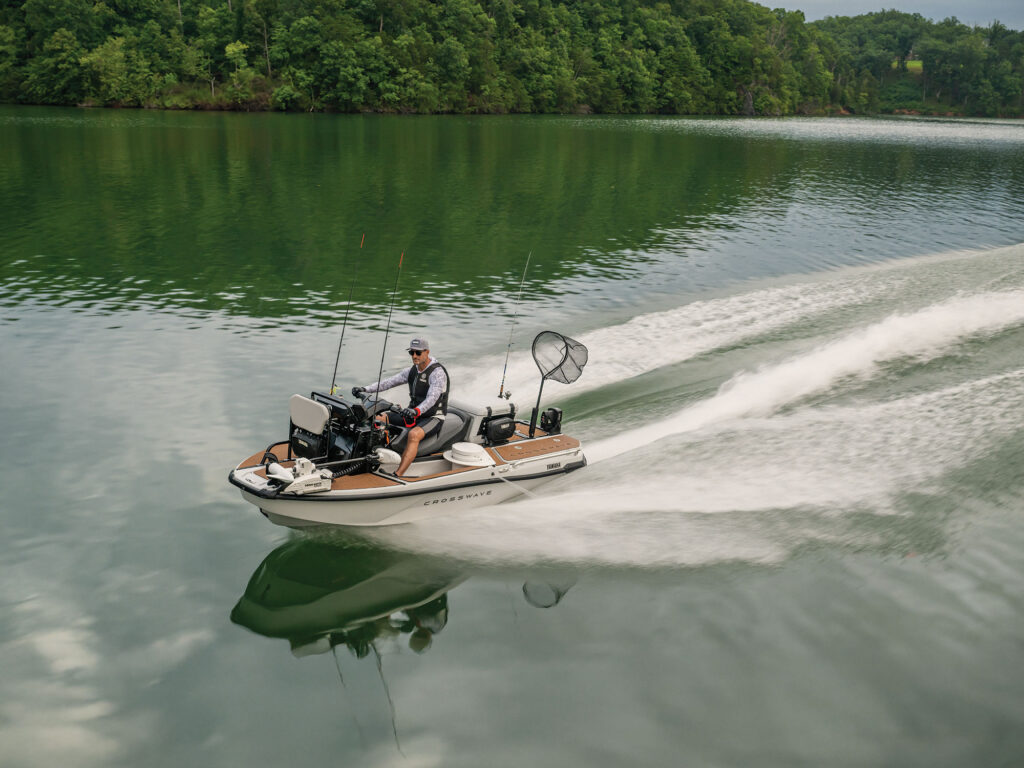
Most anglers hate to see personal watercraft coming their way, but a growing number of fishermen are looking to certain PWCs as personal fishing vessels. Yet, until today, no company had designed a fishing boat around a PWC propulsion system and platform—not like Yamaha’s WaveRunner division did with the new CrossWave. There is nothing like it on the water, and after testing it, I think it will become a favorite among anglers who might otherwise have chosen a kayak or a personal flats boat such as a Solo Skiff.
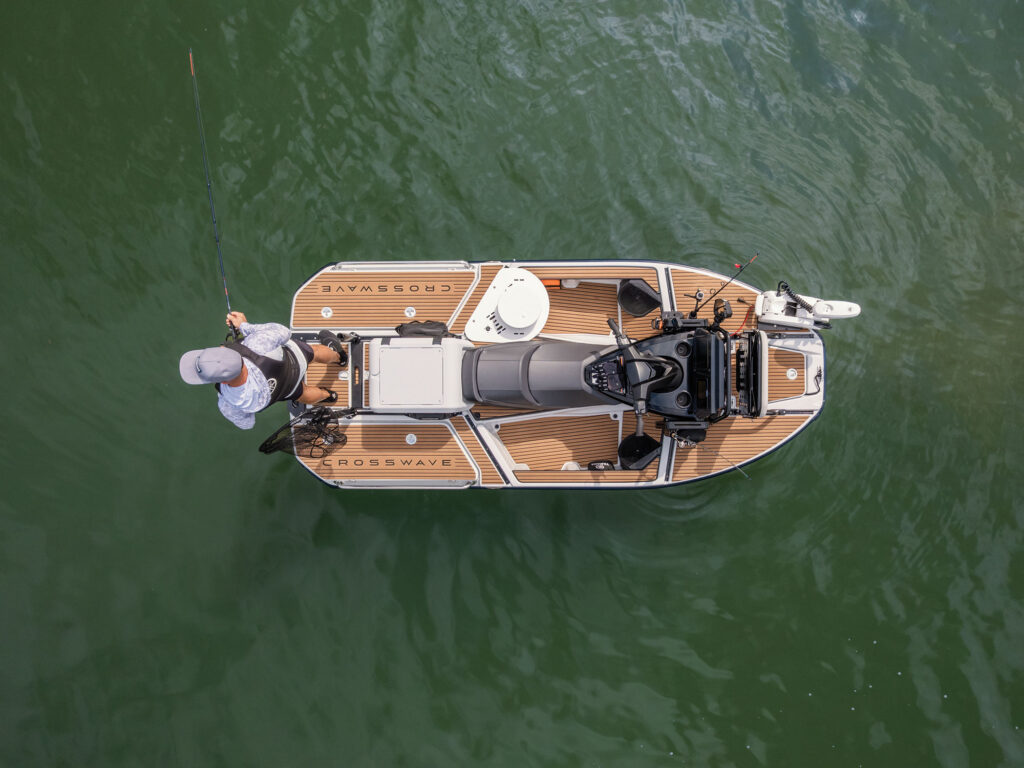
At 12 feet, 11 inches long and 5 feet, 7 inches wide, the CrossWave looks like a mini-flat-top aircraft carrier, but with the command station in the center. Deep footwells are kept dry by its generous freeboard. The walkaround layout features Marine Mat decking that flows uninterrupted from bow to stern, allowing true 360-degree mobility that makes boarding from any direction feel natural—and you can step on the gunwale without losing your balance or taking on water.
When testing PWCs, I usually wear neoprene shorts, if not full neoprene suits for protection from brisk water and falling off the rip-snorting water scooters. But I was promised by the engineers that this new CrossWave would be a dry ride, so I wore jeans and a jacket, tennis shoes and polarized glasses—typical fall-weather fishing clothes—and stayed absolutely dry. The only time I took enough spray over the bow to spot my polarized sunglasses was when I made a remorseless assault on an oncoming wake.
Similar to all PWCs, the CrossWave proved sporty. Powered by a 200 hp Yamaha 1.9L HO engine with a WaveRunner jet drive, it reached 55 mph with nearly a full tank of fuel. Not similar to other PWCs is the fact that the CrossWave carries 26.4 gallons of fuel to provide a range of over 100 miles with a generous safety reserve. Like PWCs, acceleration was typical Yamaha head-spinning. I couldn’t work the throttle and stopwatch fast enough to get an accurate time to plane, but I’d put it at under two seconds. Time to 30 mph was under four. But, more like my expectations from a boat, the CrossWave provided a stable fishing platform. I could see it was designed to go up against fishing boats.
So, let’s get back to fishing. Yamaha says the CrossWave’s draft is about 6 inches, and I did skim over some rocky drought-exposed reefs. So, skinny-water guys can drift or pole over a flat, presuming they carry a pole—there is certainly enough accessorizing capability to carry one thanks to the T-channel throughout the deck. Best of all, there is no underwater running gear to impact grass beds, oyster bars or storm-damaged mangroves, where fish hang out.
Our test day was breezy and we had a moderate chop. At rest, the CrossWave let the chop slide beneath it without bucking or experiencing significant roll. When I stepped from behind the handle bars to the bow deck and stood to cast, it was with confident balance and stability.
Yamaha says the CrossWave can carry three anglers or four passengers, and it can, but angling would be more practical with two. Additionally, Yamaha says—and we believe it—four full-grown adults can stand on one side without taking water over the gunwales.
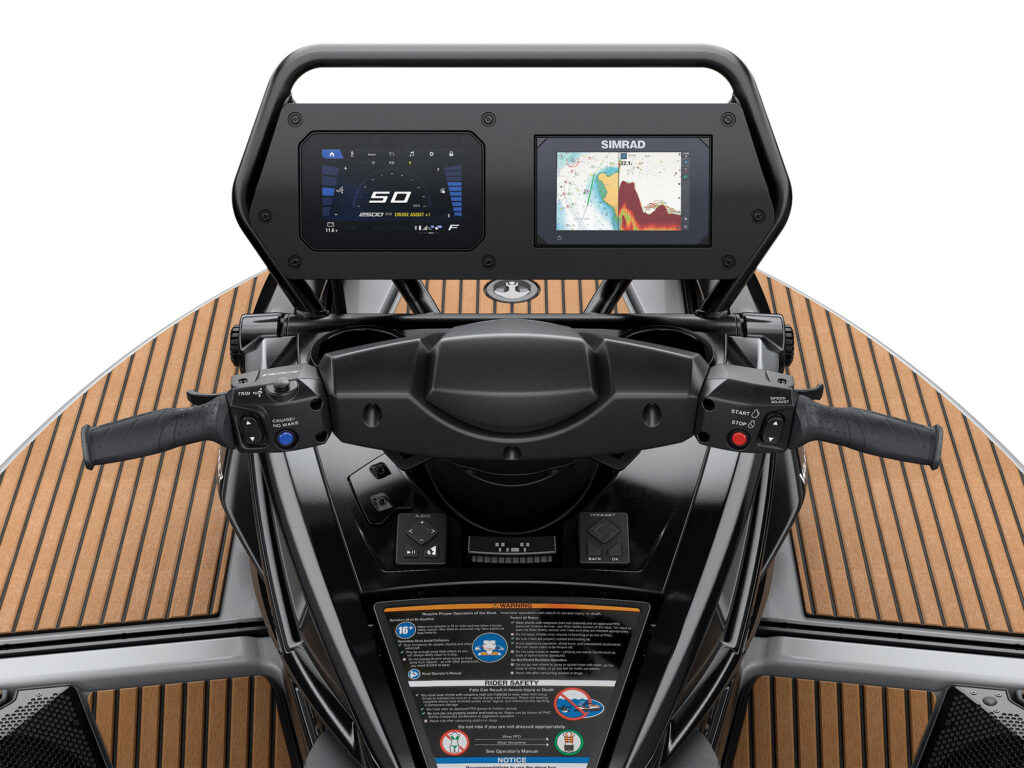
The helm design breaks new ground with dual touchscreen displays—a 7-inch Connext control interface paired with a 7-inch Simrad NSX chart plotter/fish finder—creating a “glass cockpit” that would look at home on sportfishing vessels twice the length. The displays are mounted above the handlebars on pipe-work rails, and the upper rail doubles as a handhold for moving from saddle to bow. Audio comes standard with two integrated, waterproof 8-inch EcoXGear speakers delivering Bluetooth connectivity. For the sandbar, Ecocast allows you to link your audio with other EcoXGear speakers in the vicinity so everybody can sing from the same song sheet. A pair of 12-volt power outlets stand ready to power phones or the livewell.
I thought the CrossWave was well-equipped for a day-long fishing adventure. Storage capacity is 82 gallons spread across dedicated compartments, including a specialized rod-storage-locker, located starboard aft; an anchor locker at the bow sized perfectly for a 5-pound Danforth S600 anchor, and a 3.5-gallon bucket; plus a portside aft locker that can be accessorized with a tackle and bait-bucket storage inside.
There is approximately 16 feet of integrated T-Track system around the vessel, giving anglers unlimited ability to add a universe of accessories from rod holders to tool holders, or a stand-up leaning bar for a handy grip when moving about or to stand for a better view of the fish. Even the standard removable 55-quart cooler attaches to the T-Track system.
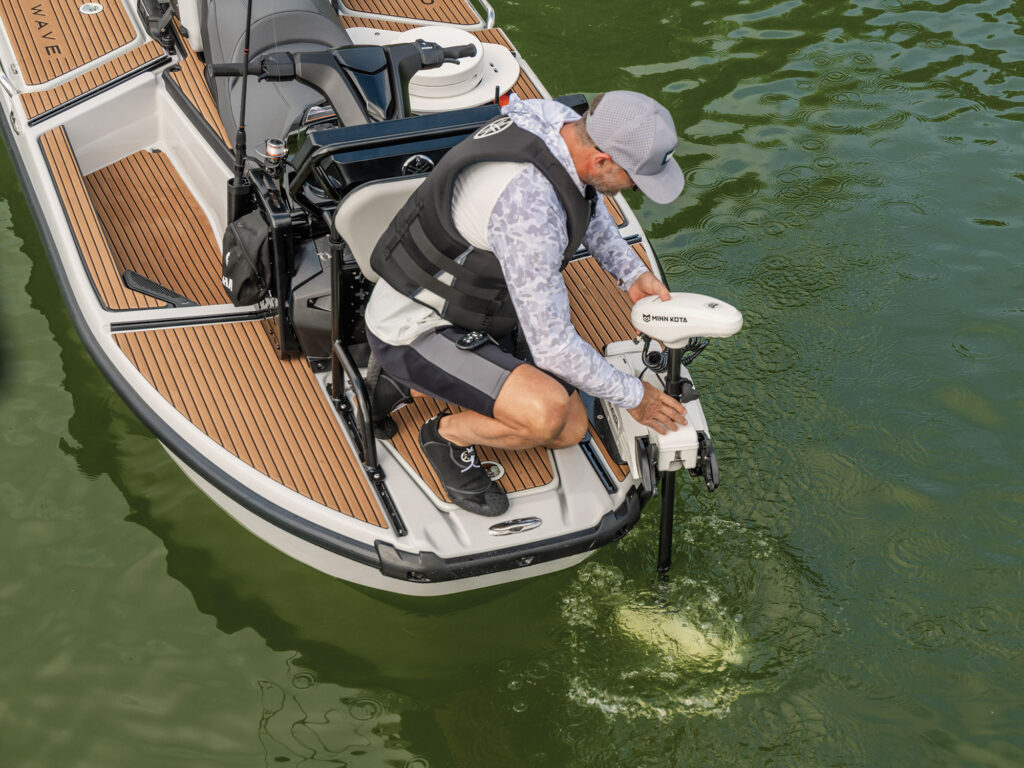
Yamaha pre-wires the CrossWave for a Group 24 deep-cycle marine battery and has an optional integrated trolling-motor bracket for mounting to the port-side bow. There is dependable power both for a trolling motor and advanced electronics. An industry-first built-in main battery switch prevents parasitic drain during storage. For shallow-water angling, the CrossWave is even equipped for a Power-Pole Micro Anchor.
Read Next: Yamaha 255 FSH Sport H
Yamaha’s patented inboard jet-pump cleanout is accessible under the custom cooler and allows access to the impeller chamber to remove debris—something that can only be done with competitors’ models by entering the water. This system is a big advantage.
While most fishing PWCs are just standard craft with bolt-on rod holders and gear bags, the CrossWave creates an entirely new category of boat that’s part utility vessel, part explorer, and 100 percent fishing machine. Plus, it’s easy to launch, tow and stow in the garage on its standard custom trailer.
Specifications
| Length | 12’11” |
| Beam: | 5’7″ |
| Draft: | 16″ |
| Fuel: | 26.4 gal. |
| Weight: | N/A |
| Max HP: | 200 |
| Price: | $30,000 (approx. w/ trailer) |
Yamaha Jet Boat Manufacturing – Kennesaw, Georgia; yamahaboats.com