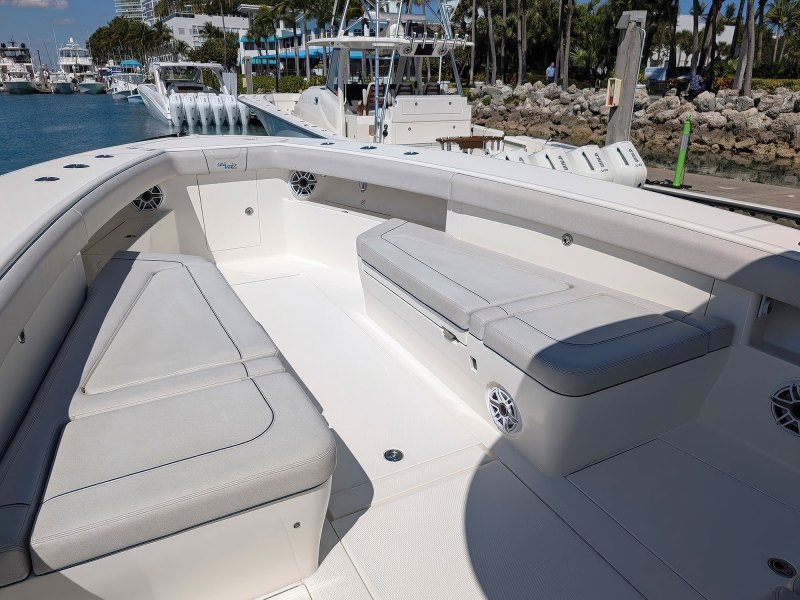
Here’s the conundrum: Avid anglers want to maximize deck space for fishing, but unless they want to stand all day, there needs to be a place to sit. Fortunately, there are plenty of options for on-demand seating that won’t take up valuable space.
Bow Seats
According to many hardcore anglers, a boat with bowrider or bench seats in the bow is a pleasure boat, not a fishing boat. But boat builders are increasingly catering to buyers who want to seat more people in comfort. For some fishermen, there’s a happy middle ground.
Pros: Reclining while making long runs to the fishing grounds is a luxury that keeps anglers refreshed. Quality bowrider seats might also be a critical selling point to persuade a non-fishing spouse to go along with the purchase of a boat. If done properly, bow seating can be a feature, not a bug. On smaller center console boats, the gap between forward bench seat bottoms can be bridged with a temporary filler section that transforms
the bow into a large, raised casting platform.
Cons: Boats with fixed backrests are less fishy, especially on smaller boats. Anglers can’t lean against the gunwale to fight a fish. For larger boats, it’s not
as problematic.
Must-Have Features: The critical element for accommodating forward bench seating is the ability to leave the bow open so those hooked up to large fish can brace against the gunwale while the driver bumps the boat forward to help retrieve lost line. Bowrider seats should have removable backrests or ones that pivot to lie flush with the coaming pads. Easily removable seat bottoms, preferably held by magnets, make transitioning from seating to fishing seamless.
Pedestal Casting Seats
Pedestal seating is a feature saltwater anglers borrowed from their bass-fishing brothers that makes it more comfortable
to cast lures all day.
Pros: Easy to install and remove, pedestal seats for boats with bow and stern casting platforms take up little space,
but offer tremendous comfort.
Cons: If the base is poorly anchored, using pedestal seats in rough water can cause cracks in the fiberglass and lead to failure due to the tremendous levering force.
Must-Have Features: Stout backing plates spread the force out. Comfortable seat designs usually feature a raised rear section or backrest. An adjustable-height pedestal is a must for accommodating anglers of all sizes.
Bring-Aboard Foldable Deck Chairs
Often overlooked, well-designed deck chairs have many advantages.
Pros: Foldable deck chairs offer the ultimate in flexibility. They can be moved wherever they are needed, temporarily stowed or left at the dock. You can bring as many as needed to augment a boat’s seating capacity.
Cons: Leave the lawn chairs at home; they are too light and can be blown around or tipped over in wind and waves.
Must-Have Features: Deck chairs must be heavy enough to stay in place when no one is sitting on them and should be foldable for easy stowage. The best chairs have a low center of gravity, and some even have a gimbal to assist during a slugfest with a large fish.

Bean Bag Chairs
Frequent long runs in lumpy offshore conditions can cause chronic back problems. Standing helps, as the legs serve as shock absorbers, but it is tiring. Bean bag chairs are one of the most common and inexpensive solutions to ease the constant pounding.
Pros: The beads inside bean bags compress to absorb the pounding of offshore waves. Bean bags are also comfy and allow some anglers to catch some sleep on long runs. Bean bag chairs sit low and are often out of the wind and spray. They double as unofficial flotation devices in an emergency.
Cons: They are large and require a lot of storage space when it’s time to fish. The beads inside compress over time and may need to be replaced. The interior can get wet if the vinyl gets ripped or the zipper is left partially open.
Must-Have Features: The vinyl cover should be UV-resistant, easy to clean and water-tight, especially at the zipper seam. Small virgin polystyrene beads are water-resistant and the best filler material. Large bean bags with amorphous shapes belong in the TV room, not on a boat. The best offshore bags are teardrop-shaped for optimal ergonomics. Grab handles make them easy to move.
Read Next: Boat Seat Maintenance
Flip-Down Bench Seats
The gold standard for temporary seating on fishing boats is the fold-down transom bench seat.
Pros: Flip-down bench seats deploy in seconds and offer comfort for two or more crew. The stern of the boat has the least motion when running, so it’s more comfortable, especially for those prone to turning green. Individual flip-down jump seats can be added to the sides of a fishing cockpit and even in the walkaround area next to the center console to take advantage of hardtop shade.
Cons: Sometimes the seat bottom’s folding mechanism can be too tight, which makes it hard to deploy. The seatbacks are the coaming pads and usually offer no recline angle. Protruding handles can chafe calves. The boat’s transom needs to be flat, which can limit livewell capacity. Flip-down bench seats are sometimes a pricey option.
Must-Have Features: When folded up, seat bottoms shouldn’t intrude into the cockpit. Smooth hinges make the seat bottom easy to flip up and down.
Cooler Seats
Cooler seats are little more than cushions on top of a beverage cooler, but on smaller boats, this is a valuable addition that kills two birds with one stone.
Pros: For smaller center consoles, the perfect place for a cooler is in front of the console, provided there’s not already a jumpseat. Put a cushion on the cooler, and it becomes a seat that’s balanced on the centerline of the boat and doesn’t slide backwards. This inexpensive option can use coaming pads
for backrests.
Cons: Cooler seats aren’t very comfortable, and the occupant must move anytime someone needs a drink.
Must-Have Features: The cushion needs to be attached to prevent it from flying off, and the cooler should be anchored to keep it in place.
For long days on the water, having a seat for everyone on board is a plus. Having seats that don’t eat up fishing space is what they call a win-win.