
The benefits of gyrostabilizers are well known among owners of V-hull offshore fishing boats. They provide roll control for bluewater anglers while anchored, drifting, or trolling in a beam sea. In these conditions, a V-hull boat can roll strongly from side to side, and a stabilizer’s ability to counteract this uncomfortable motion can make all the difference between a fun day of fishing or a nauseous mutiny.
Gyrostabilizers are not as common on offshore power catamarans — essentially two narrow V-hulls positioned feet apart and connected by a deck structure. This design presents two challenges for installing a gyro. The first is finding a location with the structural strength to install a gyro, and the second is the kinetic energy required to counteract the roll of a twin-hulled boat. And of course, there’s the issue of electrical power required to run a gyro for hours without the engines running, which normally requires an onboard generator. Still, gyros are available on some larger catamarans. For example, World Cat’s 400DC-X and 400CC-X models offer optional dual Seakeeper 3 gyros (one for each hull), which are installed by replacing the aft floor fish boxes. At just under $40K a pop, however, this is a sizeable bump to the overall price of the boat.
What about a single gyro for a large offshore catamaran? Capt. Robert Trosset III, who runs Finz Dive Center & Tackle in Key West, Florida, mulled over this very question as he worked with custom aluminum boat builder Razorhead in New Iberia, Louisiana, on a new flagship for his growing dive fleet.

Trosset needed a boat with a huge interior cabin to accommodate six passengers in air-conditioned comfort, amenities like a full-stand-up head with sink, rack storage for 28 scuba tanks, and a “landing craft” front ramp for storming the beaches of the Dry Tortugas D-Day style. The result was Park Shark, a 35-foot heavy metal monster with a 12-foot beam and four Suzuki V-6 outboards.
Park Shark was designed to deliver speed and comfort in all kinds of weather, making the 70-plus-mile run to Dry Tortugas National Park, doing multiple dives, spending time ashore exploring Fort Jefferson, and getting back to Key West that same evening. Lastly, he wanted to do it all without the expense, weight, and noise of an onboard generator.
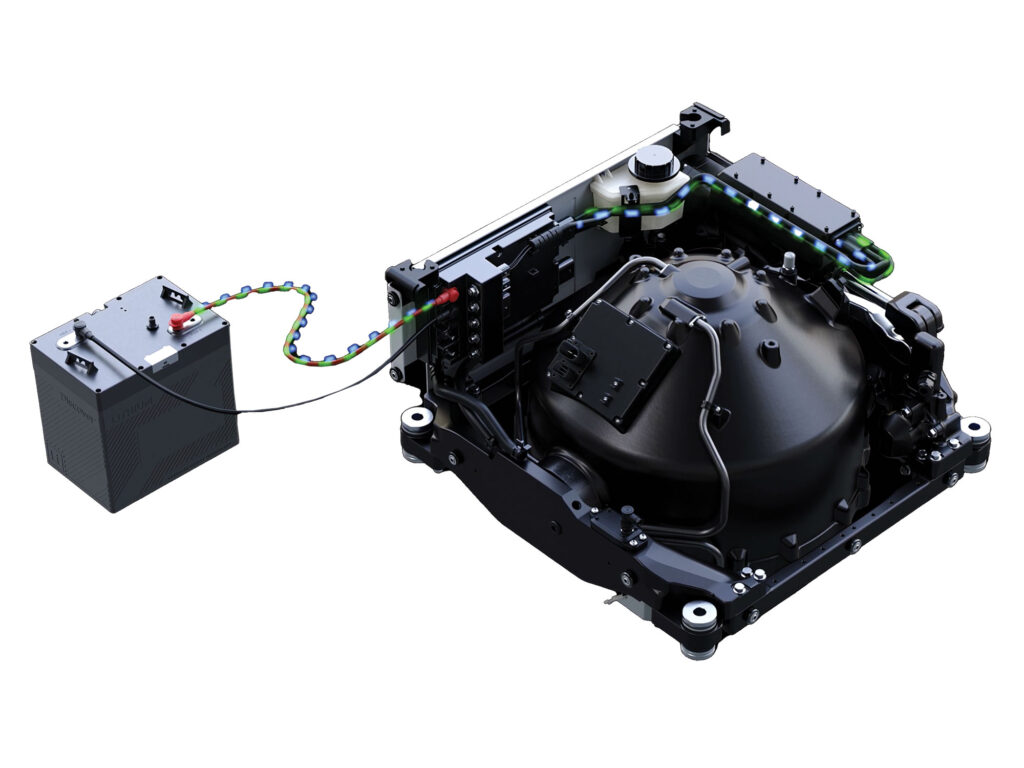
As Trosset was noodling out design ideas with the builder, Dometic was getting ready to launch its DG3 Gyrostabilizer at the 2025 Miami International Boat Show. Dometic won a NMMA Innovation Award at the show, in part for the many ways the product broke norms for gyro performance and efficiency. By reaching full RPMs in 16 minutes (versus 50 minutes), generating some of its own electrical power to slash overall energy consumption by 40 percent, eliminating hydraulics in favor of proprietary Inverted Roller Screw design for precise dynamic control of the flywheel, and spinning down in well under 20 minutes rather than up to eight hours, Dometic eliminated many of the potential obstacles to installing and using a gyro aboard a boat like Park Shark.
Trosset decided to make a single DG3 (MSRP $43,999) a centerpiece of this custom cat. Having a new boat designed and built from scratch helped make this ambitious project possible. As a longtime Dometic field tester, Trosset was able to collaborate with the builder and Dometic engineers from the get-go to make this happen. “We talked a lot before the boat ‘went into the mold’,” Trosset said. Engineers from Dometic told Razorhead what was needed for the hull to support the gyro and meet the stress loads, and they built it to the provided specs. Because of Park Shark’s layout, the DG3 was installed in the starboard sponson, well outside the vessel’s center line.
This location raised some additional installation questions. Because it was essentially installed at deck level and running inside an enclosed cabin with the passengers, some additional sound deadening was added to ensure the best customer experience. Having the DG3’s roughly 600 pounds of mass positioned off to one side required a little “balancing act,” something Trosset achieved by installing the batteries, power management system, and head/water tanks on the opposite side.
They also went against the misconception that a gyro must be installed on or near a boat’s center line to deliver equal roll stabilization in both directions — particularly for a boat as heavy and beamy as this. “The ride difference is even better than I expected,” said Trosset, who has other catamarans in his fleet. “Over 70-plus trips so far, our gyro has been a lifesaver when I’m drifting or anchoring in a beam sea, where the ‘snap roll’ motion associated with twin hulls can make life miserable”
This can be particularly bad when the space between waves and the distance between the sponsons are roughly the same. Trosset turns it on when he arrives at the boat, and it’s ready to go by the time he leaves the channel. On the long run, it helps keep the cat level and flat when coming off waves, making the ride softer, more comfortable and more fuel efficient. “I never turn it off,” Trosset explains.
Dometic engineers are equally excited about the system’s potential in this market. “Even though Robert’s boat is 23,000 pounds finished weight and we’re installed off to one side, our long-term testing has shown he’s getting 85 to 87 percent roll reduction in an application that’s way beyond DG3’s specifications,” said Dometic Product Manager Steve Watson.
Existing owners of fiberglass power catamarans up to about 34 feet could also improve their ride with a single DG3, according to Watson, and much larger cats can be accommodated with two units. “It requires two things to retrofit our gyro onto existing catamarans — installation space and support structure. The easiest route would be to replace the leaning post and make some modifications to support the floor structure beneath it.”
And if you’re not willing to sacrifice the leaning post to make room, you may still have options. Park Shark has proven there is more than one way to skin a cat.