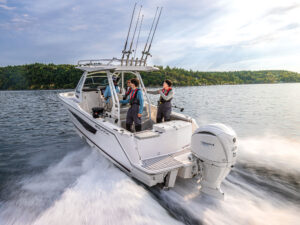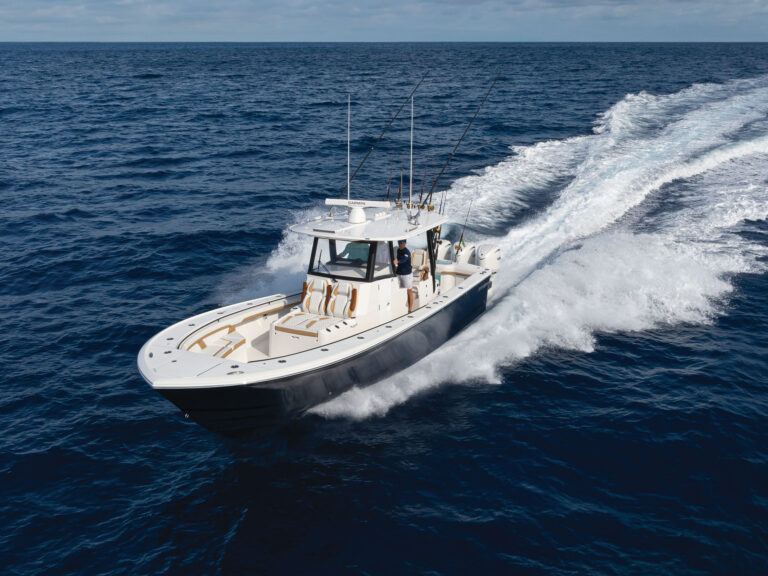
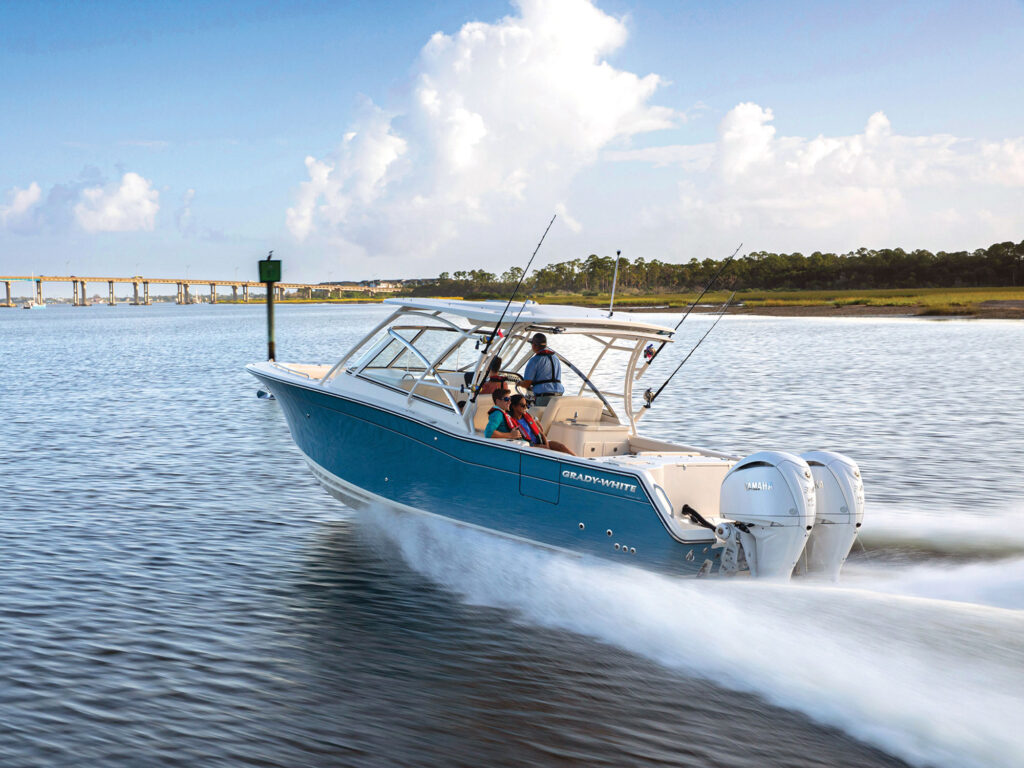
If you’re looking for a new saltwater fishing boat, odds are pretty good that most of the models under consideration will sport outboard power. And for good reason. Outboards prove responsive, convenient, simple to operate, and once they have provided a full and worthy service life, fairly easy to replace, adding life to your boat and getting you back on the water quickly.
That being said, selecting the optimum horsepower from the many options available can be confusing and involves more than determining which is fastest. In fact, top speed is the least important criteria. Favorable low to midrange torque is most important. That’s what you need to keep your boat comfortably on plane in challenging head seas and to maintain control in tricky following seas.
So, what do you need to consider when decided on the horsepower for your new boat? Well, in some cases, US Coast Guard regulations guide this process. For monohull boats under 20 feet, Coast Guard regulations specify a formula based on boat length, transom width and transom height to determine maximum horsepower, ensuring safe operation. The calculation takes into consideration other factors such as manner of steering (e.g., tiller steered or remote steering).
The maximum horsepower rating is listed on a capacity plate affixed to smaller vessels. Adhering to capacity-plate guidelines provided by manufacturers is vital to avoid overpowering, which can lead to balance, buoyancy and safety issues, as well as impaired handling and reduced fuel efficiency.
Among larger vessels over 20 feet in length overall, the maximum horsepower calculation is guided both by regulations and by builder experience. What’s more, different types of saltwater fishing boats require varying horsepower. Catamarans might need 300 to 1,600 hp or more in the form of twin or quadruple outboard configurations, while flats skiffs have a single outboard ranging from about 50 to 150 hp.
The primary purpose of the boat significantly influences horsepower needs. A flat-bottom skiff or semi-V-bottom boat is likely to perform better on the same horsepower than a deep-V fishing boat of comparable weight and dimensions—it takes more torque to lift the sharper deadrise boat.
The overall weight of the vessel, including cargo and passengers, plays a crucial role in determining engine-power requirements. A general guideline suggests 1 horsepower for every 25 to 40 pounds of boat weight. Overloading can hinder performance and fuel efficiency, emphasizing the need for an appropriately matched engine.
The bulk of these factors is considered by the boatbuilder before the plan leaves the design phase. Once it does, a prototype is built and the power calculations are put to the test. In many cases, builders adjust the maximum horsepower up or down, based on performance factors experienced in other boats.
Navigating in rough waters demands additional power to maintain control and performance. Accounting for these conditions when choosing engine power is essential to ensuring safety and stability.
Overpowering a boat poses risks, including reduced handling and voided warranties. Adhering to safety regulations and conducting regular maintenance ensures safe operation. Proper care of the engine and propeller is crucial for longevity and consistent performance.
Interestingly, larger engines can be more fuel-efficient than smaller ones struggling under heavy loads. They operate effectively at moderate rpm, conserving fuel. Smaller motors run harder to get the same performance and almost always burn more fuel at wide-open throttle.
I encourage boat buyers to select the highest horsepower available on a given model, if there is a choice in the builder specs. Yet, I’ve found exceptions to that rule. Often, higher-horsepower models are built on a block that has been developed for lower horsepower. Horsepower is increased by raising the wide-open throttle (WOT) instructions—known as “mapping”—in a motor’s electronic control module. At higher rpm, horsepower at the prop shaft is increased. However, in many cases “mapped up” motors don’t provide significant improvement over the engine model that occupies a slightly lower horsepower rating.
I have a Ranger 2510 bay boat. It’s my second one, powered by an inline-six 400 hp outboard. My previous one had the same block in a 350. Performance right up until WOT was comparable. Top speed was increased only 1 mph or so. But because of the greater horsepower rating, my insurance went up along with the purchase price. Each extra horsepower adds an average of about $110 to $130 to the retail price.
When selecting between outboard engines, I recommend choosing the offering with the bigger displacement, as expressed in liters or cubic inches. That’s what I consider real horsepower—oomph that matters all the way through the power range. But, in multi-engine vessels, that incremental mapped-up horsepower can make a noticeable difference through the power range.
Also, think ahead to when you sell your boat to upgrade to another one. For the power-hungry used-boat buyer, a bigger horsepower number on the motor makes a used boat a far more attractive offering. One additional mph might be all it takes to tip the scale in your favor. Max power is always a powerful calling card. It might not make you any more money, but it will be chosen over the next offering with a lower- horsepower propulsion system.
When choosing horsepower—be it in a new boat or repowering an existing one—consider the combination of boat type, intended use and environmental conditions. Study performance reports and comparable boats. Follow published editorial reports such as those found in magazines. When buying a used boat, make sure the outboard offered is within the maximum-horsepower guidelines or you might find it hard to obtain insurance.