California’s Channel Islands have long been ground zero for the most dedicated white seabass anglers. From the squid spawning grounds off Santa Rosa Island to the kelp forests of Santa Cruz Island, these islands offer some of the best year-round access to these big chrome-sided croakers. Every season, anglers chase these elusive gamefish, which can reach weights of 60 pounds or more. They appear and disappear like ghosts, one day thick in the shallows, the next nowhere to be found.
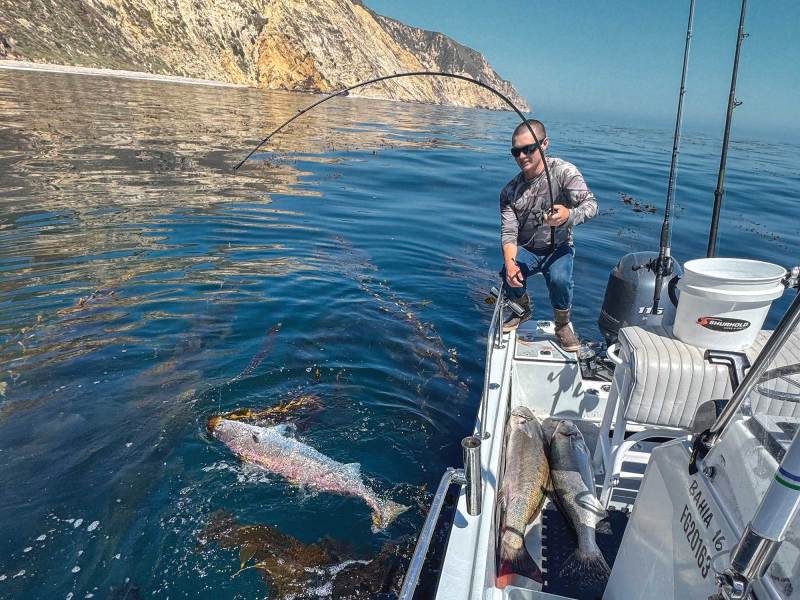
But in recent years, a new tactic has emerged among those most entrenched in a fishery which traditionally calls for fishing live squid on dropper loops. Capt. Pat O’Brien, who’s spent countless days pursuing these fish as captain of the party boat Aloha Spirit, as well as on private boats, offers a refined approach that’s as visual as it is technical. He fishes soft-plastic flukes for white seabass you can actually see. “It’s completely changed how we fish for them,” O’Brien says. “When you can see those fish cruising in the kelp or tailing just under the surface, it’s a whole different game.”

Sight Fishing
The first key to this method isn’t tackle, it’s eyesight. O’Brien calls it “eyeballing,” and it starts with slowing down. “When we’re on a skiff, we literally idle through the kelp,” he reveals. “One guy is on the bow with polarized glasses, the other is on the wheel. You’re not trolling or metering—you’re looking.”
What they’re looking for can be surprisingly subtle. Sometimes it’s the flick of a tail tip breaking the surface. Other times it’s a faint shape suspended 10 feet down, barely visible through the canopy. “It takes a practiced eye,” O’Brien says. “But once you start seeing them, you realize how often they are there.” He warns against bumping the engine in and out of gear; even that slight change in pitch can spook the fish.
While possible on a party boat, the technique truly shines on smaller skiffs that can slip quietly through shallow water. At Santa Cruz Island, O’Brien and his friends often work the backside of the island, including popular spots such as Yellow Banks and Sandstone Point. “We’ve found them everywhere around that island,” he shares. “But there are always half a dozen zones we start with.”
While O’Brien admits you can find fish in every kind of water from quiet coves with pebbly shores to isolated kelp stringers, he’s always paying attention to current breaks and tide lines. “If there’s current, you’ll want to start on the up-current end of things,” he explains. “Other times you’re just looking for a change in surface texture. It might be a line where the glassy water meets rippled water, or a bend in the kelp stringers. That’s the kind of place I’ll slow down and start looking hard.”
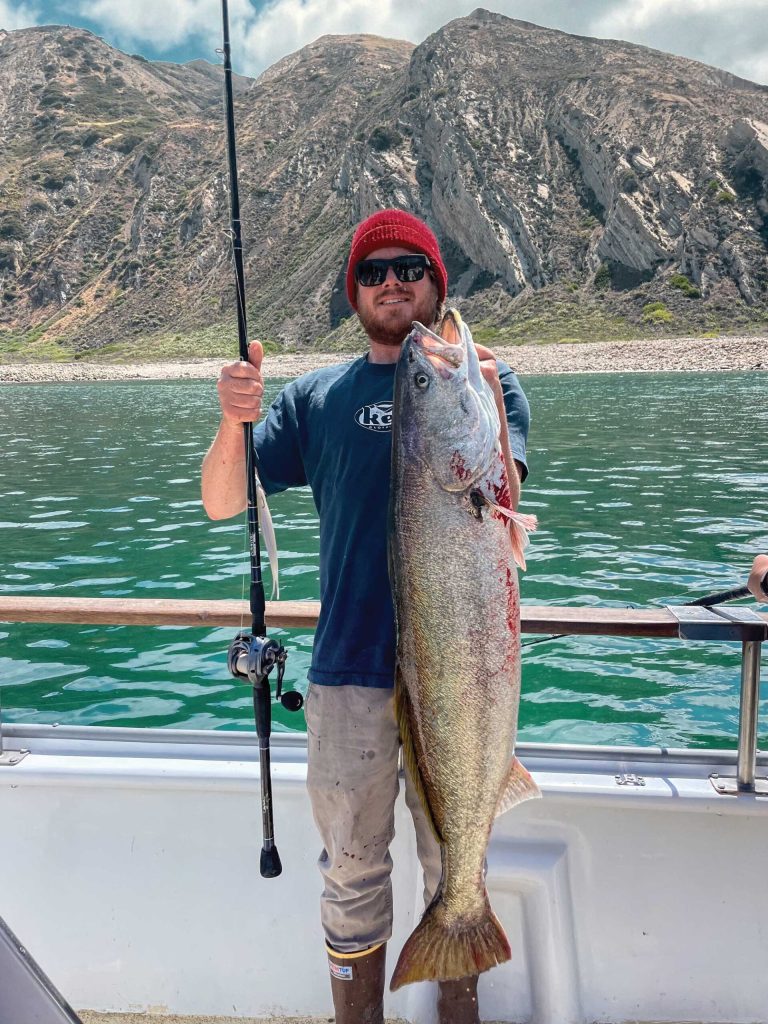
Bird Brain
Sea birds can be another giveaway. “You’ll see a big pack of gulls sitting in the kelp, and a lot of guys will just drive by,” he says. “If it’s the right time of year, I’ll go straight to them. We’ve caught fish under birds year-round. On Valentine’s Day last year we found fish that were under birds.” Like tuna fishermen scanning for “breezers” (tuna cruising just below the surface of the water), seabass hunters should focus on deviations from the norm. Anything that looks slightly off like ripples, color breaks, or eddies can signal life below.
O’Brien’s lure of choice is refreshingly simple. It is a fluke-style soft-plastic lure—an 8-inch Z-Man StreakZ XL in the pearl color, glued to a 3/4- to 1-ounce bullet-shaped lead-head jig. “I’ve seen every white fluke work, but that Z-Man StreakZ XL is special,” he says. “It’s soft, it moves great, and when you super glue it on, it doesn’t pull down after one short bite. You can catch multiple fish on the same bait.”
He prefers a standard bullet-head jig over more stylized “squid” or “dolphin” heads. “Those fancy ones glide a little weird,” he says. “The round head gives a consistent fall—a true zig-zag down.” Hook size matters, too. “You don’t want a long shank,” he cautions. “These fish eat the head of the bait. A shorter shank lets you drive the hook where they bite.”
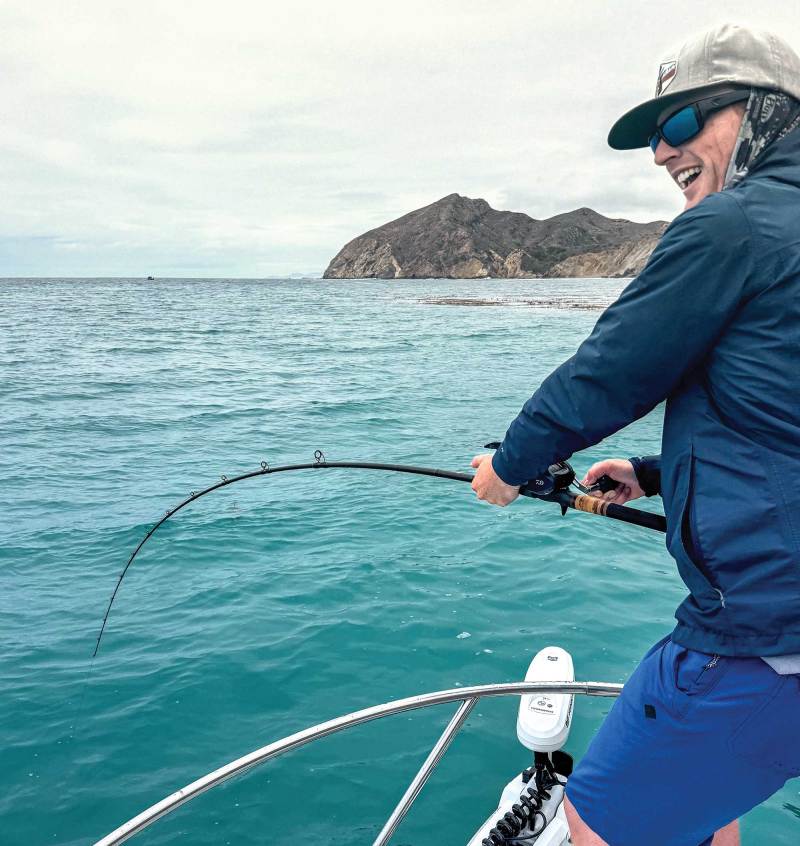
Heavy Leader
Most of O’Brien’s fishing is done with 40- to 60-pound test fluorocarbon or monofilament leader tied to 65-pound braid. “I used to think lighter fluorocarbon would get more bites,” he says. “But my buddy Cole Clary told me, ‘It’s all reaction. You’re in the kelp. Fish 60-pound.’ He was right! I lost a lot of fish before I switched.”
The rod of choice is a 9-foot graphite composite rod with a sensitive tip and plenty of backbone. “You need to be able to feel that little tick when they bite, but you also need enough backbone to hammer the hook home and muscle the fish out of the stringers,” O’Brien says. “You’re not playing them. You’re going to war.” O’Brien suggests using a 400-size low-profile baitcasting reel for its bigger drag stack and handle power. “A 300 works, but you’ll feel under-gunned on a big one,” he admits. “The 400 just feels right.”
Once you get bit, one of the hardest lessons for new fluke anglers is learning when to swing—and when not to. “These fish hit like a hammer,” O’Brien says. “You’ll feel one big bite, and that’s when you swing for the fences. Don’t wind through it like a bass bite. If you hesitate, you’re done.”
Bit and Spit
O’Brien believes the seabass’s feeding style explains the need for an aggressive hook-set. “They inhale the bait head-first,” he observes. “They open their mouth up, suck it in, and if you don’t drive that hook, they’ll spit it right back out.” Once you hook one, it’s a short, brutal fight—you’re pulling hard, drag locked down. “There’s no playing them out. You rope ’em or you lose ’em,” he says.
O’Brien goes on to explain that everything about this fishery revolves around vision: seeing the fish, anticipating their path, and casting accordingly. “If you see a school tailing ahead of you, don’t run straight at them, make a big circle, get in front of where they’re going, and shut down,” he explains. “You want to be a long cast away and let the boat drift down naturally.”
After the lure hits the water at the end of the cast, O’Brien recommends keeping the rod at about a 45-degree angle and watching the line as the bait sinks. “Most bites come on the fall,” he points out. “You can almost see it before you feel it.” If the fish are high in the column, he lets the fluke flutter naturally before engaging the reel. “Leave it out of gear a few seconds to get a little bow in your line. It looks more natural,” he says.
“If they’re deeper, like out in 60 feet, you let it sink before putting it in gear, so it doesn’t swing straight under the boat,” O’Brien adds.
Deep Thinking
The fluke technique isn’t just for skinny water. When seabass school up in deeper zones or on squid spawning beds, the same bait still works, it just needs more weight and patience. “Guys are drifting the squid beds at Rosa with ounce-and-a-half or 2-ounce heads,” O’Brien says. “You bomb a cast, let it sink to the bottom on a slack line, and then pop it with nice, steady lifts, not crazy fast. You just want that fluke to look alive.” He compares the motion to a squid pulsing off the bottom. You need to feel the bottom, and if you’re not in contact with the lure, you’re not really fishing, he reveals.
On the passenger fishing (aka party) boats, O’Brien positions his casters strategically. “If I’m running the boat, I’ll have a few guys on the bow ready with flukes,” he says. “When I mark fish on the sonar, say 30 to 40 feet down, I’ll set up 100 feet off the school and tell my guys how far to cast and how long to let it sink.
Even without sonar, private boat anglers can make it work. “You don’t need fancy electronics,” he says. “Just slow down, look, and fish smart.”
For newcomers, O’Brien emphasizes developing an eye for the subtle. “A lot of guys say, ‘I don’t see anything,’ but it’s because they’re looking too far out,” he says. “You’re scanning 10, 15 feet in front of the boat, not the horizon.” And he admits it takes time. “The fish’s tail is the giveaway, as it’s usually brighter than the body,” he explains. “Sometimes you see a V-wake on the surface like a breezer, sometimes just a change in texture of the surface water. Once you see it, you can’t unsee it.”
Read Next: Top 10 White Seabass Records
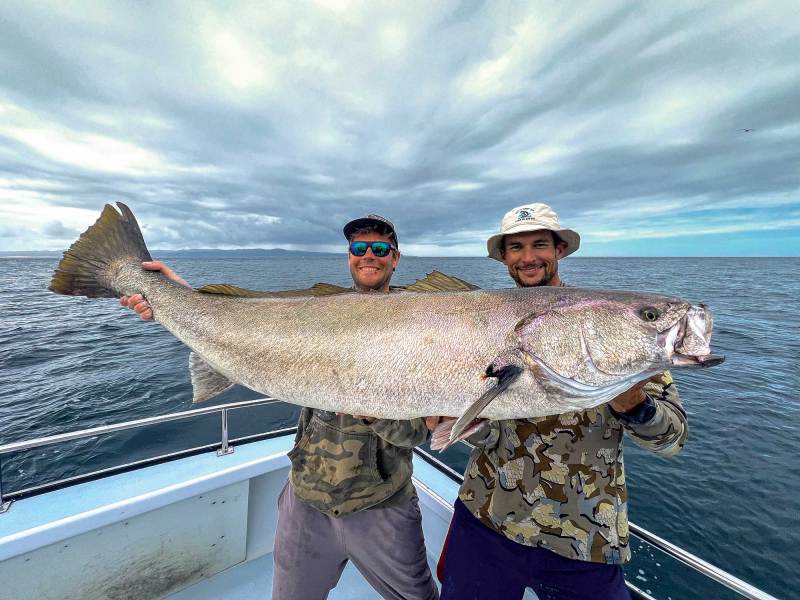
Subtle Clues
That same awareness applies to current lines and structure. Look for something different like where kelp stringers bend in the current, where the water color changes, where the tide line shows that edge; that’s where the plankton stacks up, and the seabass know it.
For the average private-boat angler, or someone who finally gets a weekend off and wants to find their own seabass, O’Brien’s advice is direct. “Slow the hell down,” he says. “Don’t run from spot to spot. Get to a good area and start looking. Get someone on the bow. Eyeball for them.”
He recommends starting with known zones like Yellow Banks or the sandstone stretches where fish have been caught before. There’s a lot of island out there, so focus on areas with current, life, and bird activity. You’ll waste less time. And when you finally do see white seabass, be ready. “You might only get one cast before they’re gone,” O’Brien says. “Have your rod rigged, drag set, and hook sharp.”
What makes the fluke presentation awesome is that it takes the sport of seabass fishing from the boredom of anchoring up and waiting for a fish to swim through, to a game of stealth, timing, and instinct. You’re hunting. You’re reading the water, looking for clues, setting up shots. When it all comes together and one of those big croakers eats that plastic right under the surface, it’s the coolest thing ever.
“You tell people you’re catching seabass on fluke-style soft-plastic lures like the Z-Man StreakZ XL, and they think you’re full of it,” O’Brien shares laughingly. “But it works, and it’s as visual and exciting as it gets.”