Three months ago, right about the time Nolan McNeil was opening his Christmas presents, a bunch of Atlantic croakers had congregated to do the wild thing along the northern reaches of the Gulf. And now here he was, ready for a 19-inch speckled trout to smash his soft-plastic paddletail.
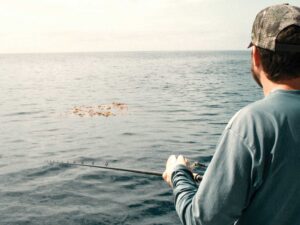
McNeil, 15, had just tossed the lure, threaded on a 3/8-ounce jig head, up onto a flat, and was working it down a ledge wall that terminated 20 feet below the surface— a veritable canyon in the otherwise shallow marshes of South Louisiana.
The nearly vertical cliff, located in the bend of a bayou, was buffeting a strong current pushed by an incoming tide. That racing water was jam-packed with tasty nuggets in the form of young-of-the-year croakers that were entirely oblivious to the gauntlet of speck maws that awaited them.
Like all predators, speckled trout prefer to get their meals as easily as possible, and meals don’t come easier than in the confusion of a strong current hurtling bait against a ledge wall.
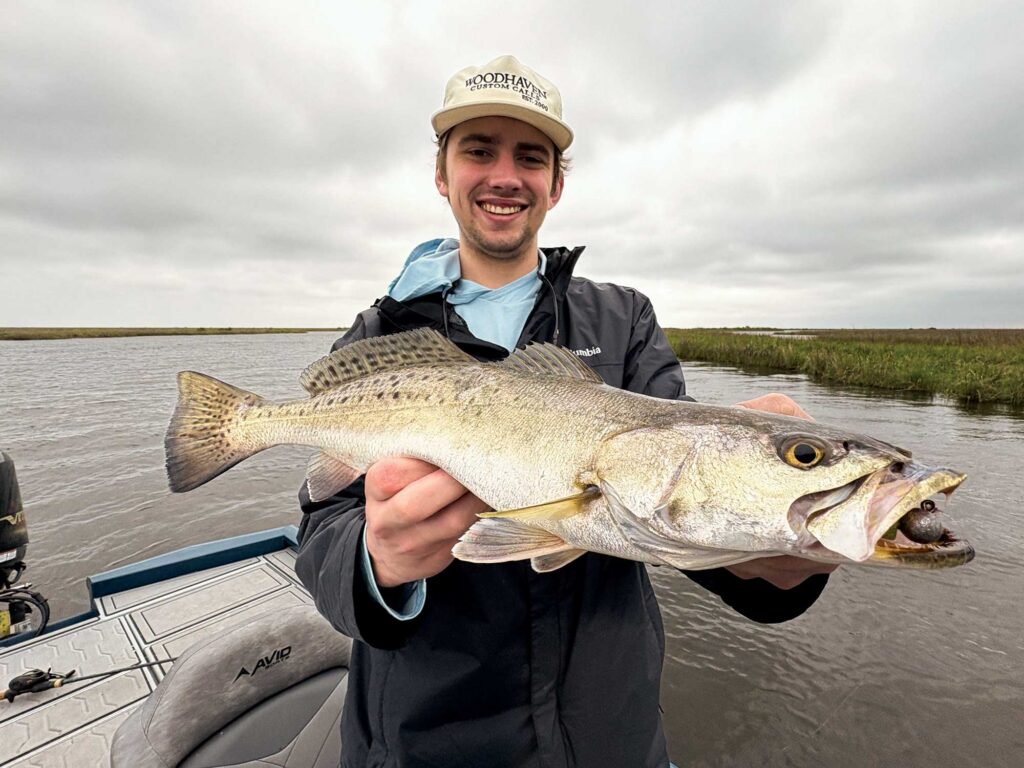
Fortunately for McNeil, frenzied specks aren’t especially particular. A 3-inch soft-plastic paddletail looks enough like a baby croaker that they’ll hit it every time. He felt the jolt surge up his line, instinctively set the hook and began battle with a furious-to-be-fooled spring speckled trout.
It’s a phenomenon that occurs every year at this time in the extensive marshes of South Louisiana.

Spring Specks on the Move
Beginning around early March most years, water temperatures warm enough for trout to flee low-current bayous and dead-end canals, where they have endured a battle of attrition with winter, surviving on the odd killifish or mullet that also sought solace in the same area.
Rising water temperatures increase the motility of the cold-blooded fish, accentuating the need for much more protein in their diets. The trout are famished, and they’d certainly love to munch on some brown shrimp, but the crustaceans are just too tiny in March to get much notice.
That’s not true of the croakers. They’re abundant and are the perfect size to fit in a trout’s mouth and fill its belly.
These fish are the progeny of the wintertime spawn, when mature Atlantic croakers congregate in 60- to 180-foot depths off the Louisiana coast. Once on site, the males make themselves absolutely irresistible to the females, according to the excellent book, Angler’s Guide to Fishes of the Gulf of Mexico.
“The Atlantic croaker gets its name from the croaking sounds that males can make by vibrating their air bladders,” reads the book. “Males use the sound to attract females during spawning season.”
The sound and bumping of bodies excites the females, causing them to release eggs, which the males then fertilize.
The eggs and larvae that spring from these romantic encounters drift with the tides into inshore waters, where the growing fish hide out along marsh edges and in patches of submerged aquatic vegetation. They stuff their faces with zooplankton, and grow rapidly, reaching 2 to 3 inches in size by spring.
On every tide, some get yanked from their hiding spots and carried to other locales, sometimes riding the conveyor belt of death to the aforementioned ledge walls along the way.

Destination: Mississippi River
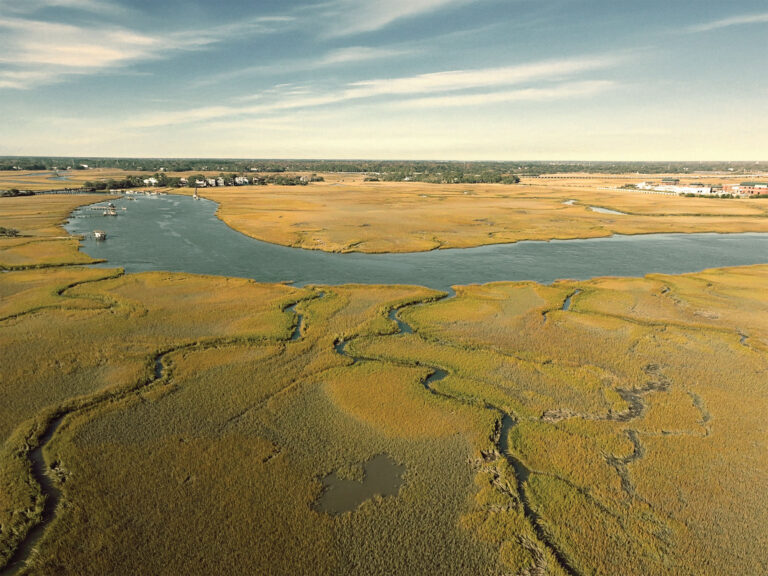
For at least a couple reasons, this springtime pattern is more entrenched in the marshes on the east side of the Mississippi River. The first is that there are far more breaks in the levee on the river’s east side, allowing turbid, nutrient-rich water to flow into the marshes. This turbocharges the entire ecosystem, and as a result, more juvenile croakers survive and thrive. Like most members of the Sciaenidae family, juvenile croakers do best in areas rich with detritus that are choked with submerged aquatic vegetation. The freshwater influence makes this prime habitat much more prevalent on the east side.
The second reason is somewhat related to the first. As a whole, Louisiana’s marshes are evaporating, perpetually succumbing to a one-two punch of subsidence and erosion. In short, they’re absolutely starved for sediment, and the marshes on the east side get it regularly whenever the river is high enough to push water through the breaks and into the marshes. That makes them healthier and, as a result, deeper.
In marshland, deep water is a result of constriction. Currents that move a lot of water through areas with defined boundaries, like bayous, will scour out the bottoms, causing them to be deeper than surrounding pock-marked marshes. If subsidence or erosion causes breaches in those boundaries, however, the water becomes less constricted, and the bayou loses depth.
That has happened at scale on the west side of the river, where marshes simply don’t have the sediment to replace what is lost to subsidence. In many areas, what was once healthy, vibrant marsh full of deep, winding bayous is now open water with maybe a few islands.
On the east side, however, the annual inflows from the river allow the marshes to repair what is lost to erosion and replace what subsidence claims. The marshes still restrict water flow and cause scouring in many bayous.
Anglers who fish this pattern regularly can spot a bayou that is likely to produce without aid of a depth-finder, simply by observing what’s going on at the surface. In strong currents, firm ledge walls invariably force upwellings in bends of bayous. The surface has a look almost as if the water is boiling.
This time of year, observant anglers cruise the marshes looking for boiling-water bends, and will fish every one they see. Not all produce, but many do, and due to the orientation of the ledge walls, those that deliver fish on a rising tide almost never do on a fall, and vice versa. Anglers who have fished the pattern for years make a milk run to historically productive bends to see which are producing that day. Invariably, they have a rising-tide list and a falling-tide list. Diligent anglers check new ones every trip.
Read Next: Wintertime Tuna Fishing off Venice, Louisiana
Living on the Ledge
Unlike many coastal destinations, Louisiana has only two tides a day—one high and one low—and two feet is considered a big range. Because this spring pattern requires croakers to be carried with the current and slammed against ledge walls, days with a large range offer far more predictable action.
Every ledge, of course, has a sweet spot, and usually, it’s on either side of the boil, but sometimes, the impatient school of speckled trout will move upcurrent of the boil, as each individual fish tries to outcompete its schoolmates for first dibs on hapless croakers.
Best methods for targeting them are with 3/8- to 1/2-ounce jig heads, either alone or in tandem, teamed with soft-plastic paddletails. Since highly productive areas necessarily include swift current and depth, anything lighter won’t easily reach bottom.
Some anglers also have success with nose-hooked paddletails and other soft-plastics drop-shotted over 1/2- to 1-ounce bell sinkers.
Since the specks are frenzied, bites are seldom subtle and engorged bellies on hooked fish are the norm. Frequently, the specks will relieve themselves of the pressure by spewing still-flapping croakers on boat decks.
Remarkably, these are some of the biggest speckled trout Louisiana marsh anglers catch all year, with fish up to 23 inches in length not uncommon. Overall, marsh fish are smaller than those anglers catch out in the bays during the spring and summer months, so battling the bigger fish is a real treat for dedicated marsh anglers.
Smaller specks are usually in the mix as well, and Louisiana allows licensed anglers to harvest 15 of them measuring at least 13 inches but only two longer than 20 inches.
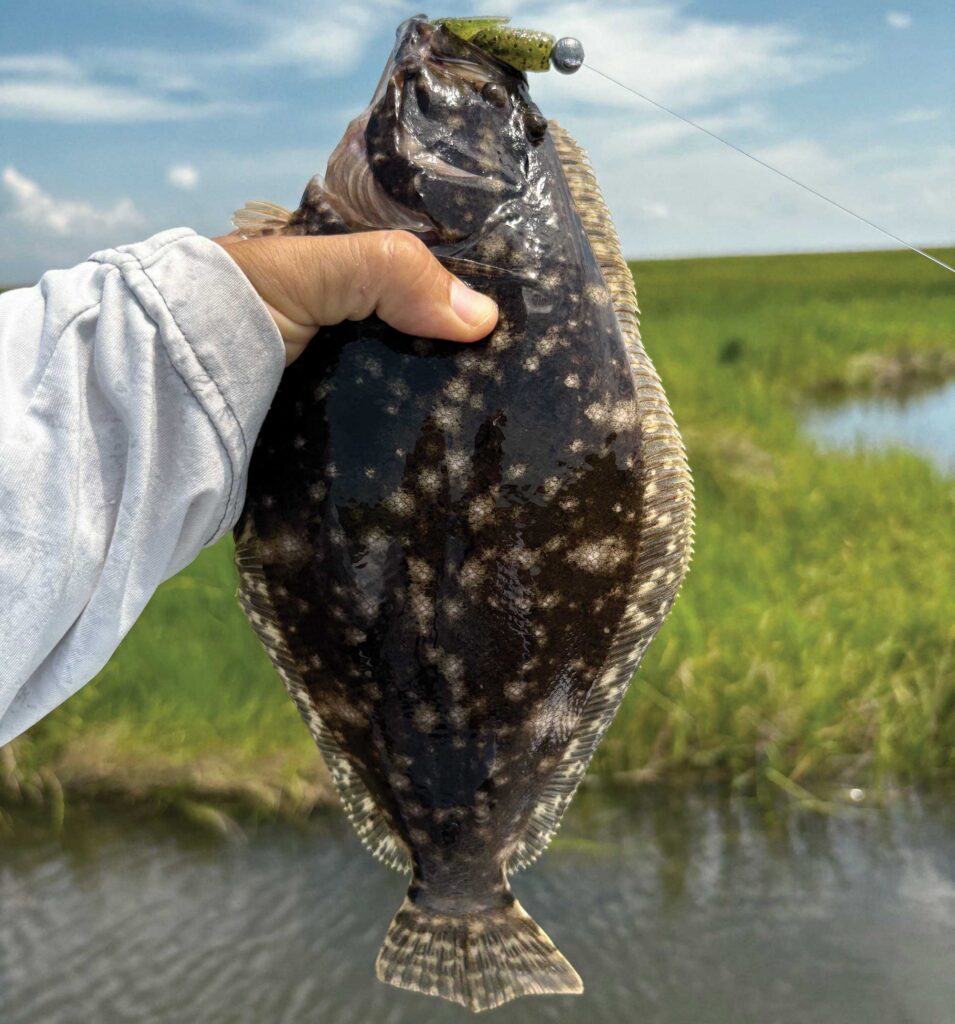
Anglers fishing the ledge walls also frequently bump into redfish and, especially flounder. In Louisiana, each angler may harvest four reds between 18-27 inches and up to 10 flounder with no size minimum.
Nolan McNeil would have been well within his legal rights to keep his 19-incher, but he let the fish go, opting instead to take a few smaller specks home for his mother to cook. But that doesn’t mean he wasn’t grinning from ear to ear when he pulled it over the gunwale. It was better than any Christmas present.
Because this spring pattern requires croakers to be carried with the current and slammed against the ledge walls, days with a large tidal range offer far more predictable action.
Where to Launch
The deep-water spring speckled trout action is best on the east side of the Mississippi River. Here are some launches that will put you right in the middle of the action.
St. Tammany Parish
- The Pointe Marina of Slidell, 118A Harbor View Ct., Slidell
- Rigolets Marina, 52250 US-90, Slidell
Orleans Parish
- Chef Harbor Marina, 21135 Chef Menteur Hwy., New Orleans
- South Shore Marina, 20510 Chef Menteur Hwy., New Orleans
- Eddie Pinto’s Marina & Seafood, 2651 Paris Rd., New Orleans
- Bait, Inc., 2001 Paris Rd., New Orleans
St. Bernard Parish
- Campo’s Marina, 1301 Yscloskey Hwy., St. Bernard
- Hopedale Marina, 7600 Hopedale Hwy., St. Bernard
- Sweetwater Marina, 6205 Delacroix Hwy., St. Bernard
- Serigne Boat Launch, 5933 Delacroix Hwy., St. Bernard
- Reggio Marina, 2000 Reggio Canal Rd., St. Bernard
Plaquemines Parish
- Beshel Boat Launch, 212 Beshel Rd., Pointe a la Hache