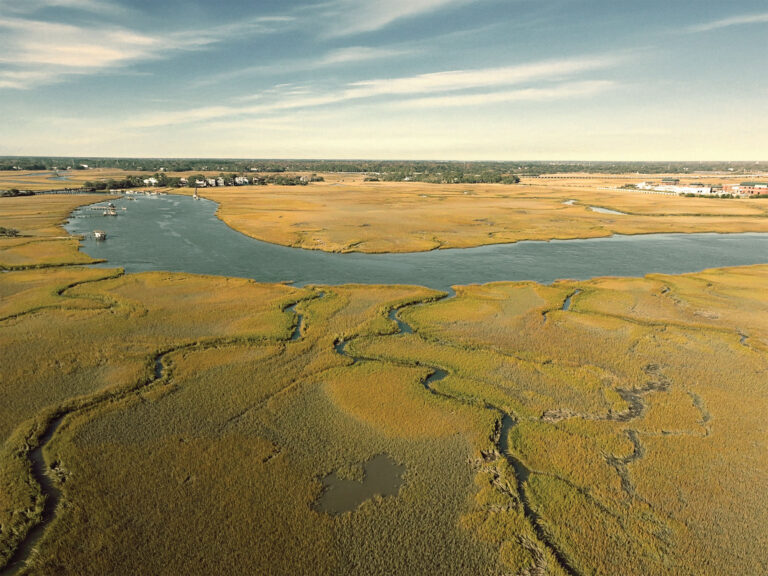
Grand Traverse Bay is a protected swath of Lake Michigan, tucked behind Leelanau Peninsula, located where the pinky in the mitten would be. Amazingly, head-scratchingly, this freshwater bay looks like Bimini. Crystal-clear waters framed by white and red pine trees—it’s quite a sight. This smallmouth bass haven started its Bahamian transformation when the zebra mussel was introduced in the late 1980s. The invasive bivalve known to grow on rocks, docks and other hard surfaces filters sediment from the water, leaving a clean, azure bay in its wake.
Elsewhere in the country’s inland lakes and waterways, invasive species and pathogens are wreaking havoc on aquatic ecosystems, the movement of baitfish between different bodies of water being a major contributor. Red shiners eat the eggs of native fish. Fathead minnows have spread viruses to new waters, killing off other baitfish species.
It’s for this reason that the non-profit Upstream Policies is making the case to restrict the use and sale of freshwater live bait in US waters. A peer-reviewed study by Upstream Policies’ sister organization Upstream Aquatic Institute went even further, concluding that “live baitfish restrictions have no detectable impact on the public’s engagement in recreational fishing.”
No, you didn’t accidentally pick up a copy of Fresh Water Sportsman. Yes, this is currently a freshwater issue. But for some, it’s the canary in the coal mine. The American Sportfishing Association sent out a press release criticizing Upstream Policies’ position and research, and published a policy brief titled “Tracking Legislative Efforts by an Animal Rights Group to Ban Live Bait.”
“Since Upstream Policies’ founding in 2023, the animal rights organization has framed its goal to ban all live bait as an effort to prevent invasive species,” the ASA press release states. “Although the live bait trade has been identified as a potential vector for the unintentional movement of invasive species, policymakers have established, and continue to review, laws and regulations to mitigate these risks.”
The press release also quotes Connor Bevan, ASA’s Inland Fisheries Policy Director. “The importance of live bait in sportfishing cannot be understated,” says Bevan. “As roughly two-thirds of anglers fish with live bait each year, proposed restrictions on the interstate sale of live bait would significantly impact anglers across the country.” The proposed restrictions “are both unwarranted and harmful to anglers and businesses nationwide.”
I later followed up with Bevan to inquire whether he believed this push for live bait restrictions could expand into saltwater. “The rationale for the group’s focus on freshwater live baitfish, as opposed to saltwater baitfish and all live bait fishing, is not explicitly stated,” Bevan explains. While restricting the use of freshwater live baitfish remains its legislative priority, Bevan says “the group may additionally advocate for bans on all live bait, including bans on the use of live bait for saltwater fishing.”
Considering the money involved in sourcing and selling baitfish, one can understand why the ASA, the country’s leading advocate for the sportfishing industry, is being so protective. In 2022, US anglers spent nearly $1.3 billion on live bait, including $291 million on saltwater live bait.
The ASA press release was reported on, shared on social media, and used as podcast fodder by media outlets and everyday anglers alike, their missives served with all the fixins that come with incredulousness: statements in all caps, excessive use of exclamation points, half-baked predictions and assumptions. (“BAN LIVE BAIT?!? Who else thinks this is ridiculous?” reads one social post.)
Here’s the problem with this issue: It’s not really an issue. “Upstream Policies has no plans to expand our work into saltwater environments, nor do we see doing so in the future,” says Victoria DeRooy, co-executive director of Upstream Policies. “The biological risks are fundamentally different in closed freshwater systems compared to open marine environments. Any concern to the contrary is unfounded.”
DeRooy also bristles at the phrase “live bait ban.” “Our work is strictly focused on live minnows in freshwater because they are high-risk vectors for fish pathogens and aquatic invasive species,” adds DeRooy. “Even regarding minnows, we are not advocating for a blanket ban on use. For example, we fully support anglers sourcing minnows locally.”
Read Next: The Top Five Issues Facing America’s Saltwater Anglers
The ASA press release was perfectly crafted to fire up the internet. Consider its headline: “Policy Brief Details Animal Rights Group’s Efforts to Ban Live Bait.” As DeRooy explains it, Upstream Policies’ goal is to mitigate the dumping of minnows into non-native waters and negatively impacting those aquatic habitats. A ban is certainly more dramatic and draconian than a restriction. The term “animal rights group” brings to mind social media warriors gluing themselves to museum artwork as a form of protest. Does “keeping native fish populations strong,” as the Upstream Policies’ mission states, make it an animal rights group?
If the ASA and Upstream Policies had spoken to each other, instead of broadcasting to the internet and social media, perhaps the paranoia and speculation could have been avoided. This is yet another reminder of the difference between the real and online worlds. It doesn’t work in the real campfire, but on social media, even the soggiest kindling can start a three-alarm blaze.