A recurring nightmare that haunts California saltwater anglers began decades ago in what many envisioned as a happy dream—the state’s Marine Life Protection Act (MLPA). It sounded good at first, but this legislation was turned against recreational fishing when well-funded environmental organizations hijacked the MLPA implementation. They even financed the process, as California was broke at the time. It became a sad version of the Golden Rule—those who have the gold make the rules.
Anglers got railroaded, overwhelmed by a well-organized and well-financed environmental community. Final implementation became reality in 2012. Today, 16 percent of coastal waters are set aside in a network of 124 marine protected areas, many of which are no-fishing zones. This nightmare won’t go away. Right now the California Fish and Game Commission is in the midst of analyzing that same network in a legally mandated process called the MPA Decadal Management Review.
“At the outset of the MPA Decadal Management Review, the rules of engagement for this process were founded on four pillars,” says Tonie Bangos, regional director-Southern California and lead advocacy staffer for the Coastal Conservation Association of California. “Those were research/monitoring, enforcement/compliance, outreach/education, and policy/permitting.
“Very importantly, the Commission and California Department of Fish and Wildlife—as well as the California Ocean Protection Council—repeatedly assured anglers that the only reason for expansion would be to improve the efficiency of the current network and better facilitate enforcement,” Bangos adds.
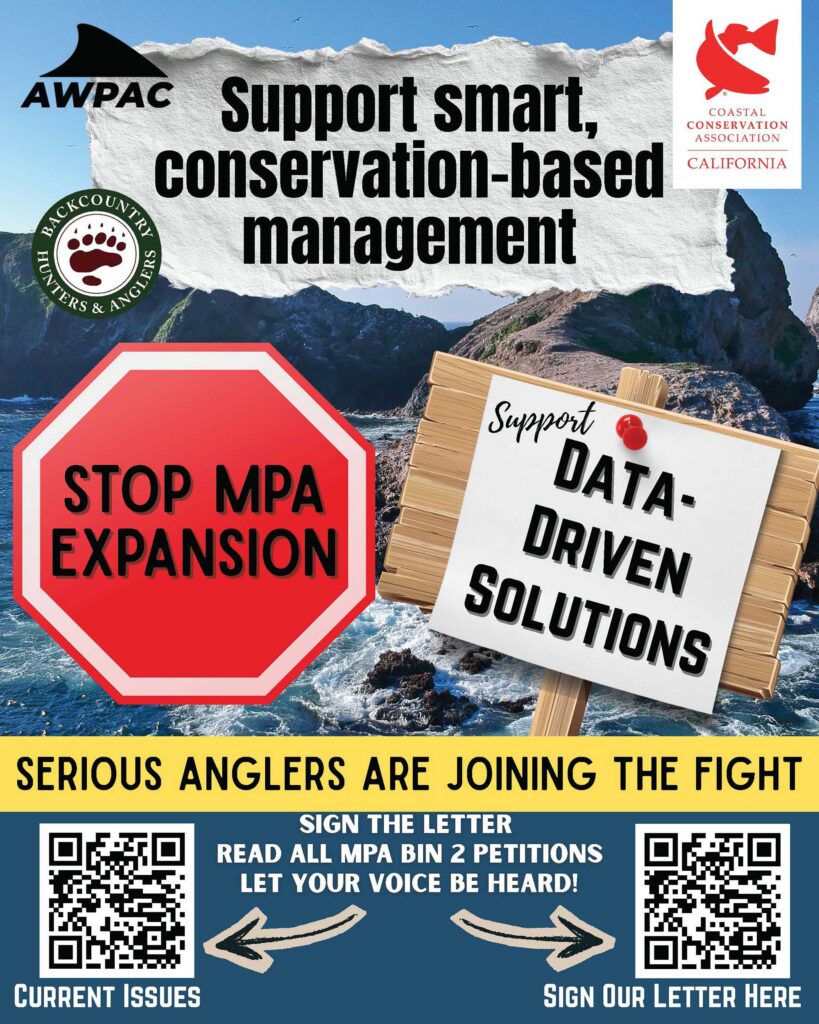
However, environmental groups are again trying to hijack the process. Azul, the Natural Resources Defense Council, West Marin Environmental Action Committee and others are pushing hard in defiance of the foundational pillars to seek further restrictions on angling access with a controversial tranche of nine anti-fishing proposals within a set of 15 known as the Bin 2 petitions.
Angling groups have cooperatively—some might say naively—abided by those pillars in submitting petitions that propose only minor tweaks and adjustments throughout the MPA network. Meanwhile, the environmental community proposed wholesale changes, including major expansions and creation of large new MPAs in San Diego, Laguna Beach, Malibu, Santa Catalina Island, San Luis Obispo and elsewhere.
These groups have conjured up a number of pretexts, but no actual science, for their anti-fishing proposals. An example of one contrived argument for MPA expansion is to protect and restore coastal kelp beds. Few anglers or scientists buy that rationale.
“Fishing activities have little to no impact on kelp health, as seen by thriving kelp populations throughout history pre-dating even the MLPA when fishing access was less restrictive,” according to a letter from a coalition of more than 30 angling, diving and conservation organizations and companies, including CCA California, that has worked in respectful collaboration with the Commission every step of the way.
Read Next: California and Feds Set to Roll Back Bottom-Fishing Restrictions
To be clear, California kelp is in crisis, but for other reasons, including chronic wasting disease among sunflower sea stars that feed mostly on sea urchins. Urchins eat kelp, and with reduced predation by sea stars, exploding urchin populations have decimated many kelp forests.
The review process is complex, and anglers are not the enemy. Yet, the threat of zealous environmental groups is real. You can help fight back. First, visit ccacalifornia.org/MPA. There you’ll find the coalition letter—read up on the angling community’s response to the petitions. Second, sign on to the letter to support the coalition’s position. This letter goes directly to the Fish and Game Commission. Third, attend one or more of three regional Commission meetings on April 21, May 5-6, and May 19 (also listed at ccacalifornia.org/MPA), as well as the June 17-18 Commission meeting, to make your voice heard in a respectful manner and stop this nightmare.