During my 29 years as a boating writer, I’ve been lucky enough to develop more than 1,300 boat tests on vessels ranging from 10-foot tenders to 100-foot superyachts and everything in between. In that time, I’ve learned how to evaluate a boat based on its handling, performance, ergonomics, quality of build and features. A lot of what I do can help you sift through the hundreds of boats out there and decide which one you want to buy. Here are key shopping tips for anglers.
Do a Walk-Through
First things first—get aboard the boat and eyeball everything. Look for wiring that is neat and secure to prevent wiggling loose while the boat is pounding through waves. Next, check out the lazarette and bilge compartments. You should have easy access to pumps and seacocks. Is the battery placement logical? On smaller boats, the batteries should be farther forward to help the boat plane faster.
At the helm, make sure you can see the bow of the boat and that there are adequate footrests. Boats with tall consoles should have a riser for shorter captains. Windshield distortion and/or large frames can hinder visibility. If the windshield goes to the top of the hardtop, is there a vent? You’ll want one on sultry days to keep cool.
Sit in every seat to make sure each has an adequate amount of backrest recline and that there are no weird badges or faux headrests that jab between your shoulders. Do your feet reach the floor comfortably? Are your knees in the air? Is the foam too soft or too hard? On a sunny summer day, does the upholstery get really hot?
Keeping Bait Alive
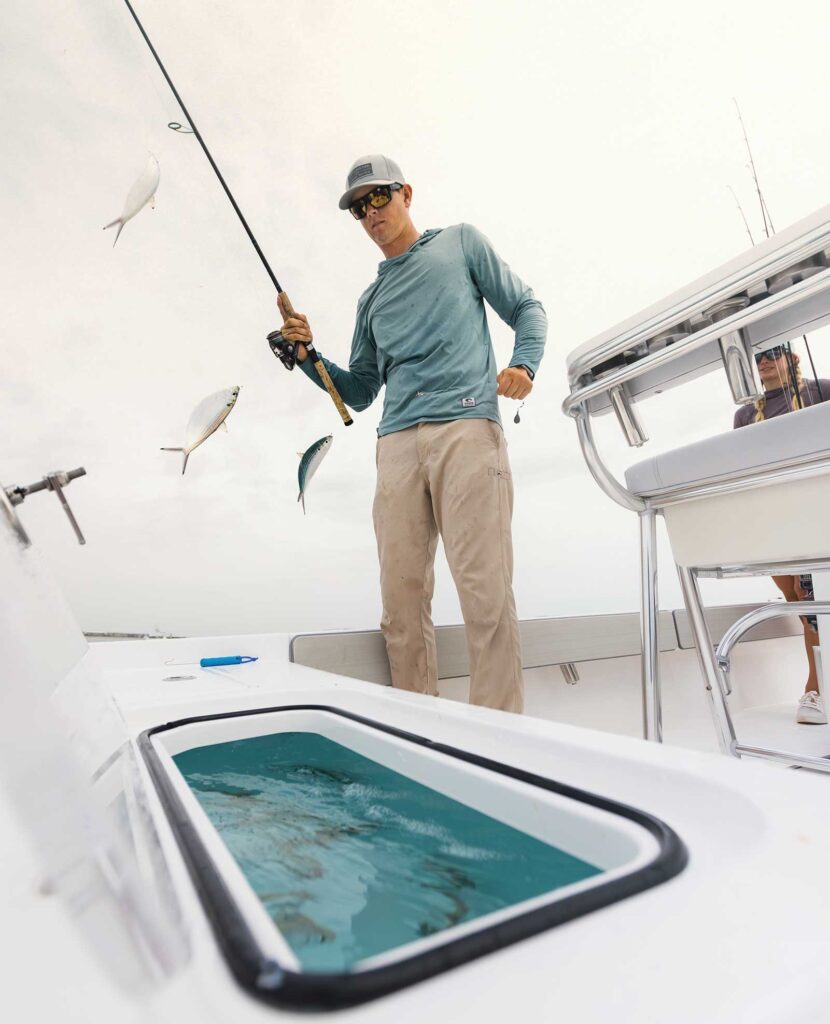
If you fish with live bait, make sure livewells are of an appropriate size and design. Better livewells are pressurized and have recirculating pumps. Offshore boats often have sea chests to purge air (that can kill live bait) from the fill hoses. Look at the position of livewells. Large, solitary livewells in the corner of the transom can make a boat list. The same weight distribution concerns apply to fishboxes as well, since they will be filled with ice (and, hopefully, fish). Can they be pumped or drained overboard? If the livewells or fish boxes are on the outer edges, there should be an identical one on the opposite side.
While I list a boat’s key features, I also spend some time determining what it doesn’t have. Features like trim tabs and electronics will have to be added if they aren’t installed, which adds to a boat’s bottom line retail price. Look for the absence of items like coaming pads, toe rails, electrical outlets for downriggers, and wiring for trolling motors. Are there enough cupholders or combo drink/rod holders to keep refreshments from spilling in rolling seas.
Grab rails should be positioned in places like behind the rearmost helm seats, on both sides of the center console, along the walkway to the bow and on the hardtop. These are critical for safety in rough water.
How do you get onto the boat? Look for a dive/boarding/tuna door on the side, a large swim platform that can be transited from side to side, along with a transom door. Is there a step-down into the cockpit with a handrail nearby? Beware of steps with rounded edges that don’t have non-skid, as they are slipping hazards. I like to go barefoot on a boat, and sometimes the non-skid is too harsh or inadequate. Take your shoes off and test it out.
If a boat has creature comforts like additional seat cushions and tables, can they be stored easily? While looking at the hatches, ensure they open easily, close securely, have gutters, and are gasketed to stay watertight. The lids should have a ram or friction hinges to hold them open for easy loading.
Welds on pipework for tops and towers should be neat and even, like fish scales or overlapping coins. On inexpensive boats, the insides of compartments or consoles are often unfinished, but there shouldn’t be any ragged fiberglass or exposed screw tips.
Read Next: Questions to Answer When Buying Electronics
Do a Sea Trial
Once satisfied with the quality and features, ask to do a test drive—aka sea trial. During holeshot, look for boats that get on plane quickly with little bowrise. Underpowered boats tend to labor to reach planing speeds and run at higher rpm when cruising, which puts extra stress on the motor.
Check a boat’s fuel economy, focusing on cruising speeds between 3,500 and 4,500 rpm. Don’t worry so much about the economy at wide-open throttle unless you are one of those backward-hat folks. Find the boat’s “happy speed,” where everything seems to quiet down and vibration is at its least.
See how slow you can go before the boat falls off plane and steerage becomes sloppy. In rough conditions, this is often the best speed to run. Put the boat into a moderately hard turn with the trim most of the way down to see if it holds its line or blows out. Sometimes, a boat will suddenly turn much faster in the middle of a turn, which can be dangerous. Even at top speed, a boat should be easy to drive and hold its line without wandering.
Use these procedures to evaluate a boat to ensure it’s the right fit for your style of fishing.
Which Boat Should I Buy?
Five tips to help you pick the best boat for your style of saltwater fishing.
- Narrow the field before you start your in-person search. Do research on brands and focus on boats that match your lifestyle and are within your budget.
- Take notes and use a scoring system to quantify the evaluation and minimize emotion.
- Shoot lots of photos. If you are seeing a lot of boats in one day—like at a boat show—make the first shot of each one a close-up of the boat’s manufacturer and model to keep them straight.
- Bring a tape measure to find out how much headroom there is in areas such as the center console and cabin. Measure the walkway space on the side of the center console. Use it to determine the square footage of the fishing cockpit. Check the height of the gunwales. Bay boats and flats skiffs will usually have an interior height of less than 20 inches, but offshore boat gunwales should be at least 24 inches tall to help anglers stay on the dry side of the boat.
- Have a list of questions to ask knowledgeable salespeople to help control the narrative and keep the conversation focused on what’s important to you.