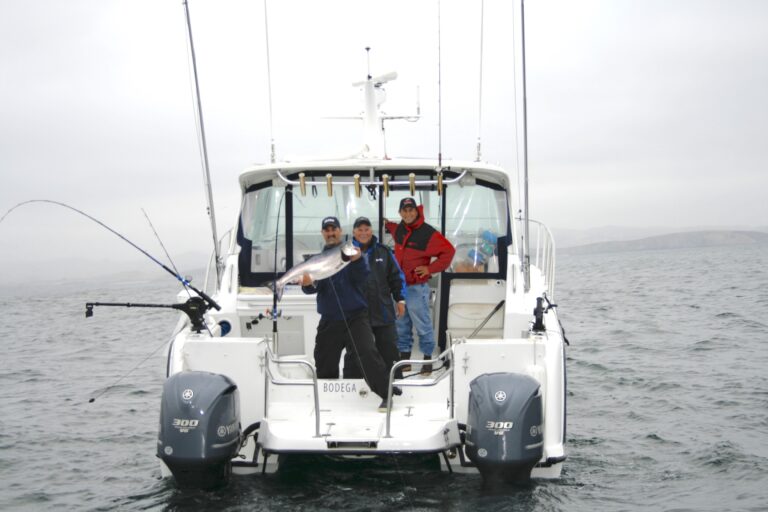
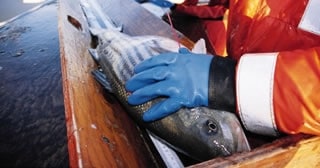
| Tagged stripers, such as this healthy specimen taken off North Carolina, are yielding important growth and migratory data that is helping biologists better manage the fishery. |
I guess there are scarier and stranger places to find yourself at eight o’clock in the morning on a chilly January day. Yet here I was, perched on the bow of a pitching 47-foot Coast Guard Motor Life Boat (MLB), bundled in a float suit, camera case in one hand and laptop slung over my shoulder, trying to clamber aboard a 170-foot research vessel. A young Guardsman had a death grip on my belt while he, in turn, was locked to a safety rail to keep us from taking a swim in the frigid water foaming around us.
My precarious position was the result of an invitation to spend a couple of days on the NOAA research vessel Oregon II as it conducted the 16th Annual Cooperative Winter Tagging Cruise in the waters off the Outer Banks. This part of the North Carolina coast plays an important role in the tagging program, as it serves as the wintering grounds for a significant portion of the adult population of East Coast striped bass.
The Coast Guard search-and-rescue team out of Station Oregon Inlet had ferried me out to the research vessel, which was awaiting our arrival a few miles off the inlet. The air and water temperatures were hovering at around 38 degrees and the wind was blowing 25 to 30 knots from the northeast. I had often fished for stripers in similar conditions back home in New Jersey, and now I was going bass fishing again – with a trawl net, no less.
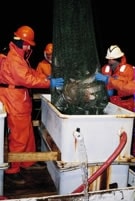
A netful of stripers is lowered into a holding tank on the fantail of the Oregon II prior to being tagged.|
After several attempts at boarding in the choppy seas, I finally found myself aboard the Oregon II, where I was greeted by its master, Commander Todd Stiles. “Welcome aboard,” he said, shaking my hand. Since I had never been so relieved to be on the deck of a boat in my life, the best I could manage was, “It’s great to be here, sir.”
Where the Bass Are
The next outstretched hand to come my way was attached to a familiar face. Bill Cole of the U.S. Fish and Wildlife Service (USF&W;) and I had spent many a meeting of the Mid-Atlantic Fishery Management Council together, and it was Cole who, a few months earlier, had invited me to witness what he described as “the longest running, scientific tagging survey of striped bass in existence.”
How could I say no, especially when there was the opportunity to see hundreds of cow stripers while learning about a program that has helped to rebuild stocks of this once beleaguered species. When the first cooperative tagging cruise was conducted, 16 years prior to my arrival, the total coastwide population of striped bass was estimated at between two and three million fish. As of the most recent stock assessment, that figure has soared to nearly 60 million fish, with the age structure of the population filling out nicely. The remarkable catches of big bass in 2003 serve as witness to what the scientists have been claiming.
The reason the cruise is conducted in the same area off the Outer Banks each January is because these are the grounds where mature bass from all the major spawning areas can be encountered. In discussions with Cole and research scientist Wilson Laney, I learned that they have recaptured tagged fish from every state north of North Carolina, and even from Nova Scotia. It appears that the majority of mature bass spawned in Albemarle Sound and Chesapeake Bay winter here, but portions of the populations that spawn in the Delaware and Hudson Rivers are present, too. Tag returns indicate that the fish return to their home waters to spawn in the spring, which creates an interesting picture of just how much traveling some striped bass do in the course of a year.
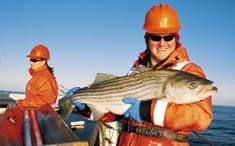
Workers measure the bass on wooden racks like the one at left before taking a scale sample, inserting a tag and releasing the fish. The operation takes only a few seconds.|
Imagine a Hudson River bass that spawns in May almost 100 miles upriver, then heads into the ocean and swims north into New England waters to fatten up over the summer. In the early fall it begins a southward migration, bypassing its home waters, ending up in January off the coast of North Carolina, where it stays until early spring. Then it’s back to the Hudson to spawn again in May and repeat the process. That’s a round trip of two to three thousand miles!
The first question that came to mind was why would so many mature bass from producer areas up and down the coast come here to winter. I found the answer as soon as the Oregon II resumed trawling operations.
Bait Haven
The Oregon II was built in 1967 for the Department of the Interior, Bureau of Commercial Fisheries, which was renamed the National Marine Fisheries Service and placed under the control of the National Oceanic and Atmospheric Administration, or NOAA. The vessel was transferred to NOAA in 1970 during the restructuring process. At 170 feet and a beam of 36 feet, she is outfitted to serve as a double-rigged trawler, longliner, gillnetter, fish-trap hauler and dredge, allowing her to performing a wide range of fisheries-research functions. She even does marine-mammal research and shark-tagging cruises in the Gulf of Mexico from her base of operations in Pascagoula, Mississippi. The Oregon II is equipped with the latest in fishing electronics and sensors, and has a complete onboard laboratory, computer room and accommodations for the staff of scientists and crew.
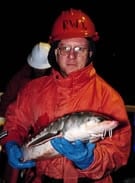
Scientist Wilson Laney cradles one of two Atlantic sturgeon that were taken in the nets during the author’s trip last January.|
During the Cooperative Tagging Cruise, the vessel would be operating a pair of 65-foot, small-mesh bottom trawls made of thick, soft twine to prevent the nets from damaging the fish. The typical “bottom time” for a set is under 15 minutes, less if the boat is in an area thick with fish. After the net is hauled back, the winch operator raises the tail bag of the net above the rear deck. The catch is removed by uncinching the bag end and allowing the fish to slip into one of two recirculating seawater holding tanks.
While it might sound like a rough way of handling fish you want to tag and release, I did not see a single striper that looked stressed or was unable to swim off in good condition after it was tagged. The short soak time prevents the net from getting too full and eliminates the chance of fish at the rear of the bag from getting crushed by too many fish on top of them.
The proof is in the tag returns. The tens of thousands of fish tagged over the years have compiled the highest return rate of any tagging program in the U.S. Over 20 percent have been recaptured, and the information gained has been compiled into a remarkable scientific database. By comparison, most fish-tagging programs realize a return rate of less than five percent.
As the first trawl set was being hauled back, I noticed the tail bag was bulging at the seams, but not with bass. Dozens of seabirds were diving and sitting on the net, picking out all manner of small baitfish that had become lodged in the webbing. There were anchovies, silversides and sand eels trapped in the net in incredible numbers, as well as all sizes of menhaden and at least two species of herring. When I asked Wilson Laney about all the baitfish, he told me that they were the reason the bass were here. It wasn’t a water-temperature thing, as I had thought. The region is a giant feeding station for millions of bass, seatrout, weakfish, sturgeon, flounder and other predatory species!
Day and Night
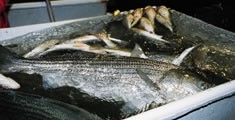
Big bass wallow in the holding tank among dead baitfish that are also taken in the nets. The staggering amount of bait in the waters off North Carolina in the winter leaves little doubt as to why the stripers gather here.|
During our cruise, the Oregon II had a ship’s complement of 34 people, plus one amazed observer from Salt Water Sportsman, to chronicle the events. The trawling and tagging operation is run like a fine-tuned engine. One trawl net is deployed off each side of the boat, suspended from a large outrigger. While one net is fishing, the other is being hauled back and emptied. There are two complete crews of gear operators comprising ex-commercial fishermen, and scientists from NOAA, USF&W;, several state agencies and a variety of universities and institutions, all interested in surveying the sea life that congregates here each winter. The wide-ranging backgrounds of the scientists and the varied sources of the assets (ship, specialized gear and funding) that make this project possible is the reason it is dubbed the “Cooperative Tagging Cruise.”
The scientists sort each haul, removing the fish one by one from the holding tanks, examining them for distinguishing marks or signs of disease, measuring, tagging, removing scale samples and recording the information on special log sheets, which are then brought to the computer room for entry into the database. The two teams work four hours on and four hours off around the clock for ten days!
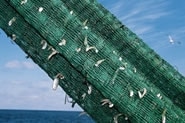
Thousands of tiny baitfish, such as bay anchovies and silversides, are captured in the fine mesh of the nets, part of a rich food chain that thrives off the Outer Banks.|
Not all the captured fish are tagged. The most common reason for this, especially during years when the numbers are high, is that they simply run out of tags. Another reason is that they frequently get too many fish in a single haul, and rather than overfill the holding tanks or keep fish out of the water for any length of time they will release a bunch without tags and just include them in the total number of captures. The other discrepancy can come when they decide to keep fish for scientific purposes, such as a post mortem examination back in the lab. Some years the scientists will keep 100 or so fish. Any fish that look sick are also kept for examination.
During my time on the Oregon II, I found it hard to sleep, even when I was exhausted. Every time I heard the winch retrieving a net it was torture not to grab the camera and see what was in the bag. The primary catch was striped bass, hundreds of them during the course of a day’s work, but we also caught spotted seatrout, weakfish, bluefish, Atlantic sturgeon, monkfish, summer flounder and a variety of small flatfish that I had neither seen nor heard of before. Then there was the incredible amount and variety of baitfish that had all these predators concentrated close to the beach. While I was aboard, the ship was making sets between 1/2 to three miles off the beach in depths of three to five fathoms.
Where Credit Is Due
| ### Of Ships and Commanders | |||
| ### The NOAA Fleet |
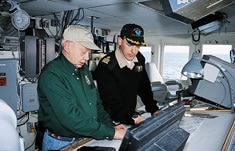
Lead researcher Bill Cole of the U.S. Fish and Wildlife Service, left, and Vice Captain Todd Stiles discuss where to make the next set.|
The Oregon II (R332) is one of 15 research vessels managed and operated by NOAA Marine and Aviation Operations. At 170 feet, she falls into the midrange of a fleet that includes five ships ranging from 215 to 274 feet; seven from 133 to 187 feet; and two under 100 feet. The purpose of the fleet is to conduct fisheries and living marine resource surveys and to perform research on global oceans, atmospheric conditions, space and the sun. The flagship is the 274-foot Ronald H. Brown (R104), built specifically for NOAA in 1997 for the purpose of doing advanced global- processes research worldwide. There are currently two brand-new, state-of-the-art fisheries survey and research vessels under construction to replace several aging members of the fleet.
NOAA Officers Corp
Commander Todd C. Stiles, NOAA Commander and Vice Captain of the Oregon II, is a proud representative of the NOAA Commissioned Officer Corps, one of the seven uniformed services of the United States. Its members provide NOAA with an important blend of operational, management, and technical skills that support the agency’s science and surveying programs at sea, in the air, and ashore. NOAA officers, in addition to managing and operating the agency’s ships and aircraft, are also scientists and engineers in their own right, serving in NOAA’s research laboratories and program offices throughout the nation and around the world.For more about the NOAA Research Fleet and the NOAA Officers Corps visit www.noaa.gov. – Gary Caputi
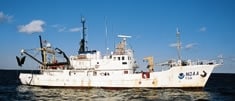
The Oregon II may not be the prettiest vessel in the NOAA fleet, but she plays a big role in the management of East Coast striped bass.|
Back in the galley with Bill Cole, who has been the Field Project Lead and Chief Scientist for all 16 of the cruises, we discussed some of the goals of the cruise. He explained that most years the program has tagged between 3,000 and 5,000 stripers (a minimum of 1,600 fish must be tagged each year to maintain the statistical validity of the survey). The data gathered provides fishery independent mortality estimates that are directly applied to the Virtual Population Analysis (VPA) scientists use to determine the health of the stocks and the rate of recovery. He said that most scientists involved in the management of striped bass do not earn their final “merit badge” until they have taken part in at least one of these cruises, because working here provides a true understanding of the population dynamics of the species. As a result, there is a waiting list of academics who want to participate, and Cole can never accommodate them all. Members of the press are rarely invited aboard, so this was a great privilege for Salt Water Sportsman.
On the morning of my departure, the sun rose over a glass-calm ocean, and the approaching MLB could be seen from miles away. I was grateful that the transfer would be considerably less harrowing this time. My brief cruise aboard the Oregon II was an experience that will be hard to forget, especially the image of scientists cradling 50-pound bass in their arms before releasing them into the cold water in an effort to gain greater knowledge about these incredible animals. The people involved – Bill Cole, Wilson Laney and all the scientists; Commander Todd Stiles and the hard-working crew of the Oregon II – are unsung heroes whose efforts have been instrumental in bringing striped bass stocks to a level of abundance no one believed possible just 15 years ago. Regardless of what you might think of fisheries management, the scientists who do the fieldwork and provide the independent data that is so sorely needed to make well-informed decisions are a dedicated and hardy bunch. They deserve the thanks of all of us who find value in our interactions with striped bass.
| ### NOAA Tagging Stats* * *### Striped Bass Caught/Tagged By Year | |||||||||||||||||||||||||||||||||||||||||||||||||||||||||||||||||||||||||||||||||||||||||||||||||||||||||||||||||||||||||||||||||||||||
| YEAR | NO. CAUGHT | NO. TAGGED | |||||||||||||||||||||||||||||||||||||||||||||||||||||||||||||||||||||||||||||||||||||||||||||||||||||||||||||||||||||||||||||||||||||
| 1988 | 1,619 | 1,335 | |||||||||||||||||||||||||||||||||||||||||||||||||||||||||||||||||||||||||||||||||||||||||||||||||||||||||||||||||||||||||||||||||||||
| 1989 | 1,169 | 1,157 | |||||||||||||||||||||||||||||||||||||||||||||||||||||||||||||||||||||||||||||||||||||||||||||||||||||||||||||||||||||||||||||||||||||
| 1990 | 3,010 | 2,010 | |||||||||||||||||||||||||||||||||||||||||||||||||||||||||||||||||||||||||||||||||||||||||||||||||||||||||||||||||||||||||||||||||||||
| 1991 | 1,810 | 1,780 | |||||||||||||||||||||||||||||||||||||||||||||||||||||||||||||||||||||||||||||||||||||||||||||||||||||||||||||||||||||||||||||||||||||
| 1992 | 1,062 | 1,017 | |||||||||||||||||||||||||||||||||||||||||||||||||||||||||||||||||||||||||||||||||||||||||||||||||||||||||||||||||||||||||||||||||||||
| 1993 | 577 | 530* | |||||||||||||||||||||||||||||||||||||||||||||||||||||||||||||||||||||||||||||||||||||||||||||||||||||||||||||||||||||||||||||||||||||
| 1994 | 5,320 | 4,632 | |||||||||||||||||||||||||||||||||||||||||||||||||||||||||||||||||||||||||||||||||||||||||||||||||||||||||||||||||||||||||||||||||||||
| 1995 | 911 | 644* | |||||||||||||||||||||||||||||||||||||||||||||||||||||||||||||||||||||||||||||||||||||||||||||||||||||||||||||||||||||||||||||||||||||
| 1996 | 799 | 696* | |||||||||||||||||||||||||||||||||||||||||||||||||||||||||||||||||||||||||||||||||||||||||||||||||||||||||||||||||||||||||||||||||||||
| 1997 | 1,391 | 1,357 | |||||||||||||||||||||||||||||||||||||||||||||||||||||||||||||||||||||||||||||||||||||||||||||||||||||||||||||||||||||||||||||||||||||
| 1998 | 468 | 463* | |||||||||||||||||||||||||||||||||||||||||||||||||||||||||||||||||||||||||||||||||||||||||||||||||||||||||||||||||||||||||||||||||||||
| 1999 | 288 | 283* | |||||||||||||||||||||||||||||||||||||||||||||||||||||||||||||||||||||||||||||||||||||||||||||||||||||||||||||||||||||||||||||||||||||
| 2000 | 6,546 | 6,275 | |||||||||||||||||||||||||||||||||||||||||||||||||||||||||||||||||||||||||||||||||||||||||||||||||||||||||||||||||||||||||||||||||||||
| 2001 | 2,473 | 2,445 | |||||||||||||||||||||||||||||||||||||||||||||||||||||||||||||||||||||||||||||||||||||||||||||||||||||||||||||||||||||||||||||||||||||
| 2002 | 4,188 | 4,093 | |||||||||||||||||||||||||||||||||||||||||||||||||||||||||||||||||||||||||||||||||||||||||||||||||||||||||||||||||||||||||||||||||||||
| 2003 | ** ¿** | 1,908 | |||||||||||||||||||||||||||||||||||||||||||||||||||||||||||||||||||||||||||||||||||||||||||||||||||||||||||||||||||||||||||||||||||||
| *Years of unusually low captures and fish tagged usually occur due to foul weather. While relatively large vessels are used for the survey, winter sea conditions can make trawling dangerous or impossible at times.* * * | |||||||||||||||||||||||||||||||||||||||||||||||||||||||||||||||||||||||||||||||||||||||||||||||||||||||||||||||||||||||||||||||||||||||
| ### Different Species Tagged To Date | |||||||||||||||||||||||||||||||||||||||||||||||||||||||||||||||||||||||||||||||||||||||||||||||||||||||||||||||||||||||||||||||||||||||
| Atlantic sturgeon | 115 | ||||||||||||||||||||||||||||||||||||||||||||||||||||||||||||||||||||||||||||||||||||||||||||||||||||||||||||||||||||||||||||||||||||||
| Spiny dogfish | 7,395 | ||||||||||||||||||||||||||||||||||||||||||||||||||||||||||||||||||||||||||||||||||||||||||||||||||||||||||||||||||||||||||||||||||||||
| Summer flounder | 921 | ||||||||||||||||||||||||||||||||||||||||||||||||||||||||||||||||||||||||||||||||||||||||||||||||||||||||||||||||||||||||||||||||||||||
| Red drum | 6 | ||||||||||||||||||||||||||||||||||||||||||||||||||||||||||||||||||||||||||||||||||||||||||||||||||||||||||||||||||||||||||||||||||||||
| Striped bass | 30,576 | ||||||||||||||||||||||||||||||||||||||||||||||||||||||||||||||||||||||||||||||||||||||||||||||||||||||||||||||||||||||||||||||||||||||
| Total | 39,013 | ||||||||||||||||||||||||||||||||||||||||||||||||||||||||||||||||||||||||||||||||||||||||||||||||||||||||||||||||||||||||||||||||||||||
| * * * | |||||||||||||||||||||||||||||||||||||||||||||||||||||||||||||||||||||||||||||||||||||||||||||||||||||||||||||||||||||||||||||||||||||||
| ### Top Two Tagging Years | |||||||||||||||||||||||||||||||||||||||||||||||||||||||||||||||||||||||||||||||||||||||||||||||||||||||||||||||||||||||||||||||||||||||
| 1994 | 4,632 | ||||||||||||||||||||||||||||||||||||||||||||||||||||||||||||||||||||||||||||||||||||||||||||||||||||||||||||||||||||||||||||||||||||||
| 2000 | 6,275 (over 600 fish per 24-hour period) | ||||||||||||||||||||||||||||||||||||||||||||||||||||||||||||||||||||||||||||||||||||||||||||||||||||||||||||||||||||||||||||||||||||||
| * * * | |||||||||||||||||||||||||||||||||||||||||||||||||||||||||||||||||||||||||||||||||||||||||||||||||||||||||||||||||||||||||||||||||||||||
| ### Tag Returns by State | ### Number | ### Percent | |||||||||||||||||||||||||||||||||||||||||||||||||||||||||||||||||||||||||||||||||||||||||||||||||||||||||||||||||||||||||||||||||||||
| Nova Scotia | 1 | 0.02% | |||||||||||||||||||||||||||||||||||||||||||||||||||||||||||||||||||||||||||||||||||||||||||||||||||||||||||||||||||||||||||||||||||||
| Maine | 58 | 1.1% | |||||||||||||||||||||||||||||||||||||||||||||||||||||||||||||||||||||||||||||||||||||||||||||||||||||||||||||||||||||||||||||||||||||
| Massachusetts | 632 | 12.0% | |||||||||||||||||||||||||||||||||||||||||||||||||||||||||||||||||||||||||||||||||||||||||||||||||||||||||||||||||||||||||||||||||||||
| Connecticut | 118 | 2.2% | |||||||||||||||||||||||||||||||||||||||||||||||||||||||||||||||||||||||||||||||||||||||||||||||||||||||||||||||||||||||||||||||||||||
| New Hampshire | 22 | 0.4% | |||||||||||||||||||||||||||||||||||||||||||||||||||||||||||||||||||||||||||||||||||||||||||||||||||||||||||||||||||||||||||||||||||||
| Delaware | 6 | 1.3% | |||||||||||||||||||||||||||||||||||||||||||||||||||||||||||||||||||||||||||||||||||||||||||||||||||||||||||||||||||||||||||||||||||||
| Rhode Island | 140 | 2.7% | |||||||||||||||||||||||||||||||||||||||||||||||||||||||||||||||||||||||||||||||||||||||||||||||||||||||||||||||||||||||||||||||||||||
| New York | 488 | 9.3% | |||||||||||||||||||||||||||||||||||||||||||||||||||||||||||||||||||||||||||||||||||||||||||||||||||||||||||||||||||||||||||||||||||||
| New Jersey | 236 | 4.5% | |||||||||||||||||||||||||||||||||||||||||||||||||||||||||||||||||||||||||||||||||||||||||||||||||||||||||||||||||||||||||||||||||||||
| Pennsylvania | 9 | 0.2% | |||||||||||||||||||||||||||||||||||||||||||||||||||||||||||||||||||||||||||||||||||||||||||||||||||||||||||||||||||||||||||||||||||||
| Maryland | 2,107 | 40.0% | |||||||||||||||||||||||||||||||||||||||||||||||||||||||||||||||||||||||||||||||||||||||||||||||||||||||||||||||||||||||||||||||||||||
| District of Columbia | 9 | 0.2% | |||||||||||||||||||||||||||||||||||||||||||||||||||||||||||||||||||||||||||||||||||||||||||||||||||||||||||||||||||||||||||||||||||||
| Virginia | 1,016 | 19.3% | |||||||||||||||||||||||||||||||||||||||||||||||||||||||||||||||||||||||||||||||||||||||||||||||||||||||||||||||||||||||||||||||||||||
| North Carolina | 179 | 3.4% | |||||||||||||||||||||||||||||||||||||||||||||||||||||||||||||||||||||||||||||||||||||||||||||||||||||||||||||||||||||||||||||||||||||
| unknown location | 180 | 3.4% | |||||||||||||||||||||||||||||||||||||||||||||||||||||||||||||||||||||||||||||||||||||||||||||||||||||||||||||||||||||||||||||||||||||
| * * * | |||||||||||||||||||||||||||||||||||||||||||||||||||||||||||||||||||||||||||||||||||||||||||||||||||||||||||||||||||||||||||||||||||||||
| ### Total Recaptures of Striped Bass to Date | |||||||||||||||||||||||||||||||||||||||||||||||||||||||||||||||||||||||||||||||||||||||||||||||||||||||||||||||||||||||||||||||||||||||
| 5,261 This is a recapture rate of 17.2%, more than quadruple the return rate of most tagging programs.* * * | |||||||||||||||||||||||||||||||||||||||||||||||||||||||||||||||||||||||||||||||||||||||||||||||||||||||||||||||||||||||||||||||||||||||
| ### Most Distant Striped Bass Recapture | |||||||||||||||||||||||||||||||||||||||||||||||||||||||||||||||||||||||||||||||||||||||||||||||||||||||||||||||||||||||||||||||||||||||
| Nova Scotia, Canada* * * | |||||||||||||||||||||||||||||||||||||||||||||||||||||||||||||||||||||||||||||||||||||||||||||||||||||||||||||||||||||||||||||||||||||||
| ### Longest Time at Large Before Recapture | |||||||||||||||||||||||||||||||||||||||||||||||||||||||||||||||||||||||||||||||||||||||||||||||||||||||||||||||||||||||||||||||||||||||
| Tag #106175 | 12.4 years | ||||||||||||||||||||||||||||||||||||||||||||||||||||||||||||||||||||||||||||||||||||||||||||||||||||||||||||||||||||||||||||||||||||||
| Fish was tagged on January 19, 1998, and recaptured on June 25, 2001* * * | |||||||||||||||||||||||||||||||||||||||||||||||||||||||||||||||||||||||||||||||||||||||||||||||||||||||||||||||||||||||||||||||||||||||
| ### Multiple Recaptures | |||||||||||||||||||||||||||||||||||||||||||||||||||||||||||||||||||||||||||||||||||||||||||||||||||||||||||||||||||||||||||||||||||||||
| 147 striped bass have been recaptured twice 3 stripers have been recaptured three times* * * | |||||||||||||||||||||||||||||||||||||||||||||||||||||||||||||||||||||||||||||||||||||||||||||||||||||||||||||||||||||||||||||||||||||||
| ### Largest Striped Bass Tagged | |||||||||||||||||||||||||||||||||||||||||||||||||||||||||||||||||||||||||||||||||||||||||||||||||||||||||||||||||||||||||||||||||||||||
| 52.6 inches |