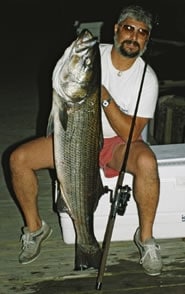
| Live eels are the key to scoring with big bass during the steamy summer months. The author took this 36-pounder on a rock ridge off Takanasee Beach on the north Jersey coast in July. |
It was another late-July scorcher. I’d been hiding in my air-conditioned office, trying to escape the oppressive heat and humidity. When the weather gets like that, not too many people think about fishing for stripers, but I had them on my mind all day. The moon was rising, only a few days from full, and the evening forecast called for a light breeze out of the west and temperatures in the low 80s. It would be a perfect night for hitting some inshore structure, and there was every reason to expect the bass to be in a cooperative mood, especially since I was bringing their favorite summer treat – live eels.
A call to Bill George, one of my fishing buddies, confirmed that I would not be fishing alone, so after dinner I grabbed a couple of rods and headed to the marina. The plan was to leave New Jersey’s Manasquan Inlet and run north along the beach, where there’s a lot of good inshore structure that bass tend to frequent under the cover of darkness. It’s over these relatively shallow, hard-bottom spots that stripers look for food, and nothing whets their appetite more than eels.
The Best Bait
Whether you’re night fishing for summer bass in New Jersey or Massachusetts, or anywhere in between, eels are the only live bait you need. Eels have a lot going for them besides their propensity for catching stripers. They are incredibly hardy, require little in the way of care, and a fresh supply is usually no farther away than the local bait shop. If you’ve got the time and access to brackish water, you can try catching them yourself with an eel pot, available at many bait and tackle stores. The pot can be baited with crushed crabs or a fish rack and suspended near the bottom of a tidal river or bay. Check it every so often and you’re in business.
Finding Prime Structure
The first stop of the evening for George and I was a small piece of rocky bottom off Long Branch. As we passed over the high spot, I watched the depthsounder intently for signs of life, but no bait or stripers were evident. So it was off to the next spot, and the next. At the sixth stop the screen finally lit up with big fish marks.
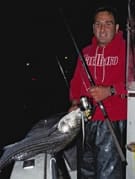
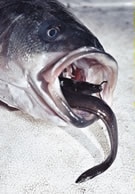
Summer eel fishing is most effective at night, when big stripers move onto shallow structure to feed. Look for fish around rocky areas where baitfish tend to concentrate, and don’t send down the “snakes” until you mark activity on your depthsounder. (bottom) Circle hooks will reduce the number of gut-hooked bass when fishing live eels.|
This is the key to summer night-fishing success: you need to spend as much time as it takes to locate the fish on your depthsounder before sending down the eels. Unless you mark bass on the sounder, don’t waste your time fishing – keep looking. When you find fish, it usually isn’t hard to catch them.
After breaking out the rods, I put the engine in neutral and watched the track line on the plotter to see how the wind and current were going to affect the drift. Meanwhile, George reached into the eel bucket and extracted the evening’s first reluctant participant.
How to Hook ‘Em
Hooking an eel is somewhat easier said than done, especially for the novice. Eels are no fun to handle. They’re unbelievably slippery and have a way of slithering out of your hands, no matter how firmly you grab them, which makes it difficult to get one on a hook. We get around this problem by bringing along a bag of ice and pouring some in a bucket. Before arriving at the first spot, we take some eels out of the live well with a bait net and plop them in the bucket to chill, literally. When they get cold, they get slow, which makes them easier to pick up with a rag. As soon as they hit the warm water, they spring back to life and take off for the bottom.
I prefer hooking my eels by pushing the point up through the lower jaw and out through one of the eye sockets. They stay on the hook longer this way, even after repeated attacks, but it is particularly important if you are casting them.
Drifting Shallow Spots
Once the boat was positioned to drift over the high point of the structure, I shut down the engine and we dropped our eels over the side. Keeping the reels in free-spool, we let out line until the eels were swimming just off the bottom. The water was only 25 feet deep, rising to 16 feet on top of the structure. The drift was slow, so we didn’t need weight. Glancing at the depthsounder, I watched the bottom steadily rise and arch-shaped marks appear on the down-current side of the high spot. A few moments later, the eels were in the strike zone and Bill smiled. “I just got bumped,” he said.
He pointed his rod at the water, put the reel in gear and lifted. Line peeled off rapidly as the fish made a dash toward deeper water, and a few minutes later we had the 25-pounder on board. After a quick hook extraction and a few photos, it was ready for release. It was a nice fish, typical of the large, mature bass we see in residence on open ocean structure during the summer.
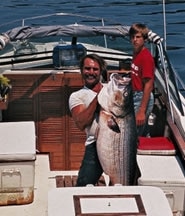
Bob Rocchetta’s 76-pound behemoth, taken on July 17, 1981, still stands as the largest boat-caught striper of all time. It was caught at night on a live eel.|
Deep Structure and Fast Water
There are places where night fishing with eels requires a slightly different approach due to increased depth and current. The deep rips between Montauk and Block Island, the ship channels between Sandy Hook and New York Harbor, the East River in New York City, and the “holes” of the Elizabeth Islands off Massachusetts are a few places where heavy sinkers and three-way rigs come into play. Three-way rigs allow you to use as much weight as necessary to get your eel down to where the bass are holding.
Tackle used in these places is generally heavier, but the basic technique is the same. Locate the fish on your depthsounder and short-drift the spot before sending your eels down. You can also try stemming the tide to slow your drift if it’s too fast. If the bass are holding tight to a particular spot, you can even try anchoring and letting the current carry the eels back.
On a trip to Massachusetts’ Cuttyhunk Island last year, the day fishing was producing only small bass, so we spent some time poking around the area, looking for potential big-fish spots. A narrow cut with lots of rocks and rips between two islands caught our attention, so we returned at night with a well full of live eels and caught fish up to 40 pounds. In fact, all of the biggest bass we caught during the five-day trip came from that same spot, and all of them were taken at night on eels!
Night fishing isn’t for everyone, which can be a good thing. Often we fish areas that are loaded with boats during the day, but at night we have them all to ourselves. Two years ago I took a couple of friends fishing on the Fourth of July. We watched the fireworks of several different towns while catching stripers to over 30 pounds barely a half-mile off the beach. Just remember: Bass do most of their feeding at night during summer and early fall, and it’s always best to be fishing when they want to eat. And if you also show them what they want to eat, action is virtually guaranteed.
| ### Two Simple Rigs |
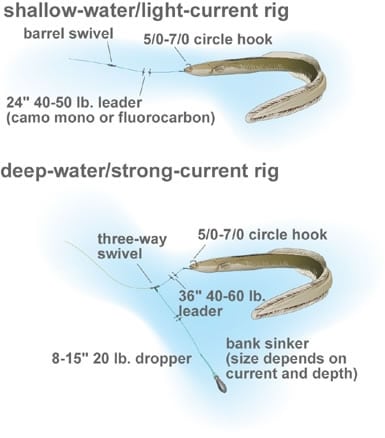
¿| Rigs for fishing live eels are as basic as they come, so tie up a couple dozen and keep them handy for when an eel tangles itself in the leader or a bluefish bites you off. In shallow water with light current, use 24 inches of 40- or 50-pound camouflage mono or fluorocarbon with a barrel swivel on one end and a circle hook on the other.In addition to causing less damage to the bass and making them easier to release, I have found that circle hooks also increase the number of hook-ups. I don’t like offset circle hooks, but if I can’t find the standard kind I’ll remove the offset by bending the point back in line with the shank. With smaller eels (under ten inches), a 5/0 hook is fine. With larger eels, a 6/0 or 7/0 will lock around the fish’s jaw with no interference from the eel.You don’t have to let a bass run with the eel when using circle hooks. When you feel that first “bump,” the fish will either drop the eel or eat it and start moving off immediately, causing the hook to set itself. As soon as the line comes tight, lift the rod and the fish is usually yours.In deeper water or in areas with strong current, use a three-way rig. You can use bank sinkers as large as necessary, which in some places may be as heavy as 12 ounces or more. Leader material can be fluorocarbon or camouflage monofilament in 40-, 50- or 60-pound test. Leader length is about 36 inches from the swivel to the hook. The dropper line to the bank sinker can be eight to 15 inches, and if you make it out of lighter line (say 20-pound test), it will allow the sinker to break off if it hangs up in the bottom. – Gary Caputi