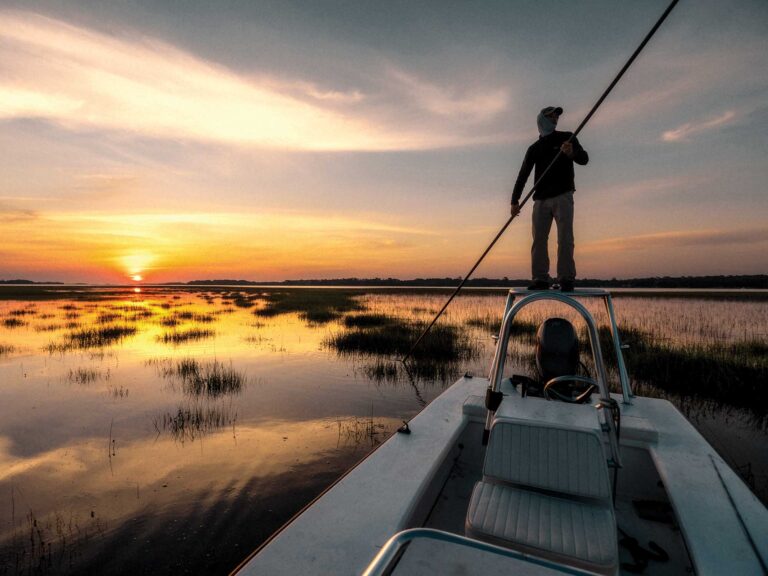
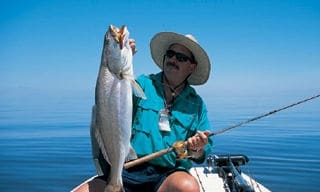
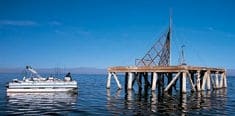
| Author Ron Ballanti agrees with corvina fishermen who say this is the place for their kind of action, though the arid landscape and hypersaline water (below) make for a strange angling destination. |
Clearing the jetties in the orange light of dawn, I pushed the throttle forward and our skiff jumped on plane. Salt spray stung my face as we bounced across the wake of another boat, but otherwise the water was flat calm. It was the perfect start to an adventure at sea, and we were excited over the prospects of tangling with big, salt water game fish.
Nothing unusual about this scene, except for the fact that Josh Hendricks and I were 100 miles from the nearest ocean and 230 feet below sea level. It was our first trip to the bizarre Salton Sea, a vast salt water lake covering some 375 square miles and sitting in the middle of California’s driest and hottest desert. Josh and I had come here in search of the Sea’s roving schools of big, aggressive orangemouth corvina, a close cousin of California’s prized white seabass. We found them, and before the trip was over we had had our fill of the wide-open, light-tackle action that draws anglers to this strange and unique fishery.
A story about landlocked salt water fishing in these pages may seem a bit of a stretch, but consider a few facts. For starters, the waters of the Salton Sea are 30 percent saltier than the Pacific. Secondly, Salton’s corvina are true marine game fish, transplanted decades ago from Mexico’s Sea of Cortez. And when it comes to sporting quality, corvina – which can weigh over 35 pounds – will stand up to anything you’ll find along the coast.
Granted, the Salton Sea isn’t everyone’s idea of an idyllic fishing hole. For one thing, the scenery is straight out of a post-apocalyptic sci-fi movie. Decomposing algae and surrounding agricultural fields combine to create a pungent potpourri of smells that defies comparison. And summer temperatures can soar to 115 degrees in the shade – if you can find any shade. In fact, this reputation is enough to keep all but the most hardcore anglers away, which is just fine with the small but growing faction of corvina fanatics who have become addicted to this weird and wonderful place.
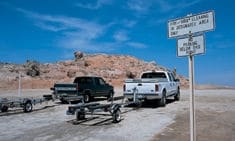
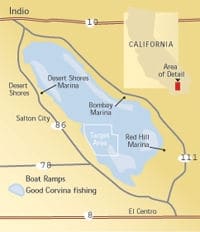
Once a popular tourist attraction, the Salton Sea boasts a number of good launch ramps, despite its remote locale.|
Talk to Salton Sea regulars and you’ll get the feeling that those who know corvina would be willing to walk barefoot across hot coals to catch them. “Once you’ve experienced a hot corvina bite, you’ll say it’s the most fun you’ve ever had,” states Barry Brightenburg, owner of Fish Trap Lures and a long-time Salton Sea aficionado. “It’s like the most wide-open seabass fishing you could imagine, except these fish love to hammer plastics, and they jump!”
It’s this type of action that keeps Salton fishing guide Jim Penn busy year-round. “We consider catching 30 to 40 fish a good day, and 100-fish days are not uncommon,” said Penn. “When you find a school, the action can be fast and furious, with double and triple hook-ups whether you’re casting lures, trolling or drifting with live bait.”
Finding a school, however, is the main challenge. The Sal-ton is a huge body of water with a mostly flat and featureless bottom, so it’s hard to predict where the fish will be from day to day. The key is finding the right water color. According to Penn, Brightenburg and other Salton Sea regulars, you want to look for dark-brown water that resembles rootbeer or coffee. This “healthy” color – which takes some getting used to as a sought-after commodity – is a result of blooming algae. Green water indicates dying algae, which saps oxygen from the water and drives the fish away. Water conditions can change rapidly, so it pays to check with local sources ahead of time. And don’t be afraid to move around in search of good water.
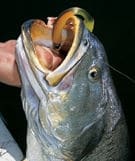
Salton Sea corvina love to hit artificials, particularly brightly colored soft-plastics fished on jigheads.|
With the fish always on the move and the water always changing, there’s no such thing as a guaranteed hot spot. Still, there are some trends to follow. Popular areas include the many rock jetties that dot the shoreline along Salton Sea State Recreational Headquarters, Bombay Marina or Red Hill Marina, as well as shoreline areas such as the Observation Tower, Black Rock, Mullet Island or the mouth of the Alamo River. In general, Penn likes to fish the northwest section of the Sea around Johnson’s Landing in March through June, and usually focuses his efforts around the Bombay and Red Hill Marinas later in the year.
The right depth to fish varies from season to season. In the warmer spring and summer months, corvina are often caught in shallow water ranging from four to ten feet as they forage for croaker and tilapia. In late fall and winter, the fish hold in deeper water and are more likely to relate to structure, such as the remains of the long pier at the abandoned Navy base or the Target, a platform that rises from 35-foot depths along the Sea’s southwestern shore.
“I love winter fishing. You don’t have to battle the heat and there’s just a handful of boats on the whole Sea,” says Penn. “You don’t get the big numbers like you do in the spring and summer, but the bite is more predictable. You can usually count on going out and getting ten nice-sized fish – and you might not see another boat all day.”
Corvina Tackle & Tactics
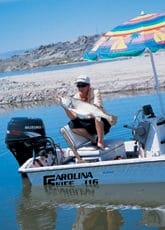
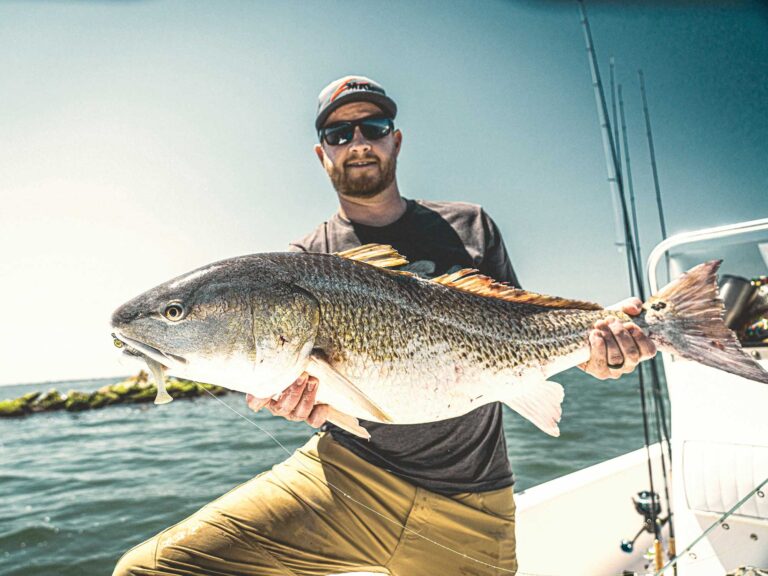
Josh Hendricks, above, and the author caught corvina up to 16 pounds in root-beer-brown water up to ten feet deep.|
Corvina are often caught on live bait such as tilapia, croaker or mudsuckers, all of which can be taken with rod and reel or purchased from local bait suppliers. These baits are often fished without additional weight, or simply with a small sliding egg or rubbercore sinker. Three- to six-inch tilapia account for the majority of corvina caught on live bait.
But it’s the corvina’s penchant for slamming artificals that excites most anglers. At times they will readily attack cast or trolled crankbaits, and when they’re suspended they can be fooled with flashy, vertically jigged spoons such as Kastmasters or Hopkins. They’ve also been known to nail topwater lures when they have bait corralled in the shallows. But day in and day out, it’s the soft-plastic swimbait that seems to be the hot ticket.
Brightenburg recommends four- and five-inch swimbaits in bright color combinations of orange, chartreuse, gold and green, fished on 1/2- or 3/4-ounce leadheads with extra-sharp hooks. In general, Brightenburg likes orange in the morning and chartreuse in the afternoon, though he’s quick to admit that there are no hard and fast rules. “Corvina can be very selective about color and pattern. They really test you. They’re no pushovers, but when you get it right the action can be rewarding to say the least.”
If there is a lesson to be taken from this, it’s to be versatile and experiment. Penn readily tosses Fish Trap lures in the aforementioned colors, but also fishes Storm swimbaits in rainbow trout, golden mullet and bluegill patterns. He also recommends trying different retrieve speeds until you find the one that works. Sometimes the fish prefer a slow, steady retrieve, sometimes they want the lure bouncing along the bottom, and sometimes they respond to a quick mid-water retrieve. Penn strongly recommends trolling as a top way to cover ground and locate the schools. Once a fish is hooked, stop the boat and immediately begin casting, as several swimbaits in close proximity can incite a frenzy.
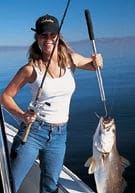
Some anglers prefer fishing the Sea in winter, simply because it’s cooler and the resident corvina act more like the marine species they are, holding deeper around structure.|
Brightenburg likes to drift a likely area while casting in different directions. “Always keep a rod in a holder with a swimbait dragging just above the bottom as you drift along,” he advises. “You’ll catch as many fish with this technique as anything else.”
Corvina put up a challenging fight on light tackle, which you can get away with because there’s little in the way of line-threatening structure. Like white seabass, corvina have large but widely spaced teeth, so you don’t have to worry about using a heavy leader. A baitcasting outfit with ten- or 12-pound line will do the job just fine. The bites tend to be very soft, so a heavy drag setting and a stout graphite rod of seven to eight feet will help set the hook when you get picked up on the cast or the troll.
The Salton Sea isn’t for everyone. Many people don’t care for its heat, smells and barren landscape. Yet others see past these things and thrive on the challenge of catching game fish in this strange environment. If this sounds like you, give the Salton Sea a try. Beauty, after all, is in the eye of the beholder.
¿
¿
¿
¿
¿
¿
¿
¿
| ## The Accidental Ocean |
The history of the Salton Sea is as strange and interesting as its corvina fishery. It was created in 1905, when an agricultural-engineering accident caused most of the Colorado River to flow into the Salton Basin for more than a year. Over the years, naturally occurring minerals in the soil converted this body of water into a salt water lake with depths of more than 50 feet. During the first and second World Wars, a thriving commercial mullet fishery existed in the Salton Sea, due in part to the fear of Nazi U-boats prowling the coast. In the 1950s, several species of salt water game fish were introduced, including halibut, grunion, gulf croaker, sargo, several strains of corvina and even roosterfish. Orangemouth corvina, along with croaker and sargo, have thrived in this rugged environment. Tilapia, a hardy African cichlid that made its way to the Salton through irrigation channels in the ’60s, is the most numerous fish, and serves as an abundant source of forage for the ravenous corvina population.In the ’50s and ’60s, the Salton Sea became a popular tourist attraction, supporting yacht clubs and marinas that catered to water-skiers, sailors and fishermen. For a time it even enjoyed a reputation as a hot spot for movie stars and other celebrities. Today, the shoreline is dotted with the sandblasted remains of this bygone era, and mainly plays host to hundreds of thousands of migratory birds and a few hardy souls in search of big fish.- Ron Ballanti|
| ## LOCATIONThe Salton Sea is located about 150 miles southeast of Los Angeles. It can be reached via Interstate Highway 10 from Los Angeles and Highway 78 from the San Diego area.#### MarinasBombay Beach Marina (760) 354-4049 Launch ramp, boat wash, camping, storeRed Hill Marina (760) 348-2310 Launch ramp, boat wash, storeDesert Shores Trailer Park (760) 395-5280 Launch ramp, boat wash, storeJohnson’s Landing (760) 394-4755 Launch ramp, boat wash, cafe#### HOTELsRay & Carol’s Motel (760) 394-0062 (Near Johnson’s Landing)Calipatria Inn & Suites (760) 348-7348 (Near Red Hill Marina)For camping information contact Salton Sea State Recreation Area, (760) 393-3052#### FISHING GUIDESJim Penn (619) 561-0043 http://www.pennsguideservice.netfirms.comRay Garnett (760) 395-5883#### LIMITS5 orangemouth corvina per personminimum length, 18″ |
| ## A Sea of Contention |
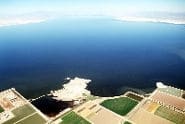
Though edged by farmland, the Salton Sea shows little of pesticide- and fertilizer-based pollution. Salt is the real enemy.|
The Salton Sea has long been a center of misunderstanding and controversy. From time to time, questions have arisen about the cleanliness of the water and the health of its fish. This bad reputation has been fueled by its odd-colored, nutrient-rich waters, occasional fish die-offs and well-publicized bird casualties from naturally occurring bacteria.
Although the Sea gets its water from the agricultural run-off of surrounding valleys, testing has shown the water to have low levels of pesticides and contaminants. “The Salton Sea is rated as a Class II waterway, suitable for swimming and full recreational body contact. I believe it’s cleaner than Mission Bay,” says local guide Jim Penn. For the record, the California Department of Fish & Game recommends limiting consumption of Salton fish to four ounces every two weeks. Penn says this safety advisory is due to elevated selenium levels in the Sea’s mud bottom.
The biggest threat to the health of the Sea comes from salt. Even at its current annual inflow rate of 1.3 million acre feet of new water, the salinity level keeps rising. With water evaporating at roughly the same rate as it enters – and no outflow to flush out the salt – eventually the salinity levels will climb until the resident fish can no longer reproduce. This demise may be hastened if Assembly Bill 1564 passes, a measure that would take 300,000 acre feet of water normally slated for the Salton Sea and divert it to San Diego for municipal use.
United Anglers of Southern California (UASC) is one of several organizations fighting to preserve the Sea. Naturalists, environmentalists, fishermen and waterfowl hunters have joined together to preserve this unique biological area and one-of-a-kind fishery. For more information, contact UASC at (714) 840-0227.
– Ron Ballanti