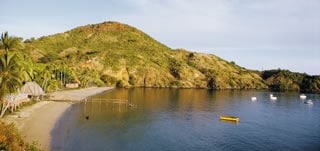
| Bob Griffin’s Club Pacifico as it appeared in 1974. It closed down 15 years later, and now serves as headquarters for a national park. |
There may well be other remote, tropical areas that provide a better blend of inshore and offshore fishing than Panama’s Isla Coiba region, but I’ve yet to find one in the 30 years since I first fished there. The range of species is truly remarkable, and you’d have to cast all day, every day, for at least a year if you wanted to cover all of the potential fish-holding spots.
Cubera and mullet snapper, roosterfish, jack crevalle, bluefin and bigeye trevally, rainbow runner, houndfish and more are often eager to hit cast and trolled lures, as well as live baits fished near island shorelines and under water rocks. Sailfish, wahoo, dolphin and even black marlin are often found very close to some of the nearby islands, although action with pelagic game fish is usually best at nearby Hannibal Bank or the offshore island of Montousa. To top it off, during the prime winter months it’s almost always sunny, warm and calm. If that doesn’t meet your criteria for a fishing dream spot, I don’t know what will!
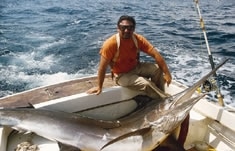
The author with a big black marlin taken on Hannibal Bank. Marlin were often landed and given to the prison camp on the opposite side of the island.|
Early Exploration
The incredible inshore fishery at the western end of Panama, near the Costa Rican border, was opened by legendary fishing pioneer Don McGuinness, who really explored the area and helped Bob Griffin establish the first camp on Coiba in 1974. Prior to that, the 100,000-acre island was mostly known for its Alcatraz-like prison. Griffin, an electrician from Florida, initially established a base camp on the mainland at Puerto Nuevo (also called Guabala), which had served as a supply site during construction of the Pan American Highway, in 1972. He even brought in some parties to fish the area, although the best waters, around Coiba, were still a couple of hours away.
From ’72 to ’74, Griffin built Club Pacifico de Panama on a protected cove at the northeast corner of Coiba, on land leased from the Panamanian government. Though the accommodations were rather basic, the camp was very comfortable and fit in well with the beautiful surroundings. A broad beach stretched in front of the complex, and anglers could enjoy the scenery while sipping cocktails at the end of the day under a thatched-roof patio.
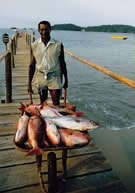
A day’s catch of once-abundant silk (colorado) snapper en route to Club Pacifico’s kitchen.|
The logistics involved in building and running a camp in such a remote area were daunting. Griffin quickly determined that outboard motors used too much hard-to-transport fuel, so he converted to diesel-powered center consoles. Most of his fleet ended up being 23-foot Makos, but he also had other models, such as a 23-foot Dusky that Griffin and I delivered to Coiba on my first trip to the island in April 1974.
It was an adventure that started when I met Griffin at the airport hotel in Panama City. After a few hours sleep, we drove to Panama City to eat a pre-dawn breakfast at McDonald’s before picking up the Dusky at Bobby Novey’s boat dealership. After hitching the boat to Griffin’s car, he, Novey and I embarked on an eight-hour drive along the Pan American Highway, a grandiose name for what was merely a twisting, two-lane road that limited our speed to an average of about 25 mph. After that ordeal was over, it was time to run the Dusky and another boat, both loaded with supplies, over to Coiba, where we arrived just before dinner.
Meet Mr. Cubera
My introduction to Coiba’s inshore fishing the next day was a memorable one. Novey and I joined Griffin’s top guide, Reto, and headed off to cast for snappers and jacks along the island’s coastline. The power of the fish we encountered was awesome, and every large cubera broke me off within seconds. There seemed to be no end of rocks and reefs to explore, and we just kept going until we wound up circumnavigating the island – an 80-mile trip. Being young and foolish, it was years before I realized the risk we had taken in a single-engine boat that had no electronics or radio, and probably no anchor!
It was a different story the next year, when large groups began arriving at the camp. Griffin had marked off six sectors on a chart. Anglers on at least two boats had to fish the same sector, and they couldn’t leave it during the day. Furthermore, the boats had to be back by 4:00 p.m. – no excuses accepted – so that Griffin would have time to look for any breakdowns while it was still light.
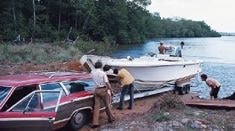
The new 23-foot Dusky is prepared for launch on the mainland for the run to Coiba in April of 1974. Note the Chevron gas pump in the stern, which would be installed at the Club for boat fueling.|
Griffin established his camp with small-game fishing in mind, and there was certainly plenty of that to go around. Not only were fish available around the innumerable nearshore rocks, the deep-water structure a bit farther offshore could produce incredible action at times. The “reef” off the neighboring island of Jicaron often produced an unforgettable sight: the water would literally turn red as dozens of mullet snapper, jacks and trevally, along with one or two big cuberas, fought for a popper, sometimes batting the lure high in the air. However, there was trouble in paradise, as sharks would inevitably arrive and begin grabbing every hooked fish from the “red horde,” forcing us to move on.
The sharks were so abundant that they’d even attack individual hooked fish along the shoreline, and occasionally hit a lure. During the 1980s, a commercial shark fishery was established in David, and after 1 1/2 years of huge catches it went belly-up due to a lack of sharks. Since then, I’ve never lost a hooked fish to a shark, and have seen only a few during the last two decades.
Exploring Hannibal
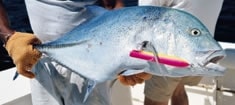
A variety of species including trevally can still be taken by plugging the shoreline. |
While inshore fishing was his focus at the time, Griffin was aware that nearby Hannibal Bank attracted lots of black marlin, and one day he had Reto take me and Novey out there. We headed offshore until Reto suddenly stopped the boat and began trolling. He had fished for snappers commercially at Hannibal, and knew the ranges for this giant underwater mountain, which rises out of thousands of feet of water to about 120 feet.
All we had for lures were six-inch Sevenstrand squids, which Griffin favored for sailfish, and I soon had a strike on Novey’s 25-pound Fin-Nor outfit. The fish turned out to be a 290-pound black marlin, which we boated after a lengthy fight. (Marlin and snappers were kept in those days, as Griffin had a good relationship with the commander of the prison on Coiba, and supplied him with all the fresh fish he needed.)
After that we used black skipjack for bait. Knowing very little about marlin fishing at the time, we trolled them dead on 15-foot cable leaders. But the method worked, and we hooked blacks regularly for the next two days. At one point we took a break from trolling and dropped some jigs to the bottom, where we hooked silk snapper (pargo colorado) on almost every drop. The black marlin were so thick that one even grabbed Novey’s jig on the way down, but threw the lure on its first jump!
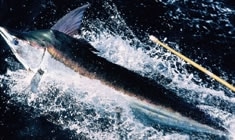
Today nearly all billfish – sailfish, black marlin, and the occasional blue marlin such as this one – are released.|
Surrounded by Fish
Ever since that first trip there has been a greater emphasis on big game at Coiba. In fact, some anglers fish for nothing else during their stay. That’s a shame, because casting plugs for cuberas and roosterfish has to be among the most exciting forms of fishing available anywhere, and the numerous jacks and trevally that attack the same lures will wear your arms out. Best of all, the inshore fish are always available, at least for those willing to work at it, while the offshore scene is less dependable. Some black marlin seasons are very good, but only a few fish may be caught the following year. Just as with any hot spot, the appearance of off-color water or water temperatures that are too high can kill the action.
Once Griffin was up and running, Club Pacifico would host up to 20 anglers a week during the dry season, which runs from January to April. After flying to Panama City, anglers would board a STOL (short take-off and landing) aircraft for a one-hour flight to Coiba. The plane would land on an uphill dirt strip at the prison camp, and inmates would carry baggage and supplies to the shallow shoreline. Guests were rowed out to the center consoles for the run to the club, where most of the work was done by “short-timers” from the prison, who were making some money prior to release.
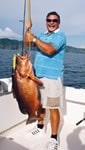
Cubera snapper, such as this brute displayed by the author, are still plentiful and can be taken on topwater plugs, but the largest specimens are normally caught on live bait.|
Inshore fishing is very good off Coiba year-round, and the best action tends to be near the island during the fall rainy season. When I returned that first year in December, we enjoyed good sailfishing between the prison and the mainland, plus a hot wahoo trolling bite at Wahoo Rock off Isla Afuera. My fishing partner, Harry Ross, even bagged a 290-pound black marlin while trolling for sails!
Unfortunately, Griffin was never able to attract many anglers during the rainy months, so the only real revenue came in from January to April. He not only invested blood, sweat and tears into the operation, he lost his son, Richard, during a freak storm in 1977, when the thatch roof of his building was blown down on him. The short season and reluctance of Americans to fly to Panama during periods of political instability finally resulted in the closure of the camp about 15 years after it opened.
Although the political situation straightened out after the American invasion, Griffin was never able to get his lease honored under the new administrations, and his buildings now serve as headquarters for a national park. The pier is gone, but otherwise the place looks much the same. At one point, the island’s prison was almost closed, but prison crowding on the mainland resulted in its resurrection. Now the prison is once again in the process of disappearing, and I wouldn’t be surprised to see tourist facilities developed there in the future.
New Players
The void left by Club Pacifico was eventually filled by several mothership operations. Paul Sanderson’s Coiba Explorer began as a no-frills barge and ended up as a near-perfect mothership, which was anchored off Isla Rancheria. However, revenue never matched expenses, and the vessel was brought back to New Orleans a few years ago.
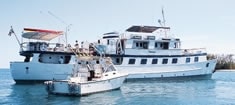
The Coral Star offers five-day trips to the grounds once accessible only from Coiba. Fishing is done from a fleet of Pursuit and Albemarle boats.|
Captain Jay Gustin, who has run a charter operation in Alaska for many years, started Pesca Panama with a 50-foot Hatteras, plus a 20-foot panga for casting, before buying and refurbishing the Explorer barge. The barge is now air-conditioned and remarkably comfortable. It can accommodate up to12 anglers, and fishing is done from 27-foot Ocean Masters. Pesca Panama normally remains anchored in one spot unless the weather changes, and is open year-round.Though the run from David takes about three hours, guests can start casting after an hour around Isla Parides and work their way over to the barge by dinnertime. Last March, I released a roosterfish in the 45-pound-class, along with trevally, houndfish and a 30-pound cubera, on the trip out to the barge.
The Coral Star was an early player in the Coiba mothership game. The 115-foot converted Danish hospital ship provides an alternative for those seeking a higher level of comfort. Fishing is done from the cuddy-cabin Pursuits and Albemarles formerly used by the Coiba Explorer. During the week, the Coral Star generally moves around the islands with its fleet of smaller fishing boats and ends up at Isla Parides. This makes for a short trip back to David after the last half day of fishing.
Coiba Today
So, how does the fishing stack up now, compared to the “good old days?” To be sure, there has been a big increase in commercial fishing, although it’s mostly directed at the deep-water colorado snapper and small grouper, or involves longlining for dolphin. There’s no longer a “red horde” that rises up to hit poppers, as the copper-colored mullet snapper that were formerly so abundant inshore are now rare, except in the smallest sizes. Yet three years ago I was amazed to run into acres of 15- to 25-pound snapper that turned the surface red almost all morning at Hannibal Bank – something I’d seen happen in the past only in small pods and for minutes at a time.
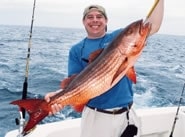
Due to commercial fishing pressure, large mullet snapper are now rarely caught inshore, but 15- to 25-pounders like this still school up over Hannibal Bank. |
Large rainbow runners have also become scarce. It was common to catch runners over 20 pounds on poppers and jigs in the ’70s, but the few fish encountered now are generally small. Dropping jigs to the bottom for silk snapper is also a thing of the past on Hannibal, although commercial fishermen still bait them at night. On the other hand, cubera snapper seem to be as abundant as ever. It’s not usually a problem to catch big cuberas by fishing live baits around deep bottom structure, but the real sport involves casting poppers for them. I caught several 40- to 50-pounders that way during the ’70s, but haven’t taken them quite so large in recent years.
Jacks and trevally also seem to be plentiful, and these days there are no sharks to eat them. Roosterfish, which were a rare catch on plugs in the old days, now appear to be more abundant than they used to be. Black marlin fishing is up and down, depending on water conditions, and sailfishing varies wildly from week to week. Trophy yellowfin tuna (many in the 200- to 300-pound class) are abundant at times, which is something I never remember seeing years ago. The same applies to blue marlin, which were very rare in the early days, but are being caught regularly now. Dolphin come and go, while wahoo are a rainy-season fish that can be trolled up in great numbers close to shore during the wet months.
The menu changes somewhat every trip, but whatever happens offshore, there’s always good plugging, trolling and bottom-fishing opportunities inshore – and you may not see another boat the entire day! If getting away from it all in an area that offers great weather and superb fishing appeals to you, Coiba is still the place to do it.
|||| |—|—|—| |### Planning a Coiba Fishing Adventure| Fishing the Coiba area isn’t cheap, but considering the problems involved in maintaining equipment out there, it’s a bargain. Better figure on about $5,000 to cover everything (including flights, fishing and tips) during your week. Direct flights to Panama City are readily available from many cities. After overnighting, anglers take an early one-hour flight the next morning to David, and are fishing on the way out to the mothership within a few hours. The captains speak English (some quite well) as well as Spanish, and most have been commercial fishing in the area since they were kids. A few (such as brothers Chi-Chi, Bartolo and Macho Gonzalez) got started at Club Pacifico during the 1970s and don’t need fishfinders, since they know the location of every underwater rock that might harbor a cubera.The Coral Star can be booked by calling (866) 924-2837. The operation has switched to five-day trips, and have replaced the engines on all seven of the Pursuits and Albemarles.Pesca Panama information can be obtained by calling (800) 946-3474. It has expanded to a six-day week for 2004 and offers slightly lower prices.The Panama Big Game Fishing Club, (866) 281-1225, is a new, land-based operation at Boca Brava, which is located on the way from David toward Isla Parides. It offers access to good inshore fishing and features Tropic Star-like facilities at comparable prices. It’s open year-round and has a fleet of larger boats for making longer trips, such as the 47-mile run to Hannibal Bank. Bookings can also be made through travel agencies specializing in fishing, such as South Fishing, (800) 882-4665. – Al Ristori