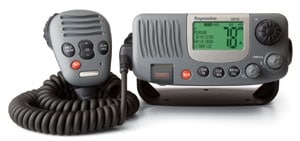
| Compact Communication The Ray49 DSC VHF radio, the newest and most compact VHF in the Raymarine line, packs big-time features and functionality into limited helm space.Linked via NMEA 0183 to a chart plotter for position polling, the integral Class-D Digital Select Calling and DSC Distress capabilities enable the transmission of boat identification, position and time of the call in the event of an emergency. Both handset and main rotary controls provide ease in frequency selection and adjustment. The radio also offers a quick-access channel 16/9 key built into the handset. The Ray49 is configured to receive minute-by-minute NOAA weather alerts as well. An optional kit allows for flush mounting on the dash. Available in gray or marine white. $209. Raymarine; 603.881.5200; raymarine.com. |
| Double Down |
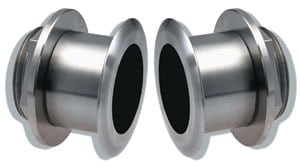
Airmar’s new paired configurations of transducers answer the demands of two schools of offshore angling: A wide-beam pair targets the serious marlin and tuna fisherman who needs to monitor a wide perimeter, and a narrow-beam pair offers more precise bottom differentiation.The SS264W Tilted-Element Wide-Beam Pair provides identical beam widths of 25 degrees at both 50 and 200 kHz for optimum fish detection in shallow to mid-water depths.For precise bottom definition, the Narrow-Beam Pair provides a 25-degree beam at 50 kHz and a 6-degree beam at 200 kHz.Both models interface with any 600- or 1,000-kW sounder and incorporate tilted ceramic elements to compensate for deadrise, providing protrusion-free mounting with built-in temperature sensors. $1,895. Airmar Technology Corp.; 603.673.9570; airmar.com.| | New Views
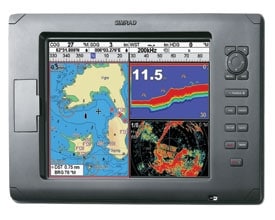
The new NX40 and NX45 NavStations from Simrad replace the popular C-series line of multifunction information systems. The NX40 features an 8.4-inch, sunlight-viewable high-resolution TFT color display; the NX45 sports a 12.1-inch screen. Both include a high-performance echo sounder. The NavStation adjusts to 600 or 1 kW output, depending on transducer selection.Both NavStations accept radar, either a 2- or 4-kW radome or 6-kW open array. Via the NMEA 2000-based SimNet data-sharing network, the NXs link peripheral Simrad instruments, autopilots, AIS and VHF radios. Non-SimNet equipment, such as fuel and engine monitoring and infrared camera images, can be incorporated in the system via NMEA 2000 or 0183 connectivity. Starts at $2,450. Navico Inc.; 425.778.8821; simrad-yachting.com.|